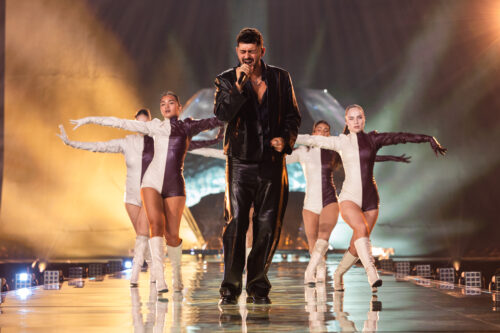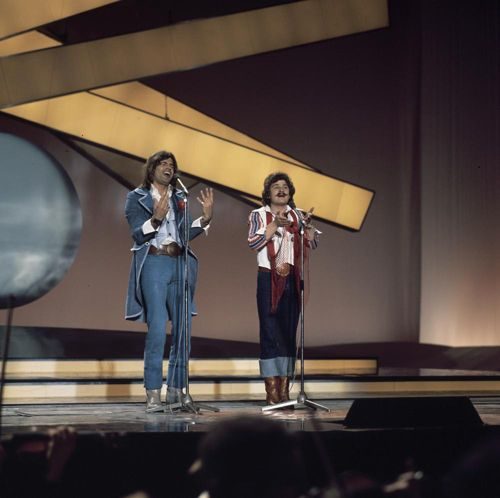
We know a lot about Eurovision and we want to share this knowledge with you! Therefore we’d like to bring you a blast from the past. Today, we go back to 1976, when Waterloo and Robinson represented Austria with the song My Little World.
Austria in the Eurovision Song Contest
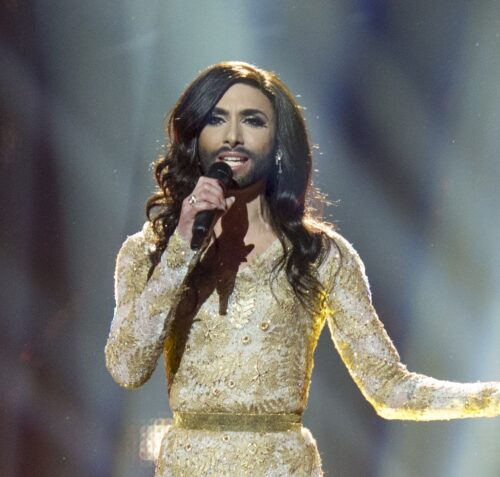
Austria started participating in 1957. Their first victory came in 1966, when Udo Jürgens won with Merci Cherie. It was his third consecutive participation. After that, Austria did not make it to the top-3 again for decades. In 2014 this changed, when Conchita Wurst gained the trophy with her Rise Like a Phoenix. In 2018 there was another top-3 place for Austria: Cesár Sampson even won the jury voting with Nobody But You. With Teya and Salena (Who The Hell Is Edgar?) last year and Kaleen (We Will Rave) this year, Austria reached the final.
Almost returning
My Little World was, as far as we know, selected internally. But in 2004, Waterloo and Robinson took part in the national selection again. Their song You Can Change the World was 2nd. After the national competition, Waterloo and Robinson, sued the winning group Tie Break. They said that the song Du Bist was too long (over three minutes) and copied the song Für Dich by German singer Yvonne Catterfield. However, the lawsuit was rejected for legal reasons. ORF, the TV broadcaster, said that the small time over the limit wasn’t enough to disqualify the song and promised to shorten it to three minutes for the Eurovision Song Contest. So no return at Eurovision for Waterloo and Robinson.
Waterloo and Robinson
Waterloo & Robinson is a pop music duo from Austria. The group consists of Hans Kreuzmayr (Waterloo) and Josef Krassnitzer (Robinson).
Beginning
Hans and Josef met in 1969 when Hans was looking for someone to help design displays for his boutique. Both were already playing in local bands. They decided to make music together. At their early shows, they were called The Edward Brothers.
In 1971, they entered a music competition and came in third place with their song Du Kannst Sehen (a song about a blind girl). After that, they had hits with songs like Lili’s Haus, Baby Blue (their first big hit in Europe), and Hollywood, a worldwide hit. In 1974, Baby Blue and Hollywood took turns being number 1 and 2 on the Ö3 chart.
Eurovision and Wild Land
The duo represented Austria in the Eurovision Song Contest in 1976. They finished in 5th place with their song My Little World. In 1978, they filmed a movie called Wild Land in Kenya, and they also released an album with the same name.
Germany
Their popularity grew in Germany, but in Austria, their songs didn’t get as much attention. In 1979, they released Do You Remember Marianne, which became a hit in Germany but not in Austria. They appeared on many popular TV shows in Germany but started having disagreements due to their declining success in Austria. This led to their split in 1981.
After the split
After the split, Waterloo continued his solo career with songs like Im Land das Ewigkeit Heißt and other hits. Robinson also released some solo music and helped produce music for young artists, but he stayed out of the spotlight. Waterloo took part in the Austrian national selections for Eurovision twice as a soloist: in 1983 and in 1990.
After about ten years, they tried working together again and performed concerts in 1989 and 1990. They both kept doing solo projects as well. Robinson went on an “Unplugged Tour,” and Waterloo spent time on a Native American reservation in North America. This experience influenced his later music, and he released albums with Native American themes like Tales of the Sun, Moon and Stars, Apaches’ Land, and Indio. While promoting Indio, Waterloo was playing Winnetou at a festival, where he met his current wife, Andrea.
Nowadays
Their concerts now include both their old hits from the 1970s and newer songs with Native American influences. In 2002, they released a new version of the Opus hit Live Is Life, which became a hit in Austria. In 2004, they placed second in the Austrian selection for the Eurovision Song Contest with their song You Can Change the World.
Waterloo released a solo CD in 2005 for his 60th birthday, and a Christmas CD in 2006. Robinson also worked on solo projects during this time. They were still touring together at that point.
In 2007, they decided to focus only on their solo work for live shows.
In 2015, they reunited for a short time to perform at special events and on TV for the Eurovision Song Contest, which took place in Vienna.
My Little World
My Little World is a song performed by the Austrian pop duo Waterloo & Robinson. The song was composed by Gerhard Heinz, who is known for his work in film scores and pop music, while the lyrics were written by Peter Orthofer. The track was selected to represent Austria in the Eurovision Song Contest in 1976.
At Eurovision, which was held in The Hague, The Netherlands, My Little World was performed as Austria’s entry. The duo delivered a heartfelt and melodic performance that resonated with both the jury and the audience. The song, with its catchy tune and reflective lyrics, stood out during the competition.
Ultimately, My Little World scored 80 points in the contest and finished in 5th place, a strong result for Austria. The song was well-received and helped further establish Waterloo & Robinson’s career both in Austria and internationally. Their Eurovision appearance cemented their reputation as one of the country’s leading pop acts during the 1970s.