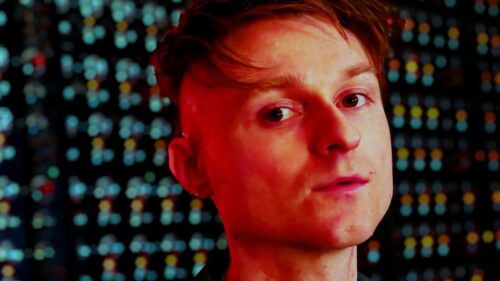
Road to Vienna: United Kingdom

Road to Vienna: United Kingdom

As the Eurovision Song Contest 2026 in Vienna approaches, we continue our daily spotlight on this year’s contestants. Road to Vienna: United Kingdom

Look Mum No Computer: Musician, inventor, and YouTuber

Sam Battle, known as Look Mum No Computer, is a British musician, inventor, and YouTuber, known for blending electronic music with DIY ( Do it yourself)  technology.                                                                                          Born in 1989 in England, Battle showed early interest in music and electronics, building his first guitar pedal at just 14. He gained initial recognition as frontman of indie band ZIBRA, performing at Glastonbury 2015 before the group split in 2016.

YouTube Breakthrough and Solo Career

After ZIBRA, Battle launched his solo project Look Mum No Computer. His YouTube channel, started in 2016, went viral with creative inventions like the “Synth Bike.” By 2026, he amassed over 85 million views and a strong global fanbase, supported through platforms like Patreon.

Unique Instruments and Creative Projects

Battle is known for building unusual instruments, including a Furby pipe organ and robotic orchestras. He also founded This Museum Is (Not) Obsolete in Kent, showcasing experimental music tech. His innovations earned him a Guinness World Record and a TEDx talk.                                                                                                        His music blends electronic, pop, and rock with analog synth sounds. Notable releases include “Groundhog Day,” alongside collaborations with artists like Barns Courtney. He has also toured across Europe and formed the synth group Uncompressed.


Eins, Zwei, Drei:

A Playful Take on Everyday Routine

A Playful Take on Everyday Routine

Eins, Zwei, Drei is an energetic electronic track that transforms the boredom of daily routines into something fun and engaging. With quirky sounds and catchy beats, the song captures a relatable sense of frustration while keeping a light, playful tone.

Breaking Free from Monotony

The track explores the struggle of feeling stuck in repetitive schedules and constant responsibilities. It reflects the desire to escape the daily grind and rediscover excitement beyond ordinary life.

Small Joys, Big Impact

Instead of focusing on negativity, the song highlights how simple pleasures—like small adventures or lighthearted distractions—can help restore energy and motivation. It’s about reclaiming control through everyday moments.

“Eins, Zwei, Drei” as a Reset

The repeated counting acts as a symbolic reset button, marking a shift from boredom to freedom. It represents starting fresh and embracing a more vibrant mindset.

United Kingdom in the Eurovision Song Contest

The United Kingdom has a storied history in the Eurovision Song Contest, having participated since 1957 and securing five victories: in 1967 with Sandie Shaw‘s “Puppet on a String,” in 1969 with Lulu‘s “Boom Bang-a-Bang,” in 1976 with Brotherhood of Man‘s “Save Your Kisses for Me,” in 1981 with Bucks Fizz‘s “Making Your Mind Up,” and in 1997 with Katrina and the Waves‘ “Love Shine a Light.” In recent years (2022), Sam Ryder was the festival runner up with “Spaceman”. As a member of the “Big Five,” the UK automatically qualifies for the Grand Final. 

The Bookmakers

The United Kingdom hasn’t performed well for years—aside from a standout result in 2022. And with bookmakers currently placing them around 18th, a top finish once again seems unlikely



Related news

History

70 years of Eurovision: from squeezed legs to politics

The Eurovision Song Contest is celebrating its 70th anniversary. That is a wonderful milestone. We at Eurovision Universe love diving into the history of the contest. That is why we are taking a closer look at the contests of the past 70 years. 2021 After the cancellation of Eurovision 2020 due to the COVID-19 pandemic, the Song Contest finally returned in 2021. The host city was Rotterdam, the Netherlands. The city that had been ready to welcome Europe a year earlier. Edselia Rombley, Chantal Janzen, Jan Smit, and Nikkie de Jager presented the event. Strict COVID measures were in place, but the organisation managed to fill the Rotterdam Ahoy arena with a live audience during all three shows. A true feat. Belarus was excluded by the EBU due to political circumstances following the disputed presidential election and the violent crackdown on protesters. Armenia withdrew because of its involvement in the Nagorno-Karabakh war.  The songs Many of the artists who were supposed to participate in 2020 were given the chance to try their luck in 2021 after all. It would be too much to name them all. However, the Estonian Uku Suviste is worth mentioning. He had not been given carte blanche, but managed to win the national final. Natalia Gordienko had already competed for Moldova in 2006. Composer Philipp Kirkorov incurred the wrath of the entire fan community during the presentation of Natalia’s song “Sugar” by saying about Conchita Wurst: “IT can sing”. And then there was Senhit: unsuccessful for San Marino in 2011, she did reach the final this time, but not alone. Rapper Flo Rida accompanied her on stage. We will see Senhit again this year, now with another global star: Boy George. Due to the strict COVID-19 rules, Australian singer Montaigne was not allowed to travel to Rotterdam. During one of the press conferences, this became too much for her and she burst into tears. The final A big name represented Belgium: Hooverphonic. Unfortunately, their song “The Wrong Place” did not finish very high. Maltese singer Destiny, a former winner of the Junior Eurovision Song Contest, was considered one of the favorites. She won the semi-final, but finished seventh in the final. Not bad, but a disappointment given the expectations. Daði & Gagnamagnið performed for Iceland, or rather, they didn’t. The year before, they were the top favorites; their “10 Years” was well-received, but not as the expected winner. One of the group members tested positive for Corona, meaning the group was not allowed to perform and a video of one of the rehearsals was shown instead. Then there was Jendrik from Germany. His entry was seen as having no chance. But the act did stand out, with a large walking middle finger on stage. The Roop for Lithuania did well. But it was the Ukrainian group Go-A that made the biggest impression. Both the music, which was very modern, and the act featuring an entire cardboard forest on stage ensured the group finished fifth. The Norwegian Tix also stood out. Not so much because of his enormous fur coat and his angel wings, but rather because of his story: Tix suffered from Gilles de la Tourette syndrome and had tics (Tix, that is). At the end of the performance, he took off his sunglasses, revealing his tics. Final Showdown It was the Swiss Gjon’s Tears who won the jury vote. With the high-pitched vocals in his “Tout l’univers,” he effortlessly received the highest number of points. Ultimately, he finished third. Because he mattered so much in the final showdown, poor Gjon couldn’t go to the toilet. With his legs squeezed together, he followed the scoring, pretending to relax every time the camera was focused on him. Barbara Pravi from France was also a favorite for the final victory. Although her “Voila”, more French than French, narrowly missed winning the Eurovision Song Contest, Pravi managed to turn her song into a true Eurovision classic in a short time. It is one of the most covered Eurovision songs of recent years. Måneskin The Roman rock band Måneskin had won Sanremo. When the results at Eurovision came in, it quickly became clear that the televoters were wild about them. Frontman Damiano David was accused of drug use after the final. Cameras had caught a suspicious movement near the table in the green room. He denied everything, offered to take a drug test, and was cleared. The controversy only seemed to boost the band’s profile. For Måneskin, it was just the beginning. Within months, they were performing sold-out shows across the United States. “Zitti e buoni” and especially “Beggin’”, an older track, became global streaming hits. Eurovision had rarely produced a winner with this kind of international commercial trajectory. 2022 For the first time since 1991, Italy hosted the Eurovision Song Contest. The Pala Olimpico arena in Turin was the venue. Laura Pausini, Alessandro Cattelan, and Mika hosted the event. Laura Pausini caught attention by suddenly disappearing during the final. Just as suddenly, she came back. Pausini didn’t feel well. To be honest, the organization was a mess. The large sun in the middle of the stage, in particular, drew attention. Not because it was so beautiful, but because it didn’t work. The context of the 2022 contest was dominated by one event: Russia’s invasion of Ukraine. The EBU expelled Russia from the contest shortly after the invasion began. There was also a debate about whether Belarus should be expelled as well, given its role in the conflict. It had already been excluded in 2021. Ukraine participated, and the contest quickly took on an emotional and political dimension that was impossible to ignore. The songs Mahmood, who had previously finished second, performed as half of a duo for host country Italy. Together with Blanco, he sang “Brividi”. It sounded good on the record, but live it didn’t. For the third time, the group Zdob și Zdub represented Moldova. The band finished seventh with a song about a train journey

Read More »
Eurovision 2026
Anja Kroeze

Road to Vienna: United Kingdom

Road to Vienna: United Kingdom As the Eurovision Song Contest 2026 in Vienna approaches, we continue our daily spotlight on this year’s contestants. Road to Vienna: United Kingdom Look Mum No Computer: Musician, inventor, and YouTuber Sam Battle, known as Look Mum No Computer, is a British musician, inventor, and YouTuber, known for blending electronic music with DIY ( Do it yourself)  technology.                                                                                          Born in 1989 in England, Battle showed early interest in music and electronics, building his first guitar pedal at just 14. He gained initial recognition as frontman of indie band ZIBRA, performing at Glastonbury 2015 before the group split in 2016. YouTube Breakthrough and Solo Career After ZIBRA, Battle launched his solo project Look Mum No Computer. His YouTube channel, started in 2016, went viral with creative inventions like the “Synth Bike.” By 2026, he amassed over 85 million views and a strong global fanbase, supported through platforms like Patreon. Unique Instruments and Creative Projects Battle is known for building unusual instruments, including a Furby pipe organ and robotic orchestras. He also founded This Museum Is (Not) Obsolete in Kent, showcasing experimental music tech. His innovations earned him a Guinness World Record and a TEDx talk.                                                                                                        His music blends electronic, pop, and rock with analog synth sounds. Notable releases include “Groundhog Day,” alongside collaborations with artists like Barns Courtney. He has also toured across Europe and formed the synth group Uncompressed.   Eins, Zwei, Drei: A Playful Take on Everyday Routine A Playful Take on Everyday Routine Eins, Zwei, Drei is an energetic electronic track that transforms the boredom of daily routines into something fun and engaging. With quirky sounds and catchy beats, the song captures a relatable sense of frustration while keeping a light, playful tone. Breaking Free from Monotony The track explores the struggle of feeling stuck in repetitive schedules and constant responsibilities. It reflects the desire to escape the daily grind and rediscover excitement beyond ordinary life. Small Joys, Big Impact Instead of focusing on negativity, the song highlights how simple pleasures—like small adventures or lighthearted distractions—can help restore energy and motivation. It’s about reclaiming control through everyday moments. “Eins, Zwei, Drei” as a Reset The repeated counting acts as a symbolic reset button, marking a shift from boredom to freedom. It represents starting fresh and embracing a more vibrant mindset. United Kingdom in the Eurovision Song Contest The United Kingdom has a storied history in the Eurovision Song Contest, having participated since 1957 and securing five victories: in 1967 with Sandie Shaw‘s “Puppet on a String,” in 1969 with Lulu‘s “Boom Bang-a-Bang,” in 1976 with Brotherhood of Man‘s “Save Your Kisses for Me,” in 1981 with Bucks Fizz‘s “Making Your Mind Up,” and in 1997 with Katrina and the Waves‘ “Love Shine a Light.” In recent years (2022), Sam Ryder was the festival runner up with “Spaceman”. As a member of the “Big Five,” the UK automatically qualifies for the Grand Final.  The Bookmakers The United Kingdom hasn’t performed well for years—aside from a standout result in 2022. And with bookmakers currently placing them around 18th, a top finish once again seems unlikely      

Read More »
Follow Us: