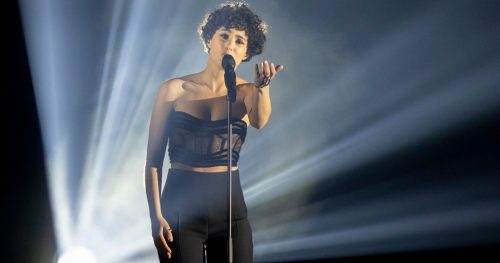

In the spotlight: France – Barbara Pravi

One of the favorites for the win is France, represented by Barbara Pravi. As one of the already placed finalists, she will perform live for the first time tomorrow. But who is she?

Barbara Pravi (birth name Barbara Piévic) was born on April 10, 1993 in Paris, France. Her family consists mainly of artists and musicians. Paternal grandfather is Serbian. She has adopted the Serbian stage name Pravi (meaning: Real) as a tribute to her grandfather.

She started her music career in 2014, after meeting French musician Jules Jaconelli. She started composing songs with Jaconelli. The following year, Barbara signed a contract with Capitol Music France. At the start of her professional recording career, she performed on the soundtrack of the French version of the Swiss film Heidi, then she was cast as Solange Duhamel in the musical show Un été 44 in November 2016, with songs written by Jean-Jacques Goldman , Charles Aznavour and Maxime Le Forestier.

In 2017 Barbara released her first official single “Pas grandir”. The single was later included to her debut EP, which was released the following year. From 2017 to 2018, she performed in the 55 Tour, in support of French singer Florent Pagny. At the end of 2018, Barbara decided to change her music style by adopting a more traditional French chanson style. In addition to writing and composing her own songs, she has written for several other artists, including Yannick Noah, Julie Zenatti, Chimène Badi, Jaden Smith, Louane and Florent Pagny.

Barbara in 2017 Barbara in 2017

In 2019 and 2020 she composed the French entries for the Junior Eurovision Song Contest; “Bim bam toi” for French teenage singer Carla in 2019 (5th place). “J’imagine”, performed by France’s Valentina, in 2020, became the first French entry to win Junior Eurovision.

Barbara is very active in the fight against violence against women, as she herself has survived domestic violence. She has often contributed to music initiatives aimed at promoting charities related to women’s rights. She also participated in the recording of “Debout les femmes”, the official song for the French women’s liberation movement (Mouvement de Libération des Femmes).

In previous years Barbara has been regularly asked by “France Télévisions” to be a candidate for the Eurovision Song Contest, but has always rejected it because she felt that she was not ready for it. Until 2020; She took part in the final on January 30, 2021 with the song “Voilà”, composed by herself together with Igit. She won the competition, and now represents France in the Eurovision Song Contest 2021 in Rotterdam.

Barbara is in the top 3 in the polls. Tomorrow we will know if she manages to bring the profit to France.

Good luck Barbara!

In cooperation with: Eurovision Artists

Photo-Videocredits: EBU


Related news

Eurovision 2026

Road to Vienna: Estonia

Road to Vienna: Estonia As we eagerly anticipate the Eurovision Song Contest in Basel, we continue our daily spotlight on this year’s contestants. Today, we focus on Estonia Vanilla Ninja: A Pop-Rock Comeback Story Vanilla Ninja is an Estonian girl band formed in 2002 in Tallinn. The original lineup—Maarja Kivi, Lenna Kuurmaa, Katrin Siska, and Piret Järvis—quickly gained attention with their energetic pop-rock sound. Their 2003 debut album introduced hits like “Club Kung Fu,” which became a fan favorite and boosted their popularity across Estonia and Central Europe. Eurovision Breakthrough and International Fame With the release of “Traces of Sadness” in 2004, the band expanded its reach. After a lineup change, they represented Switzerland at the Eurovision Song Contest 2005 with “Cool Vibes,” finishing 8th. Their third album, “Blue Tattoo,” and singles like “Tough Enough” helped establish them as one of Estonia’s biggest music exports. Lineup Changes and Musical Evolution Following more lineup changes, Vanilla Ninja continued as a trio and released “Love Is War” (2006), showcasing a more mature rock sound. Despite continued releases and performances, including the single “Crashing Through the Doors,” the band slowed down and went on hiatus by 2008. Hiatus and Solo Careers (2009–2019) During their long break from 2009 ’till 2019, members pursued individual careers. Lenna Kuurmaa found success as a solo artist and actress, while Maarja Kivi reinvented herself as rock singer Marya Roxx. Fans remained loyal, keeping hopes for a reunion alive. Reunion and New Music  Vanilla Ninja reunited in 2020, releasing their comeback album “Encore” in 2021. After further lineup changes, the band continued as a trio and remained active, releasing new music like. Eurovision Return (2026) In 2026, Vanilla Ninja made a major comeback by winning Eesti Laul with “Too Epic To Be True,” earning them a spot at the Eurovision Song Contest once again. To Epic to be true: A Love That Feels Larger Than Life To Epic to be true  tells the story of a romance that feels almost unreal. The narrator experiences a deep emotional connection that seems guided by fate. Love, destiny, and intensity are at the heart of the track, creating a cinematic and powerful atmosphere. Vulnerability and Self-Doubt Alongside passion, the song explores uncertainty. The narrator questions whether their feelings are too impulsive or naïve. Despite these doubts, they choose to trust their emotions, highlighting themes of honesty, risk, and emotional courage. From Chaos to Clarity A key element of the song is personal growth. The narrator reflects on a previously chaotic life, now transformed by love and stability. This contrast adds depth and shows how meaningful relationships can bring clarity and direction. A Story of Transformation By blending romance with self-discovery, the track delivers a relatable message. It shows how intense love can reshape identity and turn uncertainty into belief, making it both emotional and inspiring for listeners.   Estonia in the Eurovision Song Contest Estonia has participated in the Eurovision Song Contest since 1994 and secured its only victory in 2001 with “Everybody” performed by Tanel Padar, Dave Benton, and 2XL. Another top-3 songs was “Runaway” by Sahlene. She became 3rd. Over the years, Estonia has showcased a diverse range of musical styles, often earning praise for its innovative and bold entries. The country’s commitment to promoting its artists on the international stage remains steadfast, with Eesti Laul serving as a platform for both established and emerging talents. Last years entry, “Espresso Machiato” ended on place 3, in the grand final in Basel.  The Bookmakers Bookmakers are showing little confidence this year, with Estonia currently sitting at the bottom of the rankings. Their chances of reaching the final look quite slim.

Read More »
Eurovision 2026
Anja Kroeze

Road to Vienna: Estonia

Road to Vienna: Estonia As we eagerly anticipate the Eurovision Song Contest in Basel, we continue our daily spotlight on this year’s contestants. Today, we focus on Estonia Vanilla Ninja: A Pop-Rock Comeback Story Vanilla Ninja is an Estonian girl band formed in 2002 in Tallinn. The original lineup—Maarja Kivi, Lenna Kuurmaa, Katrin Siska, and Piret Järvis—quickly gained attention with their energetic pop-rock sound. Their 2003 debut album introduced hits like “Club Kung Fu,” which became a fan favorite and boosted their popularity across Estonia and Central Europe. Eurovision Breakthrough and International Fame With the release of “Traces of Sadness” in 2004, the band expanded its reach. After a lineup change, they represented Switzerland at the Eurovision Song Contest 2005 with “Cool Vibes,” finishing 8th. Their third album, “Blue Tattoo,” and singles like “Tough Enough” helped establish them as one of Estonia’s biggest music exports. Lineup Changes and Musical Evolution Following more lineup changes, Vanilla Ninja continued as a trio and released “Love Is War” (2006), showcasing a more mature rock sound. Despite continued releases and performances, including the single “Crashing Through the Doors,” the band slowed down and went on hiatus by 2008. Hiatus and Solo Careers (2009–2019) During their long break from 2009 ’till 2019, members pursued individual careers. Lenna Kuurmaa found success as a solo artist and actress, while Maarja Kivi reinvented herself as rock singer Marya Roxx. Fans remained loyal, keeping hopes for a reunion alive. Reunion and New Music  Vanilla Ninja reunited in 2020, releasing their comeback album “Encore” in 2021. After further lineup changes, the band continued as a trio and remained active, releasing new music like. Eurovision Return (2026) In 2026, Vanilla Ninja made a major comeback by winning Eesti Laul with “Too Epic To Be True,” earning them a spot at the Eurovision Song Contest once again. To Epic to be true: A Love That Feels Larger Than Life To Epic to be true  tells the story of a romance that feels almost unreal. The narrator experiences a deep emotional connection that seems guided by fate. Love, destiny, and intensity are at the heart of the track, creating a cinematic and powerful atmosphere. Vulnerability and Self-Doubt Alongside passion, the song explores uncertainty. The narrator questions whether their feelings are too impulsive or naïve. Despite these doubts, they choose to trust their emotions, highlighting themes of honesty, risk, and emotional courage. From Chaos to Clarity A key element of the song is personal growth. The narrator reflects on a previously chaotic life, now transformed by love and stability. This contrast adds depth and shows how meaningful relationships can bring clarity and direction. A Story of Transformation By blending romance with self-discovery, the track delivers a relatable message. It shows how intense love can reshape identity and turn uncertainty into belief, making it both emotional and inspiring for listeners.   Estonia in the Eurovision Song Contest Estonia has participated in the Eurovision Song Contest since 1994 and secured its only victory in 2001 with “Everybody” performed by Tanel Padar, Dave Benton, and 2XL. Another top-3 songs was “Runaway” by Sahlene. She became 3rd. Over the years, Estonia has showcased a diverse range of musical styles, often earning praise for its innovative and bold entries. The country’s commitment to promoting its artists on the international stage remains steadfast, with Eesti Laul serving as a platform for both established and emerging talents. Last years entry, “Espresso Machiato” ended on place 3, in the grand final in Basel.  The Bookmakers Bookmakers are showing little confidence this year, with Estonia currently sitting at the bottom of the rankings. Their chances of reaching the final look quite slim.

Read More »
Follow Us: