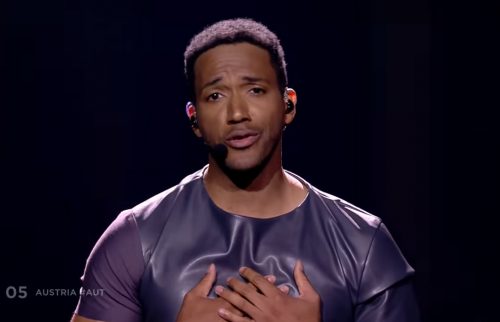
Blast from the past: Austria 2018

We know a lot about Eurovision; this is knowledge we want to share with you. Therefore we’d like to bring you a blast from the past. Back to 2018, the Austrian entry, Cesár Sampson with “Nobody but you”.

Austria in the Eurovision Song Contest

Austria is a country with a long history of bad placings in the contest. After the victory in 1966 with Udo Jürgens, it took ages before Conchita Wurst took the prize back home in 2014. However, since then Austria reached the final every time. Austria was back in the picture as a successfull country. Reason enough for the Austrians to look for another entry that would do it.

National selection

Conchita Wurst was chosen by ORF (Österreichischer RundFunk) internally to represent the country. After two national finals, Nathan Trent (the 2017 contestant) was selected internally again. ORF decided to do it this way again. Anyone could submit songs, but ORF also invited artists to submit songs themselves. On december 5th, 2017, there was news: it was Cesár Sampson who got the ticket to the contest in Lisbon. Songwriting team Symphonix International (Borislav Milanov, Sebastian Arman, Joacim Persson and Johan Alkenäs) wrote a song for him. “Nobody but you” was presented on March 9th.

Cesár Sampson

Cesár Sampson is an Austrian singer, songwriter, producer, dancer and model. He was born in Linz. His mother Kathy Sampson sang “A Good Friend” in the 1990s, the theme song of the well-known crime series Kommissar Rex. He is the nephew of the singer Helen “Pepsi” DeMacque-Crockett of the duo Pepsi & Shirlie. As a child, he was in front of the camera in a music video by La Toya Jackson.
Sampson worked as a social worker for years. He has also worked in the music business as a producer for many years, including with the Symphonix International producer collective. As a backing vocal, Sampson was on stage at the Eurovision Song Contest twice in a row, in 2016 and 2017, representing Bulgaria.

“Nobody but you”

As mentioned, the Austrian entry was written and composed by the Symphonix International songwriters team ánd by Cesár Sampson himself. It was a song with a gospel sound. The full lyrics of the song “Nobody but you” can be found here. Although the song was not the favorite to win the contest, Austria seemed to have a sure qualifier and probably even a high scoring entry.

Results

Although the expectations were high, the jury vote brought a complete surprise: the expert jury chose Cesár Sampson and Austria as there winner, with no less than 9 countries awarding the song with ‘douze points’. But with the televoters only awarding it 71 points and a 13th place, the chances to win disappeared quite quickly for Austria. In the end, Sampson reached a 3rd place.


Related news

Eurovision 2026

EBU warning Israel after voting campaign

📷EBU/Corinne Cumming The EBU warning to Israel concerns broadcaster KAN and its promotion of “Michelle” by Noam Bettan. The song is Israel’s Eurovision 2026 entry. The warning followed promotional videos in which viewers were urged to use all ten votes for Israel. Eurovision director Martin Green said the EBU contacted the delegation soon after the videos appeared. The campaign was then removed from the relevant platforms. According to the EBU, such a direct voting appeal does not fit the contest rules. It also goes against the spirit of fair competition. KAN said the campaign was the artist’s own initiative. The broadcaster also denied that illegal funding was involved. Rule changes after Israel debate The EBU warning to Israel is notable because it comes in the first year under stricter Eurovision rules. These changes followed the debate after Eurovision 2025. That year, Israel’s Yuval Raphael finished second overall and won the public vote. Several broadcasters and commentators then raised questions about promotion, voting transparency and organised support. As a result, the EBU changed parts of the voting system. The maximum number of votes per payment method was reduced from 20 to 10. Professional juries also returned to the semi-finals. In addition, the EBU tightened its rules on disproportionate promotion. This is especially relevant when governments or third parties are involved. Israel’s Eurovision entries have also faced repeated scrutiny over lyrics. In 2024, Eden Golan’s original song “October Rain” was rejected by the EBU. The lyrics were seen as too political for the contest. A second version, “Dance Forever”, was also not accepted in its first form. Israel eventually competed with the revised song “Hurricane”. This year, Israel’s 2026 entry was approved only after extra checks and reported minor changes. Taken together, the warning, the rule changes and the lyric interventions show a clear pattern. Israel remains part of Eurovision, and KAN denies deliberate rule-breaking. Still, Israel again seems to test how far the rules go. Time after time, the country appears to search for the edges of what is allowed.           

Read More »
Eurovision 2026
Martijn

EBU warning Israel after voting campaign

📷EBU/Corinne Cumming The EBU warning to Israel concerns broadcaster KAN and its promotion of “Michelle” by Noam Bettan. The song is Israel’s Eurovision 2026 entry. The warning followed promotional videos in which viewers were urged to use all ten votes for Israel. Eurovision director Martin Green said the EBU contacted the delegation soon after the videos appeared. The campaign was then removed from the relevant platforms. According to the EBU, such a direct voting appeal does not fit the contest rules. It also goes against the spirit of fair competition. KAN said the campaign was the artist’s own initiative. The broadcaster also denied that illegal funding was involved. Rule changes after Israel debate The EBU warning to Israel is notable because it comes in the first year under stricter Eurovision rules. These changes followed the debate after Eurovision 2025. That year, Israel’s Yuval Raphael finished second overall and won the public vote. Several broadcasters and commentators then raised questions about promotion, voting transparency and organised support. As a result, the EBU changed parts of the voting system. The maximum number of votes per payment method was reduced from 20 to 10. Professional juries also returned to the semi-finals. In addition, the EBU tightened its rules on disproportionate promotion. This is especially relevant when governments or third parties are involved. Israel’s Eurovision entries have also faced repeated scrutiny over lyrics. In 2024, Eden Golan’s original song “October Rain” was rejected by the EBU. The lyrics were seen as too political for the contest. A second version, “Dance Forever”, was also not accepted in its first form. Israel eventually competed with the revised song “Hurricane”. This year, Israel’s 2026 entry was approved only after extra checks and reported minor changes. Taken together, the warning, the rule changes and the lyric interventions show a clear pattern. Israel remains part of Eurovision, and KAN denies deliberate rule-breaking. Still, Israel again seems to test how far the rules go. Time after time, the country appears to search for the edges of what is allowed.           

Read More »
Follow Us: