🇺🇦 Blast from the past: Ukraine 2020

We know a lot about Eurovision and we want to share this knowledge with you! Therefore we’d like to bring you a blast from the past. Today: Go_A, who were supposed to represent Ukraine in the 2020 contest but did so a year later. We keep an eye on the, lesser known, 2020 entry.


Ukraine in the Eurovision Song Contest

Ukraine is one of the most succesful countries in the Eurovision Song Contest so far. With three victories since it’s debut in 2003, three more top-3 positions and not a single failure to qualify, this country holds a special record. Already in 2004, it was Ruslana who managed to get the first place in the contest. In 2016, Jamala brought the victory home again. It was in 2022 when Kalush Orchestra broke all the Eurovision records existing. And who does not remember Verka Serduchka, Ani Lorak, Svetlana Loboda and the group we are talking about today, Go_A?

photo: UA:PBS

Vidbir

The Ukrainian national final is called Vidbir. There had been a lot of controversy about Vidbir in 2019: the winner, Maruv, had performed on Crimea after it had been occupied by Russia in 2014. Also, Maruv had planned several performances in Russia. In the end, for this reason Ukraine withdrew. A new rule in the 2020 is that only artists who had not performed in Russia after 2014 were allowed. Also, artists who had traveled to Crimea after that year without permission from the Ukrainian authorities, were not accepted.

16 songs entered two semifinals. Six songs were allowed to the final, where televoters and a jury chose the winner. The jury members were Andriy Danilko (Verka Serduchka!), Tina Karol and producer Vitaliy Drozdov. These were the songs, entering the final:

  1. 99“, sung by Krutь, 9 pts, 3rd
  2. Vegan“, sung by Jerry Heil, 2 pts, 6th
  3. Solovey“, sung by Go_A, 12 pts, 1st
  4. Horizon“, sung by David Axelrod, 5 pts, 5th
  5. Call for love“, sung by Khayat, 9 pts, 2nd
  6. Bonfire“, sung by Tvorchi, 5 pts, 4th


Go_A

Go_A is a Ukrainian folktronica band formed in 2012.

The band’s name fuses the English term “Go” with the Greek letter “Alpha”, representing the start of all things. Thus, their name signifies a “return to origins.” The ensemble features Kateryna Pavlenko on vocals from Nizhyn, Taras Shevchenko [uk] handling keyboards and percussion from Kyiv, Ihor Didenchuk [uk] of Lutsk (who is also part of the rap group Kalush), and Ivan Hryhoriak from Bukovyna. Their songs are performed solely in Ukrainian.

Formed from a serendipitous 2012 meeting between Taras Shevchenko, a skilled keyboardist (unrelated to the renowned poet), and folk singer Kateryna Pavlenko, Go_A has swiftly become an emblem of contemporary Ukrainian music. Their initial offering, “Koliada” (Коляда), was soon overshadowed by the nationwide success of “Vesnianka” (Веснянка). This track ruled Ukraine’s 10Dance chart for six weeks and earned them the “Discovery of the Year” title by Kiss FM radio.

Their debut album, “Idy na zvuk” (Follow the Tune), launched in 2016, fortified their reputation, incorporating the hit “Vesnjanka”. A special Christmas collaboration with Katya Chilly, “Shchedryi vechir”, marked the end of the year.

Eurovision 2020 beckoned next. Chosen to represent Ukraine with “Solovey”, the pandemic’s shadow caused a cancellation. Undeterred, Go_A returned in 2021 with “Shum”, clinching fifth place overall, but a noteworthy second in public votes[9]. Adding to their laurels, band member Ihor Didenchuk, with rap group Kalush, triumphed in Eurovision the next year.

In 2023, post their European tour, Go_A graced Eurovision again, performing “Shum” alongside Ukrainian musical legends during the flag parade. They further joined Duncan Laurence’s emotive “You’ll Never Walk Alone”. From traditional roots to global acclaim, Go_A epitomizes the spirit of modern Ukraine, harmonizing history with today.
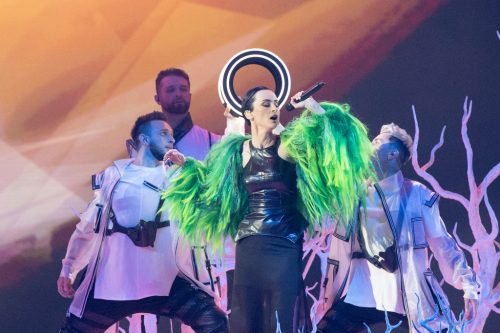
photo: EBU

Solovey

“Solovey” is the song by the Ukrainian band Go_A. Selected as Ukraine’s entry for the Eurovision Song Contest in 2020, the track became synonymous with Go_A’s unique fusion of electronic music with traditional Ukrainian sound. The title “Solovey” translates to “Nightingale” in English, and lyrically, the song tells the tale of a young woman’s complex feelings towards a man, using the metaphor of the nightingale’s song to express deep emotions.

Musically, “Solovey” incorporates the band’s signature blend of powerful vocal techniques, inspired by Ukrainian folklore, with contemporary beats and rhythms. Kateryna Pavlenko’s voice, with its distinctive timbre, rings out clear and strong, capturing the listener’s attention from the outset.

COVID19

Due to the COVID19 pandemic, EBU, host organizers NOS/NPO/AVROTROS and the city of Rotterdam had to decide to a cancellation of the contest. That also meant that Go_A could not represent Ukraine in the 2020 contest. On the evening of the Grand Final, 16 May 2020, a show from a studio in Hilversum, Netherlands, was broadcast: Europe Shine A Light. Go_A was part of this show. Ukrainian broadcaster UA:PBC however supported Go_A to be the 2021 representants in the contest. Their song “Shum” reached a 5th place in the Eurovision Song Contest.

Go_A at a home session during the pandemic.

Related news

History

🇦🇹 Austria in the Eurovision Song Contest, part 3

📷 Waterloo & Robinson This year’s Eurovision Song Contest has been won by Austria. It was the 57th Austrian entry. Reason for us to go back to all the Austrian entries in history! For the third episode, we will look back at the seventies. Austria entered the top-5 twice. They also sang in a minority language. They also had some deviant entries. 1971 – Marianne Mendt – Musik Austria returned to the Eurovision Song Contest in 1971 after a two-year absence . They boycotted the Franco-ruled 1969 contest and protesting the four-way tie of 1969 by skipping 1970. Marianne Mendt performed “Musik.” Mendt, a jazz-pop singer from Vienna, delivered the song in her native Viennese German dialect, a rarity at Eurovision. Richard Schönherz and Manuel Rigoni composed “Musik” and also wrote its lyrics, giving the entry a swinging, soulful vibe about the power of music. At the contest in Dublin, “Musik” scored 66 points and finished 16th out of 18 entries. 1972 – The Milestones – Falter im Wind The Austrian rock band The Milestones represented the country at the Eurovision Song Contest 1972 in Edinburgh with “Falter im Wind” (“Butterfly in the Wind”). Composers Richard Schönherz and Manuel Rigoni teamed up with lyricist Heinz Unger to craft this folk-tinged pop song addressed to a butterfly. They reflected on life’s impermanence. The song’s gentle melody and rich harmonies resonated with the juries. Austria earned 100 points and achieved 5th place. This was the country’s best Eurovision result since its 1966 victory, showcasing a high point for Austria before a brief mid-’70s withdrawal from the contest. 1976 – Waterloo & Robinson – My Little World After skipping the contest from 1973 to 1975, Austria returned at the Eurovision Song Contest 1976 in The Hague with pop duo Waterloo & Robinson performing “My Little World.” The duo was already popular at home. They presented an upbeat, feel-good song that songwriter Gerhard Heinz had composed. Sung in English, “My Little World” celebrates the simple joys of love and life. It earned 80 points and reached 5th place, matching Austria’s 1972 success. This strong result followed ORF’s mid-’70s Eurovision hiatus, which was reportedly due to dissatisfaction with the contest’s scoring system at the time. 1977 – Die Schmetterlinge – Boom Boom Boomerang Austria took a daring turn at the Eurovision Song Contest 1977 in London with the group Schmetterlinge and their song “Boom Boom Boomerang.” Known for their political cabaret style, Schmetterlinge delivered a satirical pop performance. In that performance they lampooned the commercial music industry, complete with nonsense “international” lyrics and zany on-stage antics. Group members like Georg “Schurli” Herrnstadt and Willi Resetarits wrote the music, while Lukas Resetarits provided tongue-in-cheek lyrics skewering formulaic pop. Despite the bold concept and humor, the entry earned only 11 points, placing 17th out of 18 countries. Notably, two members of Schmetterlinge had been part of The Milestones (Austria’s 1972 act), adding a nod to the country’s earlier Eurovision experience. 1978 – Springtime – Mrs. Caroline Robinson In 1978, Austria was represented by Springtime, a pop trio formed by brothers Walter and Gerhard Markel with bassist Norbert Niedermayer. Their song “Mrs. Caroline Robinson” was an upbeat schlager-pop number with a humorous twist. It was written by the trio themselves. The lyrics told the quirky story of Caroline Robinson, the “top-witch of this town” who captivates everyone with her charm. Springtime’s performance in Paris was fun and energetic, and the song even became a hit at home. It earned a gold record in Austria. On the Eurovision scoreboard, however, “Mrs. Caroline Robinson” earned 14 points, finishing 15th out of 20 countries in 1978. 1979 – Christina Simon – Heute in Jerusalem Austria’s 1979 entry was the soulful “Heute in Jerusalem” (“Today in Jerusalem”), performed by singer Christina Simon. Christina had a background as a jazz vocalist. This reflective ballad was composed by Peter Wolf with lyrics by Austrian artist André Heller. Musically it blended contemporary jazz and blues influences, and its lyrics carried a heartfelt plea for peace in Jerusalem. That was quite fittingly, the contest was held in Jerusalem just days after the Israel–Egypt peace treaty. Simon’s emotional delivery brought gravitas to the stage. Unfortunately, “Heute in Jerusalem” received only 5 points, ending up in 18th (last) place at the 1979 contest. 

Read More »
History
Martijn

🇦🇹 Austria in the Eurovision Song Contest, part 3

📷 Waterloo & Robinson This year’s Eurovision Song Contest has been won by Austria. It was the 57th Austrian entry. Reason for us to go back to all the Austrian entries in history! For the third episode, we will look back at the seventies. Austria entered the top-5 twice. They also sang in a minority language. They also had some deviant entries. 1971 – Marianne Mendt – Musik Austria returned to the Eurovision Song Contest in 1971 after a two-year absence . They boycotted the Franco-ruled 1969 contest and protesting the four-way tie of 1969 by skipping 1970. Marianne Mendt performed “Musik.” Mendt, a jazz-pop singer from Vienna, delivered the song in her native Viennese German dialect, a rarity at Eurovision. Richard Schönherz and Manuel Rigoni composed “Musik” and also wrote its lyrics, giving the entry a swinging, soulful vibe about the power of music. At the contest in Dublin, “Musik” scored 66 points and finished 16th out of 18 entries. 1972 – The Milestones – Falter im Wind The Austrian rock band The Milestones represented the country at the Eurovision Song Contest 1972 in Edinburgh with “Falter im Wind” (“Butterfly in the Wind”). Composers Richard Schönherz and Manuel Rigoni teamed up with lyricist Heinz Unger to craft this folk-tinged pop song addressed to a butterfly. They reflected on life’s impermanence. The song’s gentle melody and rich harmonies resonated with the juries. Austria earned 100 points and achieved 5th place. This was the country’s best Eurovision result since its 1966 victory, showcasing a high point for Austria before a brief mid-’70s withdrawal from the contest. 1976 – Waterloo & Robinson – My Little World After skipping the contest from 1973 to 1975, Austria returned at the Eurovision Song Contest 1976 in The Hague with pop duo Waterloo & Robinson performing “My Little World.” The duo was already popular at home. They presented an upbeat, feel-good song that songwriter Gerhard Heinz had composed. Sung in English, “My Little World” celebrates the simple joys of love and life. It earned 80 points and reached 5th place, matching Austria’s 1972 success. This strong result followed ORF’s mid-’70s Eurovision hiatus, which was reportedly due to dissatisfaction with the contest’s scoring system at the time. 1977 – Die Schmetterlinge – Boom Boom Boomerang Austria took a daring turn at the Eurovision Song Contest 1977 in London with the group Schmetterlinge and their song “Boom Boom Boomerang.” Known for their political cabaret style, Schmetterlinge delivered a satirical pop performance. In that performance they lampooned the commercial music industry, complete with nonsense “international” lyrics and zany on-stage antics. Group members like Georg “Schurli” Herrnstadt and Willi Resetarits wrote the music, while Lukas Resetarits provided tongue-in-cheek lyrics skewering formulaic pop. Despite the bold concept and humor, the entry earned only 11 points, placing 17th out of 18 countries. Notably, two members of Schmetterlinge had been part of The Milestones (Austria’s 1972 act), adding a nod to the country’s earlier Eurovision experience. 1978 – Springtime – Mrs. Caroline Robinson In 1978, Austria was represented by Springtime, a pop trio formed by brothers Walter and Gerhard Markel with bassist Norbert Niedermayer. Their song “Mrs. Caroline Robinson” was an upbeat schlager-pop number with a humorous twist. It was written by the trio themselves. The lyrics told the quirky story of Caroline Robinson, the “top-witch of this town” who captivates everyone with her charm. Springtime’s performance in Paris was fun and energetic, and the song even became a hit at home. It earned a gold record in Austria. On the Eurovision scoreboard, however, “Mrs. Caroline Robinson” earned 14 points, finishing 15th out of 20 countries in 1978. 1979 – Christina Simon – Heute in Jerusalem Austria’s 1979 entry was the soulful “Heute in Jerusalem” (“Today in Jerusalem”), performed by singer Christina Simon. Christina had a background as a jazz vocalist. This reflective ballad was composed by Peter Wolf with lyrics by Austrian artist André Heller. Musically it blended contemporary jazz and blues influences, and its lyrics carried a heartfelt plea for peace in Jerusalem. That was quite fittingly, the contest was held in Jerusalem just days after the Israel–Egypt peace treaty. Simon’s emotional delivery brought gravitas to the stage. Unfortunately, “Heute in Jerusalem” received only 5 points, ending up in 18th (last) place at the 1979 contest. 

Read More »
Follow Us: