Set design Eurovision Song Contest 2020 presented

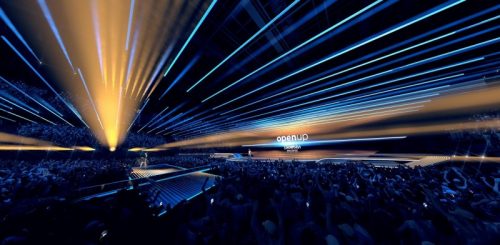
With less than six months to go until the two semi-finals and the final, the first images of the stage for the Eurovision Song Contest 2020 are unveiled today. The stage is inspired by the theme “Open Up” and the typical Dutch flat landscape.

Set designer Florian Wieder: “The set design shows the connection between the sky, the sea and the land. The horizon is the link between those elements and that horizon will work as a window to open the world of Eurovision 2020. The floor plan of the stage is inspired by the canals and bridges that connect land and water in the Netherlands. With this we want to bring the artists as close as possible to the audience. Wieder won the pitch for the stage design, in which both Dutch and foreign set designers took part.

After a year of absence, the so-called “Green Room” – where the artists take place after the performance – will return to the venue. This will make the audience feel even more connected with the artists from the 41 participating countries.

According to Sietse Bakker, Executive Producer Event of the Eurovision Song Contest 2020, this design fits seamlessly with the story the makers want to tell: “The design is innovative, modest and functionally smart. This way, the stage for each of the 41 participating acts, opening and interval acts and during the voting can create a completely different look. We will soon see an innovative stge, great in its simplicity and yet full of surprises. The designer has perfectly translated this wish into his design. ”Wieder has been designing the stage for the Eurovision Song Contest for the past three years too. “Where his experience is clearly reflected in this design, he knows how to surprise,” adds Bakker.

Florian Wieder: “I was inspired by the unique characteristics of Dutch Design. Based on that, I wanted to create an unconventional, minimalist and modern concept for next year’s show. I am very happy that the Dutch public broadcaster has been so broad-minded and enthusiastically embraced this design. As far as I’m concerned, this is a new chapter in stage design, a wish I had for a long time. “

In the past, the German designer signed for the stage design of several editions of the MTV Awards, the Emmy Awards and various major well-known international TV shows. The stage for the upcoming Eurovision Song Contest will be made in the Netherlands and will be set up in Rotterdam Ahoy in the first weeks of April.

Related news

History

70 years of Eurovision: the semifinal came

The Eurovision Song Contest is celebrating its 70th anniversary. That is a wonderful milestone. We at Eurovision Universe love diving into the history of the contest. That is why we are taking a closer look at the contests of the past 70 years. 2004 It was a nice idea to have Enrique Iglesias host the Eurovision Song Contest. It didn’t happen. Whether it was an excessive fee or protests within the broadcaster because the man wasn’t Turkish, we don’t know exactly. But in the now-demolished Abdi İpekçi Arena in Istanbul, Korhan Abay and Meltem Cumbul hosted the contest. And for the first time, there was a semi-final. Countries that had not finished in the top 10 the previous year and countries that were on the reserve bench at the time had to participate. Debuting countries Albania, Belarus, Serbia & Montenegro, and Andorra were also in it. The songs The Belarusians sent the duo Aleksandra and Konstantin with the song “My Galileo”. It was sung in English, but you had to mention that. For a few years, there was an Aleksandra and Konstantin Award for the very worst English. Jonathan Cerrada was the participant for France. By then, the Belgian was a big star in the French-speaking countries. Amidst the stilt-walking backing singers, he failed to live up to expectations. Neither did the Belgian top favorite Xandee with the disco track “1 Life.” How different it was for the Albanian Anjeza Shahini. Festivali i Këngës, a major Albanian national song contest held at the end of December, became the national selection from then on. Only the song “Dua të jem imazhi yt” had to be shortened by a minute and a half, and was therefore immediately translated into English. The Bosnian Dane also stood out with his disco beat, his bleached hair, and his pink suit. Macedonia sent its biggest star, Toše Proeski. He would die in a car accident four years later. His fame has since grown to legendary proportions. Lena Philipsson was already a big star in Sweden. Yet she never managed to win Melodifestivalen. Until 2004, that is. Greece had had an extensive national final. But while it was still underway, their biggest star, Sakis Rouvas, announced his intention to go to the Eurovision Song Contest. The entire national final was set aside, and Sakis went to Istanbul. Serbia and Montenegro were represented by Željko Joksimović, who performed a piece of his own Serbian culture with “Lane moje.” Sakis and Željko would go on to compete in the final. Ruslana But they did not fight that final battle alone. The Ukrainian Ruslana also participated. She, too, had brought her own culture with her. In the song “Wild Dances,” a Ukrainian instrument, the trembita, played the leading role. Ruslana had been internally selected to go to the Eurovision Song Contest. When she won, she was honored by President Kuchma with the highest possible distinction, People’s Artist of Ukraine. With the presidential elections of late 2004 and the subsequent Orange Revolution, she sided with presidential candidate Yushchenko. He did not win; fraud was suspected. During the revolution that followed, Ruslana went on a hunger strike for a short time. Besides being a singer, she would remain a political activist and politician. 2005 Ruslana was set to present the Eurovision Song Contest, which was held at the Palace of Sports in Kyiv. She was to do so together with Pavlo Shylko. However, Ruslana withdrew, officially because she had other commitments. But it is quite possible that her poor English also played a role. Since there was a semifinal,  Bulgaria and Moldova wanted to participate as well, Hungary returned, and even Monaco came back after 26 years. The songs The Icelandic Selma participated one more time. This time, however, she did not reach the final. Chiara from Malta also took part again. She even improved on her previous success by finishing second with her “Angel”. Constantinos from Cyprus even participated for the third time. And Helena Paparizou, who represented Greece in 2001 with the duo Antique, was also present again. Debuting Moldova sent the group Zdob și Zdub. They performed their ode to a grandmother with a real grandmother on stage, who occasionally beat a huge drum. Moldova finished an impressive sixth with it. Host country Ukraine really went all out. From no fewer than 75 songs, 15 finalists emerged. But actually, no one doubted the victory for top favorite Ani Lorak. Until the broadcaster suddenly awarded wildcards to four songs: protest songs stemming from the recently concluded revolution. With that, Ani Lorak lost her chance. Karma catches up with them: the winning group Greenjolly first had to change the lyrics of their song of praise to the president. Ultimately, the group finished 19th. The German entry was controversial. Gracia already had a major hit in her own country at the time she won the German national final. What turned out to be the case? Producer David Brandes had personally bought up many CDs to boost the sales figures. David Brandes was also the producer of the Swiss entry: the Estonian group Vanilla Ninja. But these four rock chicks, popular in German-speaking countries, experienced no hindrance from their producer. And then there was a song from Latvia, sung by the duo Walters and Kazha. They sang part of their song in sign language. Helena Paparizou Greece won for the first time. As mentioned, Helena Paparizou had participated before. The singer, who lives in Sweden, previously sang in the popular duo Antique. Now she sang solo. She was to sing four songs from which one Eurovision entry would be chosen. However, the favorite, “The Light of Our Soul”, was disqualified because it had been released too early. The song chosen from the remaining three was “My Number One”. And that did indeed become number 1.


Read More »
History
Martijn

70 years of Eurovision: the semifinal came

The Eurovision Song Contest is celebrating its 70th anniversary. That is a wonderful milestone. We at Eurovision Universe love diving into the history of the contest. That is why we are taking a closer look at the contests of the past 70 years. 2004 It was a nice idea to have Enrique Iglesias host the Eurovision Song Contest. It didn’t happen. Whether it was an excessive fee or protests within the broadcaster because the man wasn’t Turkish, we don’t know exactly. But in the now-demolished Abdi İpekçi Arena in Istanbul, Korhan Abay and Meltem Cumbul hosted the contest. And for the first time, there was a semi-final. Countries that had not finished in the top 10 the previous year and countries that were on the reserve bench at the time had to participate. Debuting countries Albania, Belarus, Serbia & Montenegro, and Andorra were also in it. The songs The Belarusians sent the duo Aleksandra and Konstantin with the song “My Galileo”. It was sung in English, but you had to mention that. For a few years, there was an Aleksandra and Konstantin Award for the very worst English. Jonathan Cerrada was the participant for France. By then, the Belgian was a big star in the French-speaking countries. Amidst the stilt-walking backing singers, he failed to live up to expectations. Neither did the Belgian top favorite Xandee with the disco track “1 Life.” How different it was for the Albanian Anjeza Shahini. Festivali i Këngës, a major Albanian national song contest held at the end of December, became the national selection from then on. Only the song “Dua të jem imazhi yt” had to be shortened by a minute and a half, and was therefore immediately translated into English. The Bosnian Dane also stood out with his disco beat, his bleached hair, and his pink suit. Macedonia sent its biggest star, Toše Proeski. He would die in a car accident four years later. His fame has since grown to legendary proportions. Lena Philipsson was already a big star in Sweden. Yet she never managed to win Melodifestivalen. Until 2004, that is. Greece had had an extensive national final. But while it was still underway, their biggest star, Sakis Rouvas, announced his intention to go to the Eurovision Song Contest. The entire national final was set aside, and Sakis went to Istanbul. Serbia and Montenegro were represented by Željko Joksimović, who performed a piece of his own Serbian culture with “Lane moje.” Sakis and Željko would go on to compete in the final. Ruslana But they did not fight that final battle alone. The Ukrainian Ruslana also participated. She, too, had brought her own culture with her. In the song “Wild Dances,” a Ukrainian instrument, the trembita, played the leading role. Ruslana had been internally selected to go to the Eurovision Song Contest. When she won, she was honored by President Kuchma with the highest possible distinction, People’s Artist of Ukraine. With the presidential elections of late 2004 and the subsequent Orange Revolution, she sided with presidential candidate Yushchenko. He did not win; fraud was suspected. During the revolution that followed, Ruslana went on a hunger strike for a short time. Besides being a singer, she would remain a political activist and politician. 2005 Ruslana was set to present the Eurovision Song Contest, which was held at the Palace of Sports in Kyiv. She was to do so together with Pavlo Shylko. However, Ruslana withdrew, officially because she had other commitments. But it is quite possible that her poor English also played a role. Since there was a semifinal,  Bulgaria and Moldova wanted to participate as well, Hungary returned, and even Monaco came back after 26 years. The songs The Icelandic Selma participated one more time. This time, however, she did not reach the final. Chiara from Malta also took part again. She even improved on her previous success by finishing second with her “Angel”. Constantinos from Cyprus even participated for the third time. And Helena Paparizou, who represented Greece in 2001 with the duo Antique, was also present again. Debuting Moldova sent the group Zdob și Zdub. They performed their ode to a grandmother with a real grandmother on stage, who occasionally beat a huge drum. Moldova finished an impressive sixth with it. Host country Ukraine really went all out. From no fewer than 75 songs, 15 finalists emerged. But actually, no one doubted the victory for top favorite Ani Lorak. Until the broadcaster suddenly awarded wildcards to four songs: protest songs stemming from the recently concluded revolution. With that, Ani Lorak lost her chance. Karma catches up with them: the winning group Greenjolly first had to change the lyrics of their song of praise to the president. Ultimately, the group finished 19th. The German entry was controversial. Gracia already had a major hit in her own country at the time she won the German national final. What turned out to be the case? Producer David Brandes had personally bought up many CDs to boost the sales figures. David Brandes was also the producer of the Swiss entry: the Estonian group Vanilla Ninja. But these four rock chicks, popular in German-speaking countries, experienced no hindrance from their producer. And then there was a song from Latvia, sung by the duo Walters and Kazha. They sang part of their song in sign language. Helena Paparizou Greece won for the first time. As mentioned, Helena Paparizou had participated before. The singer, who lives in Sweden, previously sang in the popular duo Antique. Now she sang solo. She was to sing four songs from which one Eurovision entry would be chosen. However, the favorite, “The Light of Our Soul”, was disqualified because it had been released too early. The song chosen from the remaining three was “My Number One”. And that did indeed become number 1.

Read More »
Follow Us: