Liveblog: Press Conferences 14 may


Today, we will have Press Conferences again for the Eurovision Song Contest. We will keep you updated about them all the time.

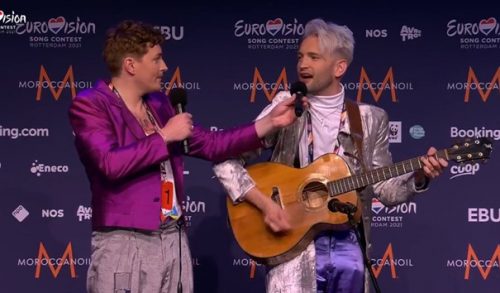
15:31 Jesper Groth van Fyr & Flamme legt uit dat ze in het Deens zingen omdat ze dat zo fantastisch vonden aan het oude songfestival: dat was net een ansichtkaart uit ieder land. De mannen zeggen geïnspireerd te zijn door de muziek van eind jaren 70. Dat was niet een speciaal zo bedoeld geluid, maar door het schrijven ontstond dat zo. De heren geven aan dat ze alleen maar door het songfestival geïnspireerd zijn. Ze vinden de sfeer fantastisch. Ze waren ook nog erg onder de indruk dat ze een ooievaar gezien hadden. Een nieuw album zal waarschijnlijk in het Deens zijn, maar ze sluiten helemaal niet uit dat het anders wordt. 
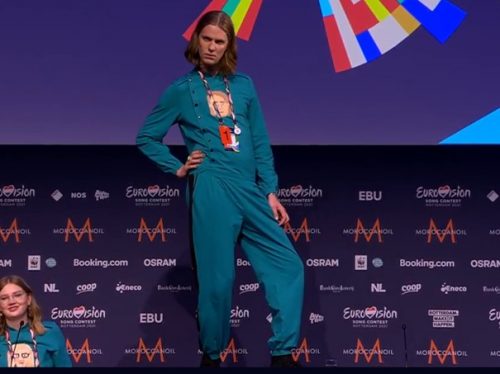
15:06 Gjon’s Tears is satisfied with the second rehearsal. He is happy that the team is heading in the right direction. Gjon’s Tears says about his clothes that he likes to work with people he knows. He thinks it is important to give Swiss talent a chance. He collaborated with Sacha Jean Baptiste on the staging. He says it has changed something in him. He thought he couldn’t dance but she convinced him to do it anyway. Gjon’s Tears is happy to have people around him who change him. He is talking about melody and text: he lives from melody, but in this case the message of “Tout l’univers” is in the text. He adds that he is not only here as a singer, but that he is also active here as a composer and lyricist. That is his livelihood. Gjon talks a lot because he says: people listen to me here. That may not be the case in five years. He was happy that his style is immediately recognized in his song. 
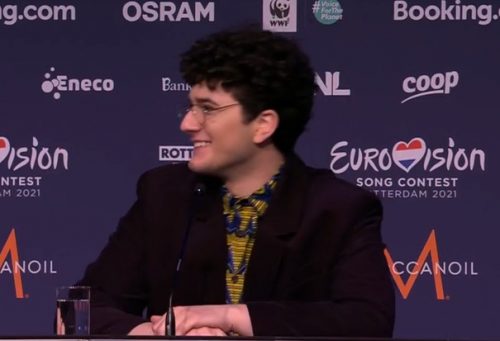
14.49 Samanta Tina from Latvia sings a song by the Russian group A-Studio. Samanta speaks of the different roles she has: at home she is a mother, a sister and a daughter. As a teenager she was searching. She has participated in national finals for a long time and often. It brought her to tears when she first came on stage. She indicates that she would like to participate again if she gets the chance, just to experience it again. She doesn’t know yet in which genre she will sing. It is different every time she is on stage, so looking ahead is not her forte. She doesn’t want to be framed, she likes to mix genres. What she does know is that if she returns to the Eurovision song contest that it will be as a singer and not as a composer. “The stage is my place,” says Samanta. 
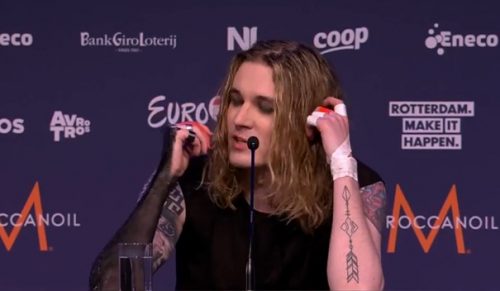
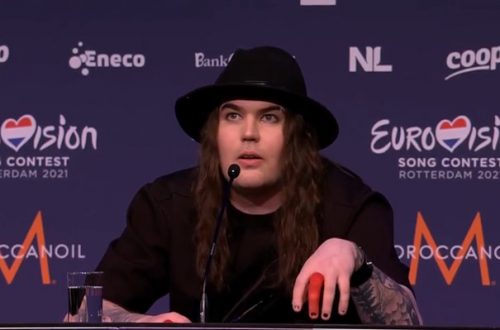
13.12 The second rehearsal of the Finnish band Blind Channel went well, pyrothechnics are added, and the gentlemen do not care anymore if something goes wrong, for example if someone has to vomit during the performance. It’s rock ‘n’ roll. They think representing Finland in the Eurovision Song Contest is cool because they show what Finland is good at: rock. They also like being number 1 in the Finnish charts, but they actually want to be number 1 everywhere in Europe. Presenting themselves as Finnish rockers all over Europe is something they like even more. For the grunt at the end, they got advise from Lordi (ESC 2006): he opens his voice with Pepsi Cola and chocolate. Yet they don’t just listen to rock songs. A favorite Eurovision song they mention is “Euforia”. They don’t want to cover that song though; they would like to work with Loreen. Beforehand they had heard negative stories about the Eurovision song contest in Finland, but they especially like it very much. They do what they have been doing for eight years: perform. 
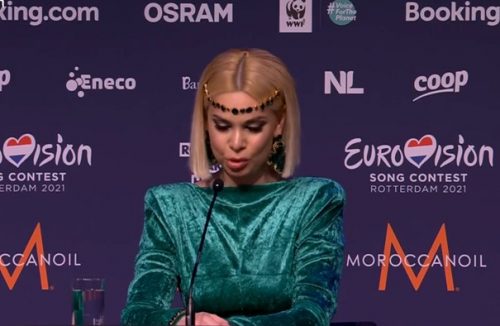
12.47 VIKTORIA indicates that there are still some small things to be done about light and camera work. The delegation leader adds that these are very normal little things and thanks the people of the technology for their work. She tells about her father, who can be seen in the photo in the act, that he has ALS and therefore cannot be there to support her. When he saw the photo he burst into tears. VIKTORIA says to be very careful and to stay in her hotel room. The most important thing for her is to be able to perform here. The team used the time to write a new song, among other things. The subject is uncertainty and confidence in yourself and your own personality. Her personal victory (= viktoria) would be if she could make good contact with the audience and get the message across. Her inspiration often comes from movie soundtracks. 
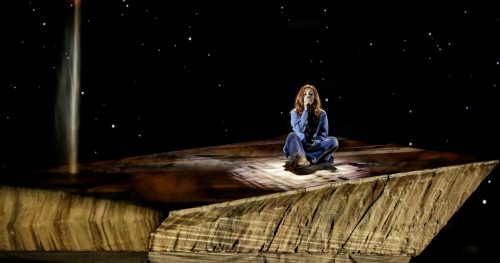
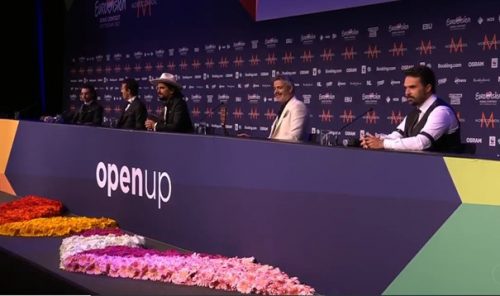
12.22 The members of The Black Mamba wrote their song about a woman from Amsterdam. They themselves have no clear memory of Amsterdam for reasons that they will not go into further. They very much hope that the woman will recognize herself in the lyrics. But they met the woman in The Bulldog, a coffee shop in Amsterdam. Perhaps that says something. They like to be called hypnotic, just like the snake after which they are named they like to hypnotize their audience. They then administer their positive poison. The Black Mamba does feel some pressure now that they are seen as “dark horse”, but they also say: they are just numbers. At the end of the press conference, the members of the group sing another song. 
11.58 The rehearsal of Albanian Anxhela Peristeri went very well. The first is a bit more to explore the stage a bit. She indicates that she has learned here that an experience like the Eurovision song contest changes you in a positive way. She says she now knows she was born to sing. She likes the way she is treated in the Netherlands. She enjoys it. They spend a lot of time in the hotel room but have a good time together as a team. Anxhela has a strong voice. She says that getting up early is not very good for her voice, so she does voice exercises in the morning. She is glad that she now has to focus on singing in the evening. 

Related news

History

🇦🇹 Austria in the Eurovision Song Contest, part 3

📷 Waterloo & Robinson This year’s Eurovision Song Contest has been won by Austria. It was the 57th Austrian entry. Reason for us to go back to all the Austrian entries in history! For the third episode, we will look back at the seventies. Austria entered the top-5 twice. They also sang in a minority language. They also had some deviant entries. 1971 – Marianne Mendt – Musik Austria returned to the Eurovision Song Contest in 1971 after a two-year absence . They boycotted the Franco-ruled 1969 contest and protesting the four-way tie of 1969 by skipping 1970. Marianne Mendt performed “Musik.” Mendt, a jazz-pop singer from Vienna, delivered the song in her native Viennese German dialect, a rarity at Eurovision. Richard Schönherz and Manuel Rigoni composed “Musik” and also wrote its lyrics, giving the entry a swinging, soulful vibe about the power of music. At the contest in Dublin, “Musik” scored 66 points and finished 16th out of 18 entries. 1972 – The Milestones – Falter im Wind The Austrian rock band The Milestones represented the country at the Eurovision Song Contest 1972 in Edinburgh with “Falter im Wind” (“Butterfly in the Wind”). Composers Richard Schönherz and Manuel Rigoni teamed up with lyricist Heinz Unger to craft this folk-tinged pop song addressed to a butterfly. They reflected on life’s impermanence. The song’s gentle melody and rich harmonies resonated with the juries. Austria earned 100 points and achieved 5th place. This was the country’s best Eurovision result since its 1966 victory, showcasing a high point for Austria before a brief mid-’70s withdrawal from the contest. 1976 – Waterloo & Robinson – My Little World After skipping the contest from 1973 to 1975, Austria returned at the Eurovision Song Contest 1976 in The Hague with pop duo Waterloo & Robinson performing “My Little World.” The duo was already popular at home. They presented an upbeat, feel-good song that songwriter Gerhard Heinz had composed. Sung in English, “My Little World” celebrates the simple joys of love and life. It earned 80 points and reached 5th place, matching Austria’s 1972 success. This strong result followed ORF’s mid-’70s Eurovision hiatus, which was reportedly due to dissatisfaction with the contest’s scoring system at the time. 1977 – Die Schmetterlinge – Boom Boom Boomerang Austria took a daring turn at the Eurovision Song Contest 1977 in London with the group Schmetterlinge and their song “Boom Boom Boomerang.” Known for their political cabaret style, Schmetterlinge delivered a satirical pop performance. In that performance they lampooned the commercial music industry, complete with nonsense “international” lyrics and zany on-stage antics. Group members like Georg “Schurli” Herrnstadt and Willi Resetarits wrote the music, while Lukas Resetarits provided tongue-in-cheek lyrics skewering formulaic pop. Despite the bold concept and humor, the entry earned only 11 points, placing 17th out of 18 countries. Notably, two members of Schmetterlinge had been part of The Milestones (Austria’s 1972 act), adding a nod to the country’s earlier Eurovision experience. 1978 – Springtime – Mrs. Caroline Robinson In 1978, Austria was represented by Springtime, a pop trio formed by brothers Walter and Gerhard Markel with bassist Norbert Niedermayer. Their song “Mrs. Caroline Robinson” was an upbeat schlager-pop number with a humorous twist. It was written by the trio themselves. The lyrics told the quirky story of Caroline Robinson, the “top-witch of this town” who captivates everyone with her charm. Springtime’s performance in Paris was fun and energetic, and the song even became a hit at home. It earned a gold record in Austria. On the Eurovision scoreboard, however, “Mrs. Caroline Robinson” earned 14 points, finishing 15th out of 20 countries in 1978. 1979 – Christina Simon – Heute in Jerusalem Austria’s 1979 entry was the soulful “Heute in Jerusalem” (“Today in Jerusalem”), performed by singer Christina Simon. Christina had a background as a jazz vocalist. This reflective ballad was composed by Peter Wolf with lyrics by Austrian artist André Heller. Musically it blended contemporary jazz and blues influences, and its lyrics carried a heartfelt plea for peace in Jerusalem. That was quite fittingly, the contest was held in Jerusalem just days after the Israel–Egypt peace treaty. Simon’s emotional delivery brought gravitas to the stage. Unfortunately, “Heute in Jerusalem” received only 5 points, ending up in 18th (last) place at the 1979 contest. 

Read More »
History
Martijn

🇦🇹 Austria in the Eurovision Song Contest, part 3

📷 Waterloo & Robinson This year’s Eurovision Song Contest has been won by Austria. It was the 57th Austrian entry. Reason for us to go back to all the Austrian entries in history! For the third episode, we will look back at the seventies. Austria entered the top-5 twice. They also sang in a minority language. They also had some deviant entries. 1971 – Marianne Mendt – Musik Austria returned to the Eurovision Song Contest in 1971 after a two-year absence . They boycotted the Franco-ruled 1969 contest and protesting the four-way tie of 1969 by skipping 1970. Marianne Mendt performed “Musik.” Mendt, a jazz-pop singer from Vienna, delivered the song in her native Viennese German dialect, a rarity at Eurovision. Richard Schönherz and Manuel Rigoni composed “Musik” and also wrote its lyrics, giving the entry a swinging, soulful vibe about the power of music. At the contest in Dublin, “Musik” scored 66 points and finished 16th out of 18 entries. 1972 – The Milestones – Falter im Wind The Austrian rock band The Milestones represented the country at the Eurovision Song Contest 1972 in Edinburgh with “Falter im Wind” (“Butterfly in the Wind”). Composers Richard Schönherz and Manuel Rigoni teamed up with lyricist Heinz Unger to craft this folk-tinged pop song addressed to a butterfly. They reflected on life’s impermanence. The song’s gentle melody and rich harmonies resonated with the juries. Austria earned 100 points and achieved 5th place. This was the country’s best Eurovision result since its 1966 victory, showcasing a high point for Austria before a brief mid-’70s withdrawal from the contest. 1976 – Waterloo & Robinson – My Little World After skipping the contest from 1973 to 1975, Austria returned at the Eurovision Song Contest 1976 in The Hague with pop duo Waterloo & Robinson performing “My Little World.” The duo was already popular at home. They presented an upbeat, feel-good song that songwriter Gerhard Heinz had composed. Sung in English, “My Little World” celebrates the simple joys of love and life. It earned 80 points and reached 5th place, matching Austria’s 1972 success. This strong result followed ORF’s mid-’70s Eurovision hiatus, which was reportedly due to dissatisfaction with the contest’s scoring system at the time. 1977 – Die Schmetterlinge – Boom Boom Boomerang Austria took a daring turn at the Eurovision Song Contest 1977 in London with the group Schmetterlinge and their song “Boom Boom Boomerang.” Known for their political cabaret style, Schmetterlinge delivered a satirical pop performance. In that performance they lampooned the commercial music industry, complete with nonsense “international” lyrics and zany on-stage antics. Group members like Georg “Schurli” Herrnstadt and Willi Resetarits wrote the music, while Lukas Resetarits provided tongue-in-cheek lyrics skewering formulaic pop. Despite the bold concept and humor, the entry earned only 11 points, placing 17th out of 18 countries. Notably, two members of Schmetterlinge had been part of The Milestones (Austria’s 1972 act), adding a nod to the country’s earlier Eurovision experience. 1978 – Springtime – Mrs. Caroline Robinson In 1978, Austria was represented by Springtime, a pop trio formed by brothers Walter and Gerhard Markel with bassist Norbert Niedermayer. Their song “Mrs. Caroline Robinson” was an upbeat schlager-pop number with a humorous twist. It was written by the trio themselves. The lyrics told the quirky story of Caroline Robinson, the “top-witch of this town” who captivates everyone with her charm. Springtime’s performance in Paris was fun and energetic, and the song even became a hit at home. It earned a gold record in Austria. On the Eurovision scoreboard, however, “Mrs. Caroline Robinson” earned 14 points, finishing 15th out of 20 countries in 1978. 1979 – Christina Simon – Heute in Jerusalem Austria’s 1979 entry was the soulful “Heute in Jerusalem” (“Today in Jerusalem”), performed by singer Christina Simon. Christina had a background as a jazz vocalist. This reflective ballad was composed by Peter Wolf with lyrics by Austrian artist André Heller. Musically it blended contemporary jazz and blues influences, and its lyrics carried a heartfelt plea for peace in Jerusalem. That was quite fittingly, the contest was held in Jerusalem just days after the Israel–Egypt peace treaty. Simon’s emotional delivery brought gravitas to the stage. Unfortunately, “Heute in Jerusalem” received only 5 points, ending up in 18th (last) place at the 1979 contest. 

Read More »
Follow Us: