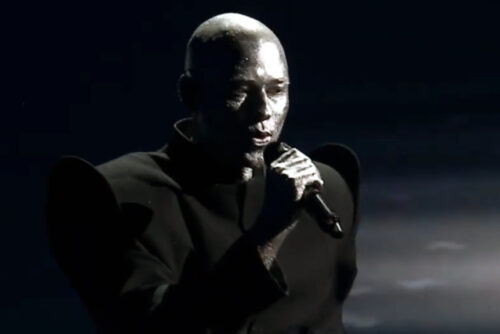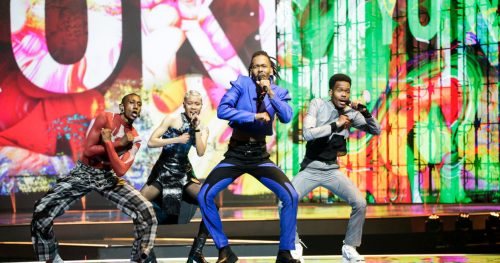
In the spotlights: The Netherlands – Jeangu Macrooy


Jeangu Macrooy was born in Surinam. His name is unique, it is a combination of his mother’s name Jeannette and his father’s name Guno. He is the half of a twin, his brother’s name is Xillan. In their youth, Jeangu and Xillan did everything together. If they made a drawing, like children do, Jeangu made one half of it, Xillan the other half. Even if they wrote a song, they wrote it together. They formed a duo together: Between Towers. They thanked their name to the fact that both of them are very tall. The boys released their first and only album together, “Stars on my radio”.

When the boys were 19, they went to the Netherlands. Their grandparents lived in the Netherlands, so there was a link already. When they went back to Surinam, Jeangu’s dream became to study in the Netherlands. It was hard to do something without his twin brother for the first time. On the other hand, in the Netherlands he felt free to be openly gay for the first time; a special moment for Jeangu, who went to study in the city of Enschede, in the eastern part of the country. He studied at the ArtEZ Pop Academy.

Enschede was the place were it all really started for Jeangu Macrooy in the Netherlands. He met music producer Pieter Perquin (Perquisite) there. Perquisite was a guest teacher. He immediately recognized the talent Jeangu has. They started working together in 2016, which resulted in the EP “High on you”. It resulted in being 3FM Talent (3FM is a Dutch national radio station), in performances in one of the most watched Dutch tv-shows, “De Wereld Draait Door”, and an Edison Pop Award in the catagory Best New Artist. His debut single “Gold” even became part of a commercial on HBO for “Game of thrones”. An album with the name “High on you” followed, and a new highlight in Jeangu’s career followed: he hit the number 1 spot in the Surinam music charts! Again, Jeangu was nominated for an Edison Pop Award, this time in the catagory best album.

It was around that time that also something special happened in Jeangu’s personal life: he met his boyfriend Sebas van der Tangen. The two currently live together in Amsterdam.

One year later a new highlight in the life of Jeangu appeared. He could play the role of Judas in “The passion”, an annual Dutch show in which the story of Easter is told in Dutch songs. The show is viewed by 3,5 million people.

A new album, “Horizon” followed in 2019. A special Horizon-tour was planned for early 2020. And something else came up at the same time. Already in 2019, Jeangu Macrooy was asked whether he might be interested in representing the Netherlands in the Eurovision Song Contest. Jeangu liked the idea, but was waiting for the right song to represent The Netherlands. In early 2020 it was announced that the Dutch selection committee had chosen Jeangu to do the job. In march, he presented his song “Grow” to the audience. In the show “De Wereld Draait Door” Jeangu explains: “Last year, for the first time in my life, I had a period in which I did not know it anymore. I was not comfortable with myself. The song is actually in two parts: the first part is about getting older, growing up and finding out that there are no manuals in life. And that there is no clearly pointed out path to happiness. I was shocked by that; I was angry and frustrated about that. But then there is the second part and it’s about accepting that it’s all highs and lows. That if you go through it, you eventually learn and grow.”

But then COVID19 came. The Eurovision Song Contest was canceled. Jeangu’s Horizon tour was canceled as well. Although that was a hard time for Jeangu, he became one of the most visible artists in 2020. He gave a concert on kingsday (the day Dutch people celebrate the birthday of the king). On the 4th of may, when the Dutch commemorate the people who died in Worldwar II, he performed. Jeangu made a new video of his old song “Gold”, where he stated that the day when the slavery has been abolished in Suriname and the Dutch Antiles should be a national celebration in the Netherlands.


When the Eurovision Song Contest was canceled, Dutch broadcaster Avrotros immediately came up with a statement: “We will remain #teamjeangu for 2021”. Jeangu was going to write and produce the Dutch Eurovision Song in 2021. It became “Birth of a new age”, a personal story. Some lines in the song were sung in Sranantongo, one of the languages of Suriname. The lines “Yu no man broko mi” were based on a Surinam saying, “Mi na afusensi, no wan man broko mi” (I’m half a cent, nobody can break me). In fact Jeangu says with these lines “I might be very small or not worth anything in your eyes, but you can’t break me”. The message is meant to empower people. “I hope I can let people feel their power”, Jeangu said in an interview with Eurovision hots Nikkie Tutorials.

Jeangu hopes that after Eurovision, whole Europe will open up to him. At least he will go back to the studio for new material!

Related news

Uncategorized

70 years of Eurovision: growing pains

The Eurovision Song Contest is celebrating its 70th anniversary. That is a wonderful milestone. We at Eurovision Universe love diving into the history of the contest. That is why we are taking a closer look at the contests of the past 70 years. 1992 As far as Sweden was concerned, it was Malmö’s turn to host the Eurovision Song Contest. Lydia Capolicchio and Harald Treutiger were given the task of presenting. Compared to 1991, the Netherlands also participated again. However, a dark shadow hung over the Song Contest: with the unification of Europe, it threatened to succumb to its own success. But it had not come to that yet. The songs Sigga, the singer of Stjórnin (see 1990), participated again. This time as half of the duo Heart2Heart. Linda Martin also participated for the second time, once again with a song by Johnny Logan. Mia Martini was present once more. She was called upon just before she was about to start. Mia had a laugh about it for a moment but then managed to bring her beautiful ballad “Rapsodia” to the stage. She finished fourth with it. Wind, twice runner up for Germany, was less successful. In Greece, people were certainly not happy with singer Cleopatra. “Olou tou kosmou i elpida” sounded typically Greek. Surely they couldn’t do that to Europe, Greek fans grumbled. Europe, however, thought it was a great song. Cleopatra finished in fifth place. France opted for reggae, with Kali, hailing from Martinique. He sang his song “Monté la rivié” in French Creole. Evridiki performed for Cyprus. She was also among the favorites but failed to live up to expectations with “Teriazoume”. And then there was Extra Nena. She represented the slowly but surely falling apart Yugoslavia. The singer herself was expecting a victory. When asked how things would work if Yugoslavia won, she said decisively: “Eurovision will be held in Belgrade next year.” She finished thirteenth. The favorite was the British Michael Ball. He was primarily a well-known musical artist. In the national final, he was the only candidate, but out of the eight songs, the televoter picked exactly the song he himself absolutely detested. Yet he came second. The other favorite was Malta. The 47-year-old Mary Spiteri strutted around Malmö like a queen. Surely victory could no longer escape her with “Little Child”? But as always, the reality of the Eurovision Song Contest was just a little different, and she came third. Linda Martin For the winner of that year was the red-haired Linda Martin with her “Why me?”. Linda had been attempting to represent Ireland at the Eurovision Song Contest since the mid-1970s. First with the group Chips and later solo. In 1984, she came second with a song by Johnny Logan. This “Why me?” was also his work. And that made the whole thing special. For the third time, now as a composer, Logan succeeded in winning the Eurovision Song Contest. With this, his title as Mr. Eurovision was definitively cemented. It was therefore a beaming Johnny Logan, alongside Linda Martin, who received the award. 1993 A large number of Eastern European countries had become members of the EBU on January 1, 1993. This allowed them to participate in the Eurovision Song Contest, and a number of them wanted to do so. It was decided to hold an Eastern European national selection. Ultimately, a number of countries withdrew, leaving seven countries in the competition. Bosnia and Herzegovina, Croatia, and Slovenia won the ticket to the Eurovision Song Contest. It was held in Millstreet, in a hall where equestrian events took place. Financier Noel C. Duggan offered his hall as the venue. That saved the Irish broadcaster RTÉ a lot of money. Fionnuala Sweeney hosted the event. We would see her later on CNN. The songs The Dane Tommy Seebach represented his country for the third, and least successful, time. However, after his death, his son Rasmus also recorded the song “Under stjernerne på himlen.” He did have a hit with it in his own country. Tony Wegas participated for Austria for the second consecutive time. Katri Helena also returned for Finland after 14 years. Singer Barbara Dex represented Belgium. The song “Iemand als jij” did not stand out much. The clothing, however, did. In fact, it stood out so much in a negative way that for years a prize was awarded for the worst-dressed artist: the Barbara Dex Award. For France, the singing was once again in a minority language. Patrick Fiori sang the chorus of his “Mama Corsica” partly in Corsican. An established artist participated for the United Kingdom: Sonia, from the hitmakers Stock, Aitken and Waterman. But the most striking candidates were the members of the group Fazla, representing Bosnia and Herzegovina. The country was at war at that time. During the press conferences, the members explained how they had to flee the country while hiding from snipers. This was the only way they could be present in Millstreet. Niamh Kavanagh And Ireland won on home soil. The ballad “In Your Eyes” by Niamh Kavanagh received the most points after a thrilling battle with the United Kingdom. The 25-year-old singer had previously collaborated on the soundtrack of the film The Commitments. At that time, she did not yet have a major career in her own country. She would, of course, build one up. 17 years later, we saw Niamh return to the Eurovision stage, but with “It’s For You” she failed to imitate Johnny Logan and take home yet another prize.

Read More »
2026
Anja Kroeze

Road to Vienna: Lithuania

Road to Vienna: Lithuania We cannot wait for the Eurovision Song Contest in Vienna. Therefore, we take a closer look at one of the contestants each day. Today, we highlight Lithuania.    Lion Ceccah: Lithuania’s Theatrical Pop Visionary Lion Ceccah, born Tomas Alenčikas, first gained attention as Alen Chicco on X Faktorius in 2017. As the show’s first drag performer, he reached the semi-finals and stood out with his bold, theatrical style and fearless self-expression. Unique Style and Music Career Blending pop, electronic, and theatrical influences, Lion Ceccah became known for boundary-pushing music and striking visuals. Songs like “Lithuanian Queen” and “Aš Čia” helped build a loyal fanbase, while his creative collective House of Alen Chicco strengthened his impact on Lithuania’s LGBTQ+ scene. Eurovision Journey and Reinvention After several attempts in Lithuania’s national selections, he reinvented himself as Lion Ceccah in 2024. This new era brought renewed success, including a runner-up finish in 2025 and growing recognition as a top contender. Road to Eurovision Song Contest 2026 In 2026, Lion Ceccah won Lithuania’s national selection with “Sólo Quiero Más.” His electrifying performance and strong public support secured his place on the Eurovision stage, marking the peak of his long journey to international recognition. Sólo Quiero Más: A Powerful Emotional Journey Sólo Quiero Más is an emotional track about self-discovery, resilience, and the constant desire for more. It explores fear, judgment, and uncertainty while encouraging personal growth. A Balance of Vulnerability and Strength The song blends introspective lyrics with powerful declarations, creating a dynamic contrast between fragility and confidence. Its multilingual approach adds depth and universal appeal. Cinematic Sound and Universal Message With atmospheric production and electronic influences, the track captures life’s emotional highs and lows. At its core, it delivers a relatable message: the drive for “more” keeps us moving forward, even in uncertain times. Lithuania in the Eurovision Song Contest Lithuania has participated in the Eurovision Song Contest 24 times since its debut in 1994. The country’s best result came in 2006 when LT United finished 6th with the song “We Are the Winners.” The last few years, since 2021, Lithuania always manages to reach the final. The Roop even reached an 8th place! The Bookmakers Lithuania is currently ranked 19th with the bookmakers, suggesting a place in the final—but can they get closer to the top 10?  

Read More »
Follow Us: