Austria in the Eurovision Song Contest, part 7

This year’s Eurovision Song Contest has been won by Austria. It was the 57th Austrian entry. Reason for us to go back to all the Austrian entries in history!

For Austria in the Eurovision Song Contest, part 7, we look back at the start of the 21st century. Alf Poier participated for Austria, but there were also some unsuccesful entries. And there was a 3-year gap.

2000 – The Rounder Girls – All To You

Austria’s 2000 entry “All To You” was internally selected by broadcaster ORF. The song was written by American songwriter Dave Moskin. Moskin gave the three-piece vocal group The Rounder Girls an up-tempo, gospel-influenced pop track. Performing last in the Stockholm final, the trio, with members from Austria, the US and the UK, delivered slick harmonies and choreography. They finished 14th out of 24 countries with 34 points. The Rounder Girls were a seasoned soul/gospel ensemble, and their Eurovision appearance raised their profile, though Austria’s middling result meant the country sat out the contest in 2001.

2002 – Manuel Ortega – Say A Word

“Say A Word” by Manuel Ortega won Austria’s “Song.Null.Zwei” 2002 national final out of ten songs. this entry was an upbeat pop song with a catchy, boy-band style hook. It was composed by Alexander Kahr with lyrics by Robert Pfluger. At Eurovision 2002 in Tallinn, Ortega performed third and Austria placed 18th (26 points) in the final. Manuel Ortega, a young pop singer, had scored a summer hit in 2001 and was nicknamed “the Austrian Ricky Martin” for his Latin pop flair. His Eurovision song’s fun choreography and positive message reflected that image, though the result was a lower mid-table finish.

2003 – Alf Poier – Weil der Mensch zählt

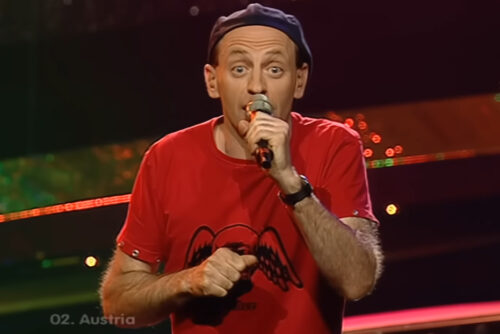
ORF organized the “Song.Null.Drei” 2003 selection. Petra Frey (ESC 1994) was the runner up. Comedian-singer Alf Poier triumphed with “Weil der Mensch zählt”. Poier penned this satirical song himself. Musically it’s a quirky folk-pop tune delivered in Styrian dialect. The performance, complete with cartoonish animal props, was a parody of Eurovision’s over-the-top style. At the Riga contest, this offbeat entry surprised many by scoring 6th place with 101 points. Alf Poier, an Austrian stand-up comedian known for absurdist humor, thus earned Austria’s best Eurovision result in over a decade. His comedic approach and catchy refrain turned him into a fan favorite that year.

2004 – Tie Break – Du bist

Austria’s national final “Song.Null.Vier” chose Tie Break’s “Du bist” for Eurovision 2004. Waterloo & Robinson (ESC 1976!) were the runners up. Note that a song, written by popstar Falco, participated too. So posthumously, Falco did a Eurovision attempt!
Written by composer Peter Zimmermann, “Du bist” is a tender schlager-style pop ballad performed in German. Tie Break, a trio of fresh-faced male singers (a boy band formed via a talent search), delivered tight harmonies in Istanbul’s final. Thanks to Austria’s top-10 result the year before, they pre-qualified directly for the final. Tie Break finished 21st out of 24 with 9 points. The group had gained national fame through the selection process, but on the Eurovision stage their gentle ballad struggled to stand out in a field dominated by more dynamic acts.

2005 – Global.Kryner – Y así

In 2005, “Song.Null.Fünf” was held and the crossover folk band Global.Kryner won with “Y así”. They narrowly beated Alf Poier. The controversy was that Austria changed the rules of the voting on the very last moment. Would the original voting procedure be used, Alf Poier would have won.
Band members Edi Köhldorfer (composer) and Christof Spörk (lyricist) combined Latin salsa rhythms with Austrian alpine polka to create this unique “salsa-polka-pop” song. Global.Kryner was a six-member ensemble known for blending folk and jazz influences. They opened the Eurovision semi-final in Kyiv with an energetic performance featuring yodels and Latin dance breaks. However, “Y así” did not advance to the final, placing 21st of 25 in the semi-final with 30 points. The group had earned acclaim in Austria and Germany, but their daring genre fusion proved too quirky for the Eurovision televote that year.

2007 – Eric Papilaya – Get A Life – Get Alive

After a brief Eurovision hiatus, Austria returned in 2007 by internally selecting Eric Papilaya. His entry “Get A Life – Get Alive” – composed by Greg Usek with lyrics by Austin Howard. It was the official anthem of Vienna’s Life Ball AIDS charity event. This song is an upbeat pop-rock anthem with an inspirational message and flashy staging. Papilaya performed with a giant red ribbon on stage. Papilaya, a rock vocalist who rose to fame on the TV talent show Starmania, gave a spirited performance in Helsinki’s semi-final. Unfortunately Austria did not qualify for the final; he placed 27th (four points) in the semi. The entry drew media attention for its charity theme, but it wasn’t enough to overcome tough competition in 2007.

2011 – Nadine Beiler – The Secret Is Love

Austria returned to Eurovision in 2011 through the national selection “Düsseldorf – wir kommen!”. The competition featured ten songs. However, well-known artists Alf Poier and Petra Frey failed to pass the online preselection. As a result, Nadine Beiler won the final with her soulful ballad “The Secret Is Love”. She co-wrote the song with veteran producer Thomas Rabitsch. Musically, the entry combines elements of gospel and pop, while it clearly highlights Beiler’s strong vocal range.

Previously, Nadine Beiler had gained national fame by winning the television talent show Starmania in 2007 at the age of 16. Therefore, expectations were already high when she took the stage in Düsseldorf. Her Eurovision performance began a cappella and gradually built towards a powerful climax. Consequently, Austria qualified from the semi-final in seventh place with 69 points. In the grand final, Beiler finished 18th, scoring 64 points. Nevertheless, this result marked Austria’s first appearance in a Eurovision final in seven years and therefore signalled a credible and positive comeback.


Related news

Eurovision 2026

Song: Switzerland, Armenia, Czechia and Georgia complete the latest reveal wave

The latest Eurovision 2026 entries have sharpened the picture for Vienna. Switzerland has confirmed Veronica Fusaro with Alice. Armenia has completed the artist lineup with SIMÓN and Paloma Rumba. Czechia moves forward with Daniel Zizka and CROSSROADS. Georgia closes the release cycle with Bzikebi’s On Replay. Together, these four songs add alternative pop, rebellious energy, emotional sincerity and a strong dose of comeback value to a contest field that is now taking clear shape ahead of May. Switzerland brings a darker message with Alice Switzerland’s new entry may be one of the most serious songs in this latest batch of Eurovision 2026 entries. Eurovision describes Veronica Fusaro’s Alice as an alternative pop track with rock influences. The song tells the story of a woman whose boundaries are crossed under the disguise of affection. In the official article you can read the lyrics explore several forms of violence, including manipulation, control and abuse of power. It is also a new version of a song from Fusaro’s 2025 album Looking for Connection, reworked with British producer Charlie McClean. Armenia completes the lineup with Paloma Rumba Armenia, meanwhile, arrives with one of the day’s most immediate concepts. Paloma Rumba, performed by SIMÓN, is framed by Eurovision as a rebellious anthem about breaking out of a suffocating routine and choosing ambition over comfort. The official story explains that the title refers to a joyful dance of freedom, while the lyrics follow a character who walks away from an unrewarding nine-to-five life. The song was composed by LI’LITH, and the lyric team includes Rosa Linn, who represented Armenia at Eurovision 2022. With this announcement on 11 March, Armenia also became the final country to confirm its singer for Vienna 2026. Czechia puts its faith in Daniel Zizka Czechia takes a different route. Rather than leaning into spectacle, broadcaster ČT appears to be backing authenticity with 23-year-old Daniel Zizka. Eurovision describes him as one of the most compelling voices of a new generation in Czech music, while the official participant list confirms CROSSROADS as his song for Vienna. The Eurovision feature also notes that magazine Headliner has named him among the future talents of the Czech scene. In addition, Czech delegation head Kryštof Šámal praised Zizka’s focus and control in early studio sessions, while Zizka himself said he wants to bring music and emotion rather than hide behind flashy tricks. Georgia turns nostalgia into a new Eurovision chapter Finally, Georgia offers one of the most intriguing stories of the season. Bzikebi are no ordinary newcomers: the trio won Junior Eurovision for Georgia in 2008, and Eurovision.com notes that the country has since gone on to collect a record-setting four Junior Eurovision victories. Now reunited as adults, Giorgi Shiolashvili, Mariam Tatulashvili and Mariam Kikuashvili return with On Replay, which Eurovision calls the final song to be released for the 70th contest. Composed by Giga Kukhianidze with lyrics by Lizi Japaridze, the entry sends Georgia into the First Half of the First Semi-Final on 12 May with a familiar name and a fresh mission. What these Eurovision 2026 entries say about this year Taken together, these Eurovision 2026 entries reveal a striking balance. Switzerland brings social weight and a darker lyrical edge. Armenia goes for motion, release and personal freedom. Czechia bets on sincerity and clean emotional delivery. Georgia, by contrast, turns proven Eurovision history into a contemporary comeback story. That variety matters. In a contest where memorability is often just as important as melody, none of these four countries has chosen the same lane, and that should help each entry carve out its own identity as rehearsals draw closer. source: eurovision.com        

Read More »
Eurovision 2026
Martijn

Song: Switzerland, Armenia, Czechia and Georgia complete the latest reveal wave

The latest Eurovision 2026 entries have sharpened the picture for Vienna. Switzerland has confirmed Veronica Fusaro with Alice. Armenia has completed the artist lineup with SIMÓN and Paloma Rumba. Czechia moves forward with Daniel Zizka and CROSSROADS. Georgia closes the release cycle with Bzikebi’s On Replay. Together, these four songs add alternative pop, rebellious energy, emotional sincerity and a strong dose of comeback value to a contest field that is now taking clear shape ahead of May. Switzerland brings a darker message with Alice Switzerland’s new entry may be one of the most serious songs in this latest batch of Eurovision 2026 entries. Eurovision describes Veronica Fusaro’s Alice as an alternative pop track with rock influences. The song tells the story of a woman whose boundaries are crossed under the disguise of affection. In the official article you can read the lyrics explore several forms of violence, including manipulation, control and abuse of power. It is also a new version of a song from Fusaro’s 2025 album Looking for Connection, reworked with British producer Charlie McClean. Armenia completes the lineup with Paloma Rumba Armenia, meanwhile, arrives with one of the day’s most immediate concepts. Paloma Rumba, performed by SIMÓN, is framed by Eurovision as a rebellious anthem about breaking out of a suffocating routine and choosing ambition over comfort. The official story explains that the title refers to a joyful dance of freedom, while the lyrics follow a character who walks away from an unrewarding nine-to-five life. The song was composed by LI’LITH, and the lyric team includes Rosa Linn, who represented Armenia at Eurovision 2022. With this announcement on 11 March, Armenia also became the final country to confirm its singer for Vienna 2026. Czechia puts its faith in Daniel Zizka Czechia takes a different route. Rather than leaning into spectacle, broadcaster ČT appears to be backing authenticity with 23-year-old Daniel Zizka. Eurovision describes him as one of the most compelling voices of a new generation in Czech music, while the official participant list confirms CROSSROADS as his song for Vienna. The Eurovision feature also notes that magazine Headliner has named him among the future talents of the Czech scene. In addition, Czech delegation head Kryštof Šámal praised Zizka’s focus and control in early studio sessions, while Zizka himself said he wants to bring music and emotion rather than hide behind flashy tricks. Georgia turns nostalgia into a new Eurovision chapter Finally, Georgia offers one of the most intriguing stories of the season. Bzikebi are no ordinary newcomers: the trio won Junior Eurovision for Georgia in 2008, and Eurovision.com notes that the country has since gone on to collect a record-setting four Junior Eurovision victories. Now reunited as adults, Giorgi Shiolashvili, Mariam Tatulashvili and Mariam Kikuashvili return with On Replay, which Eurovision calls the final song to be released for the 70th contest. Composed by Giga Kukhianidze with lyrics by Lizi Japaridze, the entry sends Georgia into the First Half of the First Semi-Final on 12 May with a familiar name and a fresh mission. What these Eurovision 2026 entries say about this year Taken together, these Eurovision 2026 entries reveal a striking balance. Switzerland brings social weight and a darker lyrical edge. Armenia goes for motion, release and personal freedom. Czechia bets on sincerity and clean emotional delivery. Georgia, by contrast, turns proven Eurovision history into a contemporary comeback story. That variety matters. In a contest where memorability is often just as important as melody, none of these four countries has chosen the same lane, and that should help each entry carve out its own identity as rehearsals draw closer. source: eurovision.com        

Read More »
Follow Us: