Austria in the Eurovision Song Contest, part 8

This year’s Eurovision Song Contest has been won by Austria. It was the 57th Austrian entry. Reason for us to go back to all the Austrian entries in history!

For Austria in the Eurovision Song Contest, part 8, we look back at the more recent years. Austria was back in the race, with even a victory for Conchita Wurst. Austria was a significant factor during this period.

2012 – Trackshittaz “Woki mit deim Popo”

Trackshittaz – a hip-hop duo known for their tongue-in-cheek “tractor gangster party rap” style – represented Austria at Eurovision 2012 with the song “Woki mit deim Popo”. The upbeat track was performed in an Austrian dialect. It was co-written by the duo’s members Lukas Plöchl and Manuel Hoffelner. They earned their spot by winning the national final “Österreich rockt den Song Contest” 2012. They narrowly won the contest. Conchita Wurst was the runner up. Despite a lively stage show, the entry failed to qualify for the final, placing 18th in its semi-final with only 8 points.

2013 – Natália Kelly “Shine”

Teenage singer Natália Kelly competed for Austria at Eurovision 2013. Her song was the mid-tempo pop song “Shine”. The track was co-written by Kelly along with songwriters Andreas Grass, Nikola Paryla and Alexander Kahr. She secured her Eurovision spot by winning Austria’s national selection in 2013 out of five entries. Performing first on the night of the semi-final in Malmö, “Shine” unfortunately did not advance to the final. It finished 14th out of 16 entries with 27 points.

2014 – Conchita Wurst “Rise Like a Phoenix”

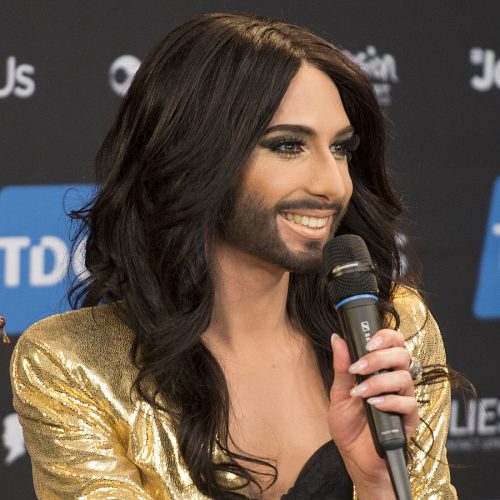
Conchita Wurst, the drag stage persona of singer Tom Neuwirth, was internally selected to represent Austria at Eurovision 2014. Her power ballad “Rise Like a Phoenix” was a dramatic orchestral pop song, reminiscent of a James Bond theme. It was composed by an international team including Charlie Mason, Joey Patulka, Alexander “Ali” Zuckowski and Julian Maas. In Copenhagen, Conchita delivered a show-stopping performance with powerful vocals and theatrical flair. The entry captivated Europe and won the contest, earning Austria 1st place with 290 points in the Grand Final. This was the country’s first Eurovision victory since 1966.

2015 – The Makemakes “I Am Yours”

The Makemakes were an Austrian pop-rock band. They won the national final “Wer singt für Österreich?” 2015 to become the host country’s Eurovision act in Vienna. Their entry “I Am Yours” was a soulful, piano-driven ballad co-written by the band members together with American songwriter-producer Jimmy Harry. Despite a visually striking staging (including a burning fake piano mid-song), Austria’s home entry failed to win over voters. The Makemakes finished 26th (last) in the 2015 Grand Final with 0 points. This was marking the first time a host nation ever scored “nul points” at Eurovision.

2016 – Zoë “Loin d’ici”

Zoë Straub, performing simply as Zoë, represented Austria in 2016 with “Loin d’ici,” a rare French-language song for the country. The track is an upbeat, whimsical electropop tune co-written by Zoë and her father Christof Straub. She earned her Eurovision spot by winning Austria’s national selection (“Wer singt für Österreich? 2016”) in a televised final. Zoë won out of five finalists. At the contest in Stockholm, Zoë charmed the audience and qualified for the Grand Final, where she placed 13th with 151 points.

2017 – Nathan Trent “Running on Air”

Nathan Trent, an emerging singer-songwriter, was internally selected by ORF to compete for Austria at Eurovision 2017. His entry “Running on Air” was an upbeat pop song with an optimistic message. The song was written by Nathan himself along with co-writer Bernhard Penzias. Trent’s performance in the second semi-final earned Austria a spot in the Grand Final. In the final held in Kyiv, he finished in 16th place with a total of 93 points.

2018 – Cesár Sampson “Nobody But You”

Cesár Sampson is a seasoned vocalist and played a key role in Bulgaria’s successful Eurovision entries in 2016 and 2017. In 2018, ORF internally chose him to represent Austria. His song “Nobody But You” blends gospel and soul influences with contemporary pop. Sampson co-wrote the track with the Symphonix International team: Borislav Milanov, Sebastian Arman, Joacim Persson and Johan Alkenäs. On the Lisbon stage, Sampson delivered a confident and controlled performance. As a result, he achieved one of Austria’s strongest results of the decade. He finished third in the Eurovision Song Contest 2018 final with 342 points and even topped the jury vote.

Related news

Eurovision 2026

Road to Vienna: Luxembourg

Road to Vienna: Luxembourg We cannot wait for the Eurovision Song Contest in Vienna Therefore, we take a closer look at one of the contestants each day. Today, we highlight Luxembourg. Eva Marija: Luxembourg’s Voice for Eurovision 2026 Eva Marija Kavaš Puc, born on December 24, 2005, in Luxembourg, grew up in a multicultural Slovenian family. Inspired by Eurovision at a young age, she began learning violin early and later studied at the Conservatoire de Luxembourg. Her training in violin, vocals, piano, and bass shaped her versatile style, blending classical, jazz, and contemporary pop. From Young Performer to Songwriter By her early teens, Eva Marija was already performing live and writing her own songs. Her music focuses on emotional storytelling, authenticity, and personal reflection. She later moved to London to study songwriting, expanding her artistic vision and international influences. Music Releases and Artistic Growth Eva Marija debuted with “When 2 Lovers Meet” (2021), followed by “Toxic Trait” (2023) and later singles like “TIME TO GO” and “Sweet Child” (2025). Her sound evolved into a more mature, introspective pop style, earning her recognition in Luxembourg’s music scene. A Promising Future in Music Representing a new generation of artists, Eva Marija combines strong musical training with authentic songwriting. As she prepares for Eurovision, her steady growth and artistic focus position her as one of Luxembourg’s most promising emerging talents. Mother Nature:  A Journey of Growth and Self-Discovery “Mother Nature” by Eva Marija explores personal growth and the path toward self-discovery. The song reflects how life evolves from simplicity into complexity, showing how challenges help shape identity and emotional maturity. Nature as a Symbol of Healing Nature is at the heart of the song’s meaning. It serves as a metaphor for renewal, balance, and inner strength. Just like the natural world, emotional healing is portrayed as a gradual and instinctive process. Letting Go and Finding Balance A central theme is learning to let go of doubt and emotional burdens. The song highlights acceptance, self-trust, and the importance of reconnecting with oneself to find inner balance. An Uplifting and Hopeful Message With its calm and introspective tone, “Mother Nature” delivers a positive message of renewal and self-acceptance. Eva Marija encourages listeners to embrace change and find strength through both vulnerability and connection to nature. Luxembourg in the Eurovision Song Contest Luxembourg has a storied history in the Eurovision Song Contest, participating 38 times since its debut in 1956. The country has won the contest five times: in 1961 (Jean-Claude Pascal‘s “Nous les amoureux”), 1965 (France Gall‘s “Poupée de cire, poupée de son”), 1972 (Vicky Leandros‘ “Après toi”), 1973 (Anne-Marie David‘s “Tu te reconnaîtras”, and 1983 (Corinne Hermès‘ “Si la vie est cadeau”). After a 31-year hiatus, Luxembourg returned to the contest in 2024.​ The Bookmakers Currently sitting 18th with the bookmakers, Luxembourg looks set for another Eurovision final — but could it climb even higher?

Read More »
Eurovision 2026
Anja Kroeze

Road to Vienna: Luxembourg

Road to Vienna: Luxembourg We cannot wait for the Eurovision Song Contest in Vienna Therefore, we take a closer look at one of the contestants each day. Today, we highlight Luxembourg. Eva Marija: Luxembourg’s Voice for Eurovision 2026 Eva Marija Kavaš Puc, born on December 24, 2005, in Luxembourg, grew up in a multicultural Slovenian family. Inspired by Eurovision at a young age, she began learning violin early and later studied at the Conservatoire de Luxembourg. Her training in violin, vocals, piano, and bass shaped her versatile style, blending classical, jazz, and contemporary pop. From Young Performer to Songwriter By her early teens, Eva Marija was already performing live and writing her own songs. Her music focuses on emotional storytelling, authenticity, and personal reflection. She later moved to London to study songwriting, expanding her artistic vision and international influences. Music Releases and Artistic Growth Eva Marija debuted with “When 2 Lovers Meet” (2021), followed by “Toxic Trait” (2023) and later singles like “TIME TO GO” and “Sweet Child” (2025). Her sound evolved into a more mature, introspective pop style, earning her recognition in Luxembourg’s music scene. A Promising Future in Music Representing a new generation of artists, Eva Marija combines strong musical training with authentic songwriting. As she prepares for Eurovision, her steady growth and artistic focus position her as one of Luxembourg’s most promising emerging talents. Mother Nature:  A Journey of Growth and Self-Discovery “Mother Nature” by Eva Marija explores personal growth and the path toward self-discovery. The song reflects how life evolves from simplicity into complexity, showing how challenges help shape identity and emotional maturity. Nature as a Symbol of Healing Nature is at the heart of the song’s meaning. It serves as a metaphor for renewal, balance, and inner strength. Just like the natural world, emotional healing is portrayed as a gradual and instinctive process. Letting Go and Finding Balance A central theme is learning to let go of doubt and emotional burdens. The song highlights acceptance, self-trust, and the importance of reconnecting with oneself to find inner balance. An Uplifting and Hopeful Message With its calm and introspective tone, “Mother Nature” delivers a positive message of renewal and self-acceptance. Eva Marija encourages listeners to embrace change and find strength through both vulnerability and connection to nature. Luxembourg in the Eurovision Song Contest Luxembourg has a storied history in the Eurovision Song Contest, participating 38 times since its debut in 1956. The country has won the contest five times: in 1961 (Jean-Claude Pascal‘s “Nous les amoureux”), 1965 (France Gall‘s “Poupée de cire, poupée de son”), 1972 (Vicky Leandros‘ “Après toi”), 1973 (Anne-Marie David‘s “Tu te reconnaîtras”, and 1983 (Corinne Hermès‘ “Si la vie est cadeau”). After a 31-year hiatus, Luxembourg returned to the contest in 2024.​ The Bookmakers Currently sitting 18th with the bookmakers, Luxembourg looks set for another Eurovision final — but could it climb even higher?

Read More »
Follow Us: