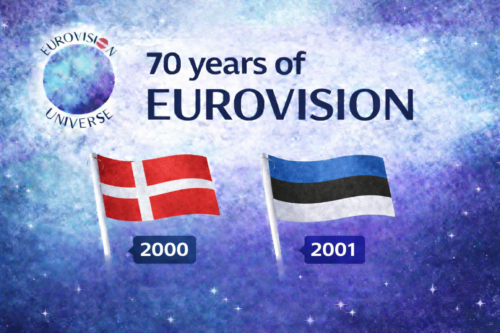
70 years of Eurovision: middle-aged men

The Eurovision Song Contest is celebrating its 70th anniversary. That is a wonderful milestone. We at Eurovision Universe love diving into the history of the contest. That is why we are taking a closer look at the contests of the past 70 years.

2000

And so the Eurovision Song Contest entered the 21st century. Russia returned after a break, and Latvia made its debut. The contest was held at the Globen Arena in Stockholm. The presentation was handled by Kattis Ahlström and Anders Lundin.

The songs

Alexandros Panayi participated for Cyprus for the second time, this time as the male half of the duo Voice. Serafin Zubiri returned for Spain. Roger Pontare also participated for Spain for the second time.

Israel had a remarkable entry. The members of the group PingPong sang incredibly off-key. But that was not what caused a shitstorm. At the end of the song, the group members waved Israeli and Syrian (!!) flags. The Dutch Linda Wagenmakers wore an enormous dress, under which four dancers turned out to be sitting. The Netherlands had to cut short the broadcast halfway through. A fireworks factory had exploded in that country, wiping out an entire residential area.

With a cowboy hat and moss-green clothing, the Estonian Ines was the favorite. Her “Once in a lifetime” ultimately took fourth place for Estonia. For Russia, Alsou took the lead with the song “Solo”. A pop song that fit perfectly into its time and consequently secured second place. The German Stefan Raab mocked the abolition of the language rule in the song “Wadde hadde dudde da”. Raab himself was dressed in a white and gold glitter suit, while his dancers partially undressed. All in all, it was a show that captivated the viewer from start to finish.

Latvia made a debut that was immediately remarkable. The group Brainstorm sang “My Star”, a song that fit perfectly into the tradition of 90s Britpop. The group led by singer Renārs Kaupers effortlessly secured third place.

The Olsen Brothers

The winners were two anti-heroes. Two Danish brothers in their fifties took first place. Jørgen and Nils Olsen had been a duo since the 1960s. In 1978, they participated in Melodi Grand Prix, the Danish national final, for the first time. Many times they made attempts, either together or Jørgen alone. It never worked out. And then, in 2000, when no one expected it anymore, “Smuk som et stjerneskud,” in English “Fly On The Wings Of Love,” won the ticket to the Eurovision Song Contest. In all the polls and odds, the two brothers played no role whatsoever. And yet they won, to the delight of many.

The Olsen Brothers continued making music for a long time. Until Nils became seriously ill. He has since recovered, but the two never took to the stage again.

2001

The Parken Stadium in Copenhagen was perhaps the largest venue for a Eurovision Song Contest ever. Natasja Crone-Back and Søren Pilmark presented the festival from there. Greece returned after a short break. A total of 23 countries participated.

The songs

None of the artists had participated before. Michelle from the Netherlands was notable. She sat on the floor and argued with the director. She felt they were asking impossible things of her. While an intimate and small song was presented during the Dutch national final, Michelle completely faded into the background on the large stage at Parken.

Then there was the duo Friends from Sweden. Their song “Listen To Your Heartbeat” bore a striking resemblance to the Belgian entry from 1996, “Liefde is een kaartspel” (Love is a card game). For a long time, disqualification loomed. Ultimately, it did not come to that, but in 2003, the Belgian music association SABAM determined that it was indeed plagiarism. Although the composers vehemently denied it, it ended in a settlement.

Once again, a Canadian singer was one of the favorites: Natasha St-Pier represented France with “Je n’ai que mon âme” (I don’t have but my soul). She ultimately finished fourth. Expectations for the Slovenian Nuša Derenda were also high. She ultimately finished seventh. Confusion abounded: in addition to the Dutch Michelle, Germany also sent a singer named Michelle. Because this lady had a longer career, it was felt that the Dutch Michelle should simply call herself Antje, a typically Dutch name. A salient detail: The Dutch Michelle was actually named that. The German Michelle was actually named Tanja.

And then there was the duo Antique from Greece. That is to say: they actually lived in Sweden and had had hits there as well. But with “Die For You,” they were favorites for their homeland, Greece. They had to share that role with the Danes. Rollo & King already had a major hit to their name in their own country and now sang “Never Ever Let You Go” to a second place finish.

Tanel Padar & Dave Benton

Quite surprisingly, the duo Tanel Padar and Dave Benton won for Estonia. Padar had previously sung in the backing choir for Estonia. Benton was from Aruba, but had also lived and worked in the Dutch city of Rotterdam for some time. Traveling in pursuit of love, he ended up in Estonia. The lyrics “Not even time can take away the starlight from us, no it wont fade” suited Dave Benton very well, who was 50 years old by then. But one might wonder why the 20-year-old Padar sang along. Incidentally, in recent years we have already been able to admire Sissi, Dave Benton’s daughter, several times in the Estonian national final.


Related news

Eurovision 2026

Road to Vienna: Serbia

Road to Vienna: Serbia As the Eurovision Song Contest 2026 in Vienna approaches, we continue our daily spotlight on this year’s contestants. Today, we focus on Serbia   Lavina: Serbia’s Metal Force Heading to Eurovision 2026 Lavina is a six-member metal band from Niš, Serbia, formed in 2020. The lineup includes vocalist Luka Aranđelović, guitarists Pavle Samardžić and Andrija Cvetanović, bassist Nikola Petrović, keyboardist Pavle Aranđelović, and drummer Bojan Ilić. Known for blending heavy riffs with melodic and emotional elements, Lavina has quickly become one of Serbia’s most talked-about modern metal acts. Early Years and Formation From the beginning, Lavina focused on crafting a distinct sound rather than rushing into the spotlight. Their music combines progressive metal influences with accessible songwriting and modern production. This careful approach helped the band establish a strong identity within the Serbian music scene. Breakthrough with Odyssey In November 2022, Lavina released their debut album Odyssey. The record introduced their powerful and emotional style to a wider audience and marked a major milestone in their career. Early tracks like “Id” further showcased their musical direction and helped expand their reach beyond Niš. Growing Reputation Through Live Performances Between 2023 and 2024, Lavina built a solid reputation as a live act by touring across Europe. They performed in countries including Croatia, Romania, Bulgaria, Greece, Hungary, and Poland. These shows played a key role in growing their international fanbase and establishing their presence beyond the local scene. New Music and Evolution Lavina continued evolving with new releases such as “In Your Absence” (2024), “IRON WILL” (2024), and “this, too, will pass.” (2025). These tracks highlight the band’s artistic growth, combining heavy soundscapes with deeper emotional and atmospheric elements. Eurovision 2026 Breakthrough In 2026, Lavina won Serbia’s national selection, Pesma za Evroviziju, with the song “Kraj mene.” Performing in Serbian added authenticity and emotional depth to their entry. With this victory, Lavina will represent Serbia at the Eurovision Song Contest 2026 in Vienna, marking a historic moment as one of the country’s first metal acts on the Eurovision stage. Kraj Mene: A Powerful Song About Unrequited Love Kraj Mene (“Next to Me”) is an emotional track about unrequited love. The song explores feelings of longing, heartbreak, and vulnerability, making it highly relatable for listeners who have experienced one-sided love. The Tension Between Love and Reality At its core, the song highlights the struggle between desire and reality. The narrator seeks closeness but faces emotional distance and rejection. This contrast creates a powerful narrative that resonates with anyone who has loved without equal return. Minimalist Sound, Maximum Impact The music enhances the emotional depth of the track. With soft instrumentals and a minimalist arrangement, the focus remains on the vocals. This allows every emotion—hope, pain, and sadness—to stand out clearly, drawing listeners deeper into the story. A Message of Self-Awareness and Strength Beyond heartbreak, “Kraj Mene” also reflects self-awareness and resilience. The narrator recognizes the one-sided nature of their love and begins to accept it. This adds emotional depth and transforms the song into a story about personal growth. Serbia in the Eurovision Song Contest Serbia has participated in the Eurovision Song Contest 16 times since its debut as an independent nation in 2007. The country achieved its best result in its debut year, winning the contest with Marija Šerifović‘s “Molitva.” Serbia continues to showcase a diverse range of musical talents on the Eurovision stage.​    The bookmakers Serbia is currently sitting in 24th place; it’s getting tense. Will they fall short in the semi-final again, just like last year, or can they pull in enough points to make it to the final?

Read More »
History
Martijn

70 years of Eurovision: middle-aged men

The Eurovision Song Contest is celebrating its 70th anniversary. That is a wonderful milestone. We at Eurovision Universe love diving into the history of the contest. That is why we are taking a closer look at the contests of the past 70 years. 2000 And so the Eurovision Song Contest entered the 21st century. Russia returned after a break, and Latvia made its debut. The contest was held at the Globen Arena in Stockholm. The presentation was handled by Kattis Ahlström and Anders Lundin. The songs Alexandros Panayi participated for Cyprus for the second time, this time as the male half of the duo Voice. Serafin Zubiri returned for Spain. Roger Pontare also participated for Spain for the second time. Israel had a remarkable entry. The members of the group PingPong sang incredibly off-key. But that was not what caused a shitstorm. At the end of the song, the group members waved Israeli and Syrian (!!) flags. The Dutch Linda Wagenmakers wore an enormous dress, under which four dancers turned out to be sitting. The Netherlands had to cut short the broadcast halfway through. A fireworks factory had exploded in that country, wiping out an entire residential area. With a cowboy hat and moss-green clothing, the Estonian Ines was the favorite. Her “Once in a lifetime” ultimately took fourth place for Estonia. For Russia, Alsou took the lead with the song “Solo”. A pop song that fit perfectly into its time and consequently secured second place. The German Stefan Raab mocked the abolition of the language rule in the song “Wadde hadde dudde da”. Raab himself was dressed in a white and gold glitter suit, while his dancers partially undressed. All in all, it was a show that captivated the viewer from start to finish. Latvia made a debut that was immediately remarkable. The group Brainstorm sang “My Star”, a song that fit perfectly into the tradition of 90s Britpop. The group led by singer Renārs Kaupers effortlessly secured third place. The Olsen Brothers The winners were two anti-heroes. Two Danish brothers in their fifties took first place. Jørgen and Nils Olsen had been a duo since the 1960s. In 1978, they participated in Melodi Grand Prix, the Danish national final, for the first time. Many times they made attempts, either together or Jørgen alone. It never worked out. And then, in 2000, when no one expected it anymore, “Smuk som et stjerneskud,” in English “Fly On The Wings Of Love,” won the ticket to the Eurovision Song Contest. In all the polls and odds, the two brothers played no role whatsoever. And yet they won, to the delight of many. The Olsen Brothers continued making music for a long time. Until Nils became seriously ill. He has since recovered, but the two never took to the stage again. 2001 The Parken Stadium in Copenhagen was perhaps the largest venue for a Eurovision Song Contest ever. Natasja Crone-Back and Søren Pilmark presented the festival from there. Greece returned after a short break. A total of 23 countries participated. The songs None of the artists had participated before. Michelle from the Netherlands was notable. She sat on the floor and argued with the director. She felt they were asking impossible things of her. While an intimate and small song was presented during the Dutch national final, Michelle completely faded into the background on the large stage at Parken. Then there was the duo Friends from Sweden. Their song “Listen To Your Heartbeat” bore a striking resemblance to the Belgian entry from 1996, “Liefde is een kaartspel” (Love is a card game). For a long time, disqualification loomed. Ultimately, it did not come to that, but in 2003, the Belgian music association SABAM determined that it was indeed plagiarism. Although the composers vehemently denied it, it ended in a settlement. Once again, a Canadian singer was one of the favorites: Natasha St-Pier represented France with “Je n’ai que mon âme” (I don’t have but my soul). She ultimately finished fourth. Expectations for the Slovenian Nuša Derenda were also high. She ultimately finished seventh. Confusion abounded: in addition to the Dutch Michelle, Germany also sent a singer named Michelle. Because this lady had a longer career, it was felt that the Dutch Michelle should simply call herself Antje, a typically Dutch name. A salient detail: The Dutch Michelle was actually named that. The German Michelle was actually named Tanja. And then there was the duo Antique from Greece. That is to say: they actually lived in Sweden and had had hits there as well. But with “Die For You,” they were favorites for their homeland, Greece. They had to share that role with the Danes. Rollo & King already had a major hit to their name in their own country and now sang “Never Ever Let You Go” to a second place finish. Tanel Padar & Dave Benton Quite surprisingly, the duo Tanel Padar and Dave Benton won for Estonia. Padar had previously sung in the backing choir for Estonia. Benton was from Aruba, but had also lived and worked in the Dutch city of Rotterdam for some time. Traveling in pursuit of love, he ended up in Estonia. The lyrics “Not even time can take away the starlight from us, no it wont fade” suited Dave Benton very well, who was 50 years old by then. But one might wonder why the 20-year-old Padar sang along. Incidentally, in recent years we have already been able to admire Sissi, Dave Benton’s daughter, several times in the Estonian national final.

Read More »
Follow Us: