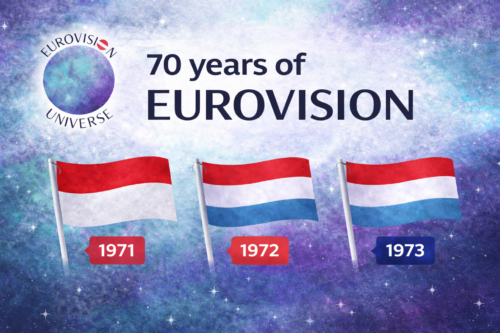
70 years of Eurovision: holding up signs

The Eurovision Song Contest is celebrating its 70th anniversary. That is a wonderful milestone. We at Eurovision Universe love diving into the history of the contest. That is why we are taking a closer look at the contests of the past 70 years.

1971

Sweden, Finland, Norway, Austria, and Portugal returned. Malta made its debut. Enthused by the 1970 festival, everyone dared to give it another try. The scoring system changed drastically. Each country had two jurors; one over 25 and one under. They indicated their votes by holding up signs live on television. It all took place in Dublin, where everything was held at the Gaiety Theatre. That is not entirely true: all sorts of things happened just outside the theatre. Almost every protest group to be found in Ireland was standing there. From Irish feminists and people opposed to hunting and Irish people against color television, to an action group promoting the Irish language. They didn’t like the Eurovision Song Contest. “Very low level pop music,” one of the protesters called it when asked.

The Belgian duo Nicole and Hugo were very unlucky. Although they had won the national final, the two could not travel to Dublin because Nicole contracted jaundice. They were replaced by Jacques Raymond and Lily Castel. This duo had to practice the dance steps in their hotel room. For Austria, Marianne Mendt sang in a Viennese dialect. The 15-year-old Norwegian Hanne Krogh sang her song with a small parasol. We would see her again more often in the future. And then there was Clodagh Rodgers for the United Kingdom. It wasn’t fun for her in Dublin. As a Catholic Northern Irish lady, she received many threats, including death threats. Fortunately, there is also a cheerful note about her: she and her song “Jack in the Box” starred in an episode of ‘Monty Python’s Flying Circus’.

Séverine

It was Monaco that walked away with the trophy. The French singer Séverine represented the principality. By doing so, she comfortably beat the Spanish Karina and the German Katja Ebstein. “Un banc, un arbre, une rue” was her song. The song became a huge hit, even reaching number 1 in Belgium. She also finished in the top 3 in Ireland and Norway. Séverine later participated in national finals in Germany twice more but did not win them.

1972

The same countries as in 1971 participated. The jury was now strictly guarded and was not allowed to leave Edinburgh Castle, where they awarded the points. The festival itself took place in the Usher Hall. Surprisingly, not Cathy Boyle, but Moira Shearer was the presenter.

Vicky Leandros returned for Luxembourg. The Family Four represented Sweden for the second time. Tereza, who once participated for Monaco, now sang for her native country, Yugoslavia. We do not want to leave Ireland unmentioned: for the first and only time, the country sang in its regional language, Gaelic. Sandra and Andres participated for the Netherlands. They also came up with something new: they got the audience happily clapping along to their song. The duo ultimately finished fourth. The two were overtaken by Mary Roos, who participated on behalf of Germany and mainly complained that she was staying in such a cold hotel. The New Seekers were the favorites. Their song “Beg, Steal or Borrow” became an international hit. The duo representing Malta, Helen & Joseph, were promised a statue on the island if they won. Spoiler: the statue never materialized, as the two finished last.

Vicky Leandros

Vicky Leandros won by a considerable margin. “Après Toi” was the undisputed winner of the festival. Yves Dessca wrote the lyrics, and the composers were Klaus Munro and Mario Panas. The latter was actually secretly Leo Leandros, Vicky’s father, under a pseudonym. The story goes that Vicky had first offered the songs from her album to Germany, but the German broadcaster politely declined. She then translated all the songs into French and asked Luxembourg if they were interested. The rest is history.

1973

Austria and Malta dropped out. However, there were still 17 countries because Israel made its debut. This did mean, however, that the Nouveau Théâtre Municipal in Luxembourg was very heavily guarded. In this impregnable fortress, Helga Guitton hosted the 1973 Eurovision Song Contest.

Nicole and Hugo were allowed to participate for Belgium this time. In bright purple suits, they finished last with their “Baby Baby.” They did, however, achieve immortal status with it, as the two appear in just about every compilation of Eurovision songs. The Finnish Marion Rung made a comeback, improving her own record for Finland (from seventh to sixth place). Massimo Ranieri also participated for Italy for a second time. And yes, Cliff Richard was back too. With “Power To All Our Friends,” he was once again the favorite, yet once again he failed to win. The Spanish group Mocedades also failed to do so, securing second place and a worldwide hit with their “Eres Tu.”

We also do not want to leave The Nova from Sweden unmentioned. In their home country, they had defeated Abba in the national selection. At the time, the duo was still called The Malta. To avoid confusion with the country, they changed their name. The lyrics were striking, to say the least: “Oh your breasts are like swallows a nestling,” the duo sang enthusiastic. But anyway, Nicole and Hugo sang in their song “Een vrouw kan niets alleen” (A woman can do nothing alone). 1973 was not a very woman-friendly year.

Anne-Marie David

It was, however, the year of a girl from the Camargue who loved horses: Anne-Marie David. She participated for host country Luxembourg and she won with “Tu te reconnaîtras”. Although the entire team was French, there was still a real Luxembourgish touch to it: conductor Pierre Caó was a true Luxemburger. But whether the Luxembourg broadcaster was happy that the country won again is doubtful.

Anne-Marie David would return to the Eurovision Song Contest six years later and still enjoys performing at Eurovision-related parties.


Related news

Eurovision 2026

Road to Vienna: Sweden

Road to Vienna: Sweden.  We cannot wait for the Eurovision Song Contest inVienna. Therefore, we take a closer look at one of the contestants each day. Today, we highlight Sweden.  Felicia Eriksson: From Fröken Snusk to Eurovision. Felicia Eriksson first gained attention as the voice behind Fröken Snusk. The act became a viral Swedish music phenomenon. It was known for cheeky lyrics, party anthems, and a signature face mask. She performed in a pink balaclava. The mask became a key part of her identity and branding. It also added mystery to the project created by producer Rasmus Gozzi. Her 2022 hit “Rid mig som en dalahäst” became one of the most-streamed songs in Sweden. By 2023, she ranked among the top Spotify artists in the country. She also performed more than 300 live shows across the Nordic region. In 2024, she entered Melodifestivalen with “Unga & fria.” The song reached #1 on the Swedish charts after the show. That same year, she won Sweden’s Masked Singer. This confirmed her mainstream breakthrough. Solo Career and New Identity In 2025, Felicia Eriksson left the Fröken Snusk persona. She launched her solo career under her own name. However, she kept the face mask as part of her identity. It also helps her manage social anxiety on stage. She introduced a more authentic image and a modern pop sound. Her debut single “Black Widow” reached #3 on Spotify Sweden. She followed this with tracks like “Sugar High” and “Hard.” She also won the Swedish reality show Spelet. This increased her popularity and media exposure. Melodifestivalen 2026 and Eurovision In 2026, Felicia Eriksson returned to Melodifestivalen as herself. She competed with the electro-pop song “My System.” She won the competition with a total of 161 points. This secured her place at Eurovision 2026 for Sweden. My System My System explores the struggle of letting go of a toxic relationship. It focuses on the feeling of being emotionally and physically attached to someone, even when you know the connection is unhealthy. The narrator tries to appear strong and in control, convincing themselves they have moved on—but the feelings never fully fade. A Cycle of Relapse and Dependency As the story unfolds, old emotions return during vulnerable moments, like nights out or weekends. This creates a repeating cycle. The narrator feels independent at times, but keeps falling back into the same patterns. The connection feels like an addiction that is hard to break. Regret and Growing Awareness After giving in, the narrator is left with regret and frustration. There is a clear sense of self-awareness. They begin to understand that the situation is unhealthy and needs to change. This adds emotional depth and realism to the song. The Core Message The song’s message is simple but powerful. You cannot erase deep feelings overnight. Letting go takes time, effort, and honesty with yourself. It shows that moving on is not just a decision, but a process. Sweden in the Eurovision Song Contest Sweden has a storied history in the Eurovision Song Contest, having participated since 1958. The country boasts seven victories: ABBA‘s “Waterloo” (1974), Herreys‘ “Diggi-Loo Diggi-Ley” (1984), Carola‘s “Fångad av en stormvind” (1991), Charlotte Nilsson‘s “Take Me to Your Heaven” (1999), Loreen‘s “Euphoria” (2012), Måns Zelmerlöw’s “Heroes” (2015), and Loreen’s “Tattoo” (2023). Known for its strong pop music tradition and high-quality entries, Sweden consistently ranks among the top contenders in the competition. The bookmakers It looks like Sweden is set to deliver once again this year. Currently sitting in 6th place with the bookmakers, the country appears well on track for another strong Eurovision result—and a solid Top 10 finish seems well within reach.            

Read More »
History
Martijn

70 years of Eurovision: holding up signs

The Eurovision Song Contest is celebrating its 70th anniversary. That is a wonderful milestone. We at Eurovision Universe love diving into the history of the contest. That is why we are taking a closer look at the contests of the past 70 years. 1971 Sweden, Finland, Norway, Austria, and Portugal returned. Malta made its debut. Enthused by the 1970 festival, everyone dared to give it another try. The scoring system changed drastically. Each country had two jurors; one over 25 and one under. They indicated their votes by holding up signs live on television. It all took place in Dublin, where everything was held at the Gaiety Theatre. That is not entirely true: all sorts of things happened just outside the theatre. Almost every protest group to be found in Ireland was standing there. From Irish feminists and people opposed to hunting and Irish people against color television, to an action group promoting the Irish language. They didn’t like the Eurovision Song Contest. “Very low level pop music,” one of the protesters called it when asked. The Belgian duo Nicole and Hugo were very unlucky. Although they had won the national final, the two could not travel to Dublin because Nicole contracted jaundice. They were replaced by Jacques Raymond and Lily Castel. This duo had to practice the dance steps in their hotel room. For Austria, Marianne Mendt sang in a Viennese dialect. The 15-year-old Norwegian Hanne Krogh sang her song with a small parasol. We would see her again more often in the future. And then there was Clodagh Rodgers for the United Kingdom. It wasn’t fun for her in Dublin. As a Catholic Northern Irish lady, she received many threats, including death threats. Fortunately, there is also a cheerful note about her: she and her song “Jack in the Box” starred in an episode of ‘Monty Python’s Flying Circus’. Séverine It was Monaco that walked away with the trophy. The French singer Séverine represented the principality. By doing so, she comfortably beat the Spanish Karina and the German Katja Ebstein. “Un banc, un arbre, une rue” was her song. The song became a huge hit, even reaching number 1 in Belgium. She also finished in the top 3 in Ireland and Norway. Séverine later participated in national finals in Germany twice more but did not win them. 1972 The same countries as in 1971 participated. The jury was now strictly guarded and was not allowed to leave Edinburgh Castle, where they awarded the points. The festival itself took place in the Usher Hall. Surprisingly, not Cathy Boyle, but Moira Shearer was the presenter. Vicky Leandros returned for Luxembourg. The Family Four represented Sweden for the second time. Tereza, who once participated for Monaco, now sang for her native country, Yugoslavia. We do not want to leave Ireland unmentioned: for the first and only time, the country sang in its regional language, Gaelic. Sandra and Andres participated for the Netherlands. They also came up with something new: they got the audience happily clapping along to their song. The duo ultimately finished fourth. The two were overtaken by Mary Roos, who participated on behalf of Germany and mainly complained that she was staying in such a cold hotel. The New Seekers were the favorites. Their song “Beg, Steal or Borrow” became an international hit. The duo representing Malta, Helen & Joseph, were promised a statue on the island if they won. Spoiler: the statue never materialized, as the two finished last. Vicky Leandros Vicky Leandros won by a considerable margin. “Après Toi” was the undisputed winner of the festival. Yves Dessca wrote the lyrics, and the composers were Klaus Munro and Mario Panas. The latter was actually secretly Leo Leandros, Vicky’s father, under a pseudonym. The story goes that Vicky had first offered the songs from her album to Germany, but the German broadcaster politely declined. She then translated all the songs into French and asked Luxembourg if they were interested. The rest is history. 1973 Austria and Malta dropped out. However, there were still 17 countries because Israel made its debut. This did mean, however, that the Nouveau Théâtre Municipal in Luxembourg was very heavily guarded. In this impregnable fortress, Helga Guitton hosted the 1973 Eurovision Song Contest. Nicole and Hugo were allowed to participate for Belgium this time. In bright purple suits, they finished last with their “Baby Baby.” They did, however, achieve immortal status with it, as the two appear in just about every compilation of Eurovision songs. The Finnish Marion Rung made a comeback, improving her own record for Finland (from seventh to sixth place). Massimo Ranieri also participated for Italy for a second time. And yes, Cliff Richard was back too. With “Power To All Our Friends,” he was once again the favorite, yet once again he failed to win. The Spanish group Mocedades also failed to do so, securing second place and a worldwide hit with their “Eres Tu.” We also do not want to leave The Nova from Sweden unmentioned. In their home country, they had defeated Abba in the national selection. At the time, the duo was still called The Malta. To avoid confusion with the country, they changed their name. The lyrics were striking, to say the least: “Oh your breasts are like swallows a nestling,” the duo sang enthusiastic. But anyway, Nicole and Hugo sang in their song “Een vrouw kan niets alleen” (A woman can do nothing alone). 1973 was not a very woman-friendly year. Anne-Marie David It was, however, the year of a girl from the Camargue who loved horses: Anne-Marie David. She participated for host country Luxembourg and she won with “Tu te reconnaîtras”. Although the entire team was French, there was still a real Luxembourgish touch to it: conductor Pierre Caó was a true Luxemburger. But whether the Luxembourg broadcaster was happy that the country won again is doubtful. Anne-Marie David would return to the Eurovision Song Contest six years later and still enjoys performing

Read More »
Follow Us: