photo: EBU/Sarah Louise Bennett
The hosts Petra Mede and Malin Åkerman open the show with their own version of “Tattoo.”
Malta
In the Maltese act by Sarah Bonnici, there is a lot of movement and dancing. Later during the act, she is blindfolded, as are her dancers. Despite so much movement, Sarah manages to sing remarkably well.
Albania
Besa wears a turquoise gown with gemstones. The stage also includes several dancers, which might make it look a bit messy. However, many dancers are projected onto LED screens. Besa’s voice sounds a bit sharp here and there.
Greece
First, we see her purple boots, then the whole Marina Satti. She is also flanked by four dancers, but it looks much more organized. Greece has chosen a sophisticated entry not meant for casual listeners. A lot happens during this entry. Marina continues to sing well.
Switzerland
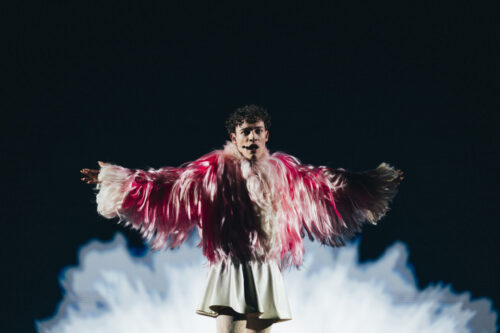
Nemo takes the viewer into his story with the song “The Code,” managing to crack the (binary) code. Their clothing says it all. Nemo has so far managed to enhance their narrative through fashion statements. Nemo jumps, skips, shows himself to be a balancing artist… and continues to sing crystal clear. We do not know if this is a winner, but we definitely respect their skills.
Czechia
You would expect Aiko to be standing on a pedestal during her performance. That’s not the case, but we find that the ceiling (one of the cubes) is very low. Aiko has four… Her nipples are no longer visible. Pay particular attention to the high note that Aiko effortlessly hits. Aiko surprises!
During the first semifinal, Nicole (from Hugo) received a tribute, and in this semifinal, Jahn Teigen (ESC 1978, 1982, 1983) is honored. We are treated to a journey through Eurovision history with several participants who did not finish very high.
France
Slimane, dressed in white, starts singing while lying down, then sits up. Everything is shot in close-up, which makes the song even more intimate. Slimane pulls out all the stops in terms of his singing ability. The song has its distinct fans, but others are completely on the opposite end of the spectrum.
Austria
It’s interesting to put someone on stage who has held various other roles at the contest. Singing is clearly not Kaleen’s strongest suit. Regardless of how enjoyable the song may be found, the singing is forgotten in Austria. However, the act looks absolutely tight, and Kaleen knows very well what she is doing in terms of dance.
Denmark
It seems like you only see a singer sprinkling some sand and singing her song. However, we also see a second Saba in the background… A hologram, as it turns out, because at one point she disintegrates into sand. Occasionally, Saba tends to sing too loud, which makes the whole thing seem a bit shouty.
Armenia
Cheerfulness all over, garnished with typical Armenian sounds. Singer Jaklin Baghdasarian of Ladaniva plays a leading role throughout the act. The other band members and backing band stand behind her, but at one point, the flutist also comes forward. We see all sorts of things in the background: trumpets, chickens, and the artists themselves.
Latvia
Looking at his Instagram account, he is very cheerful and humorous: the Latvian Dons. But seeing him standing there in his sleeveless leather outfit amid a circle, and hearing his very serious ballad, we notice little of that. There is nothing wrong with this song, but that might also be the problem.
Spain
Both the singer and the dancers are dressed in black. The singing isn’t fantastic, but Nebulossa certainly knows how to throw a party in the hall. And of course, halfway through the act, the dancers strip off their clothes and continue dancing with bare chests and buttocks. At the end, a keyhole appears behind the singer Mery. The Spaniards really throw a party.
San Marino
We stick with the Spanish language, as San Marino sends the Spanish group Megara. Singer Kenzy Loevett is briefly flanked by two dancers in scary Easter bunny suits. Everything is pink and black in this act. It’s all rock, and the group tries to match the scariness of Bambie Thug, but it remains rather tame for a horror show.
Georgia
Nutsa Buzaladze is dressed in gold and stands in a circle of fire, which at one moment looks like a sun, the next a burning hoop. Nutsa is flanked by four dancers, and gives her all in terms of singing, but that doesn’t necessarily mean it’s good. For Georgia, it’s definitely not a done deal.
Belgium
We had already seen photos of Mustii amid a circle of microphones, but he starts alone on stage. He then stands on a rotating platform. Later, he goes into this circle. Mustii is dressed in white. The singing we hear here is very cautious, with Mustii consciously staying below the high notes. He did not, as we previously reported, take his shirt off. But towards the end, we see the whole hall going wild with the Belgian entry!
Estonia
5miinust and Puuluup are having a party on stage. The title of the song is, as previously mentioned, the longest ever. Whether the party really come across with all the “hey hey hey” is still a question. Possibly a finalist position for Estonia, but that is by no means certain.
Italy
Angelina Mango starts lying down, with roses projected under her. She has a sort of henna-like print depicted. This print also continues with the dancers. There are so many prints all over. There are so many details that you occasionally don’t see Angelina and her dancers at all. The singing is fine where it concerns Angelina. She ends a cappella. That takes skilsl, and Angelina has them. Italy will finish high, but perhaps not win.
Israel
The Israeli entry is the only ballad in this latter stage of the second semifinal. Just before she starts singing, Eden Golan leans back in a circle with lights. Five dancers flank her, and of course, she is lifted in the middle of the song. The singing is good, including the high note. Israel got both bood and cheered; possibly SVT and EBU will filter the booing tomorrow.
Norway
Norwegian instruments, we see branches everywhere, and we see the Norwegian band Gåte. Nightwish meets Within Temptation during this entry. The whole has a Norwegian mystical character. The band seems to have come right out of the Norwegian mythology. Singer Gunnhild Sunli effortlessly hits all the high notes.
Netherlands
Joost starts while standing on a picture of his head, depicted on the floor. Next to him are two dancers, and on stage with him are his friends Appie Mussa (in a bird suit) and Stuntkabouter in a blue suit. The graphics correspond in part with the text. It’s a lot, we see many different graphics. Next to typical Dutch snacks, we also see the burning mill, silhouettes of the parents, and the word papa (daddy) pass by. During the 90s gabber music part, the stage turns red. During the emotional outro, the background is black, with subtitles. Then follows the text for his parents.
Tonights interval act contains various surprises. First, we see a singalong with Sertab Erener, Charlotte Perrelli, and Helena Paparizou. Then we see the two presenters singing the song “We just love Eurovision too much.” They do this with the aforementioned Sertab, Charlotte, and Helena, but also Käärijä and The Herreys take the stage.
After that follows the moment of announcement. We think the following countries will make it to the final: Greece, Switzerland, Austria, Denmark, Armenia, Georgia, Belgium, Israel, Norway, and the Netherlands.