🇺🇦 Blast from the past: Ukraine 2020

We know a lot about Eurovision and we want to share this knowledge with you! Therefore we’d like to bring you a blast from the past. Today: Go_A, who were supposed to represent Ukraine in the 2020 contest but did so a year later. We keep an eye on the, lesser known, 2020 entry.


Ukraine in the Eurovision Song Contest

Ukraine is one of the most succesful countries in the Eurovision Song Contest so far. With three victories since it’s debut in 2003, three more top-3 positions and not a single failure to qualify, this country holds a special record. Already in 2004, it was Ruslana who managed to get the first place in the contest. In 2016, Jamala brought the victory home again. It was in 2022 when Kalush Orchestra broke all the Eurovision records existing. And who does not remember Verka Serduchka, Ani Lorak, Svetlana Loboda and the group we are talking about today, Go_A?

photo: UA:PBS

Vidbir

The Ukrainian national final is called Vidbir. There had been a lot of controversy about Vidbir in 2019: the winner, Maruv, had performed on Crimea after it had been occupied by Russia in 2014. Also, Maruv had planned several performances in Russia. In the end, for this reason Ukraine withdrew. A new rule in the 2020 is that only artists who had not performed in Russia after 2014 were allowed. Also, artists who had traveled to Crimea after that year without permission from the Ukrainian authorities, were not accepted.

16 songs entered two semifinals. Six songs were allowed to the final, where televoters and a jury chose the winner. The jury members were Andriy Danilko (Verka Serduchka!), Tina Karol and producer Vitaliy Drozdov. These were the songs, entering the final:

  1. 99“, sung by Krutь, 9 pts, 3rd
  2. Vegan“, sung by Jerry Heil, 2 pts, 6th
  3. Solovey“, sung by Go_A, 12 pts, 1st
  4. Horizon“, sung by David Axelrod, 5 pts, 5th
  5. Call for love“, sung by Khayat, 9 pts, 2nd
  6. Bonfire“, sung by Tvorchi, 5 pts, 4th


Go_A

Go_A is a Ukrainian folktronica band formed in 2012.

The band’s name fuses the English term “Go” with the Greek letter “Alpha”, representing the start of all things. Thus, their name signifies a “return to origins.” The ensemble features Kateryna Pavlenko on vocals from Nizhyn, Taras Shevchenko [uk] handling keyboards and percussion from Kyiv, Ihor Didenchuk [uk] of Lutsk (who is also part of the rap group Kalush), and Ivan Hryhoriak from Bukovyna. Their songs are performed solely in Ukrainian.

Formed from a serendipitous 2012 meeting between Taras Shevchenko, a skilled keyboardist (unrelated to the renowned poet), and folk singer Kateryna Pavlenko, Go_A has swiftly become an emblem of contemporary Ukrainian music. Their initial offering, “Koliada” (Коляда), was soon overshadowed by the nationwide success of “Vesnianka” (Веснянка). This track ruled Ukraine’s 10Dance chart for six weeks and earned them the “Discovery of the Year” title by Kiss FM radio.

Their debut album, “Idy na zvuk” (Follow the Tune), launched in 2016, fortified their reputation, incorporating the hit “Vesnjanka”. A special Christmas collaboration with Katya Chilly, “Shchedryi vechir”, marked the end of the year.

Eurovision 2020 beckoned next. Chosen to represent Ukraine with “Solovey”, the pandemic’s shadow caused a cancellation. Undeterred, Go_A returned in 2021 with “Shum”, clinching fifth place overall, but a noteworthy second in public votes[9]. Adding to their laurels, band member Ihor Didenchuk, with rap group Kalush, triumphed in Eurovision the next year.

In 2023, post their European tour, Go_A graced Eurovision again, performing “Shum” alongside Ukrainian musical legends during the flag parade. They further joined Duncan Laurence’s emotive “You’ll Never Walk Alone”. From traditional roots to global acclaim, Go_A epitomizes the spirit of modern Ukraine, harmonizing history with today.
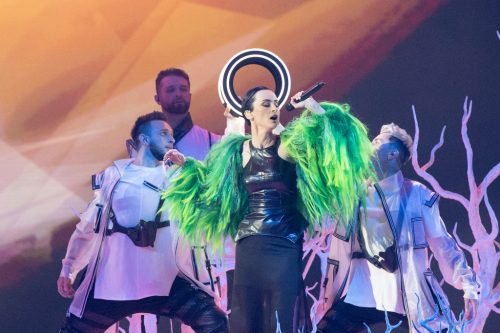
photo: EBU

Solovey

“Solovey” is the song by the Ukrainian band Go_A. Selected as Ukraine’s entry for the Eurovision Song Contest in 2020, the track became synonymous with Go_A’s unique fusion of electronic music with traditional Ukrainian sound. The title “Solovey” translates to “Nightingale” in English, and lyrically, the song tells the tale of a young woman’s complex feelings towards a man, using the metaphor of the nightingale’s song to express deep emotions.

Musically, “Solovey” incorporates the band’s signature blend of powerful vocal techniques, inspired by Ukrainian folklore, with contemporary beats and rhythms. Kateryna Pavlenko’s voice, with its distinctive timbre, rings out clear and strong, capturing the listener’s attention from the outset.

COVID19

Due to the COVID19 pandemic, EBU, host organizers NOS/NPO/AVROTROS and the city of Rotterdam had to decide to a cancellation of the contest. That also meant that Go_A could not represent Ukraine in the 2020 contest. On the evening of the Grand Final, 16 May 2020, a show from a studio in Hilversum, Netherlands, was broadcast: Europe Shine A Light. Go_A was part of this show. Ukrainian broadcaster UA:PBC however supported Go_A to be the 2021 representants in the contest. Their song “Shum” reached a 5th place in the Eurovision Song Contest.

Go_A at a home session during the pandemic.

Related news

Eurovision 2026

Vienna 12 points: from eighties music to progressive metal

Five more countries start their second rehearsals. As we still don’t have access to the rehearsals, we will do something else. Per entry, we highlight one subject and give you some more information. That can be something about the artist, the song, the lyrics or even something completely different.  Belgium – Essyla, “Dancing on the Ice” Running order: 11 | Rehearsal: 10:30–10:55 CEST During Belgium’s second rehearsal in Vienna, with ESSYLA carrying the flag in 2026, another Belgian Eurovision story returns to the spotlight. Forty years ago, Sandra Kim won the contest in Bergen with “J’aime la vie”, giving Belgium its first and so far only victory. Her triumph, however, has always carried an unusual footnote. In the song she sang that she was fifteen. At the time, the public was told she was fourteen. Later, Sandra Kim admitted she had actually been only thirteen when she stepped onto the Eurovision stage. The revelation made her the youngest winner in contest history, a record that can no longer be broken under today’s age rules. While ESSYLA rehearses for a new Belgian chapter, Kim’s story remains a reminder of Eurovision’s unpredictable past: a bright, youthful performance that became both a national celebration and a lasting controversy for fans across Europe and beyond, even today.  Lithuania – Lion Ceccah, “Sólo Quiero Más” Running order: 12 | Rehearsal: 11:05–11:30 CEST Six languages in the Lithuanian entry may sound like a Eurovision record, but the multilingual crown still belongs to Norway. In 1973, the Bendik Singers performed “It’s Just A Game” in Luxembourg and packed an extraordinary twelve languages into one playful pop song. English and French carried most of the lyrics, but the performance also included brief phrases in Spanish, Italian, Dutch, German, Irish, Serbo-Croatian, Hebrew, Finnish, Swedish and Norwegian. The result was more than a gimmick: the song’s jazzy vocal exchanges and theatrical delivery made it stand out in a year when Eurovision had just introduced the free-language rule. Norway finished seventh with 89 points, its best result for several years. Today, “It’s Just A Game” remains a fascinating reminder that Eurovision’s love of linguistic experiments is not new. Long before Lion Ceccah, Bendik Singers had already turned the contest into a multilingual playground and a lasting Eurovision curiosity.  San Marino – Senhit feat. Boy George, “Superstar” Running order: 13 | Rehearsal: 11:40–12:05 CEST ulture Club may be a household name for older pop fans, but many people watching Eurovision this year might not know the band, for a simple reason: they were not born yet when the group ruled the charts. Formed in London in 1981, Culture Club became one of the defining acts of the 1980s. With Boy George as their charismatic frontman, the band stood out with a colourful image and a sound that mixed pop, soul, reggae and new wave. Their breakthrough came with “Do You Really Want to Hurt Me”, followed by international hits such as “Karma Chameleon” and “Time (Clock of the Heart)”. Culture Club’s impact went beyond record sales. They helped shape the look and feel of 1980s pop and challenged expectations around fashion, identity and performance. For younger Eurovision viewers, this is a chance to discover an influential chapter in British pop history for themselves today.  Poland – Alicja, “Pray” Running order: 14 | Rehearsal: 12:20–12:45 CEST Hit Hit Hurra! was a Polish music talent show aimed at young performers, broadcast on TVP1. The format gave children and teenagers a national stage, combining competitive performances with professional guidance and live musical backing. Its jury included well-known figures from the Polish music scene, among them Eurovision 1994 runner-up Edyta Górniak, music journalist Hirek Wrona and vocal coach Bartek Caboń. One of the programme’s most notable winners was Alicja Szemplińska. In 2016, at just 14, she won the first edition after impressing viewers and the jury with her performance of Beyoncé’s “Listen”. Her victory became an early milestone in a career that later led her to The Voice of Poland and to Eurovision. Alicja rehearses today for the Eurovision Song Contest in Vienna. Today, Hit Hit Hurra! is remembered as an important stepping stone for young Polish talent and future pop stars nationwide.  Serbia – Lavina, “Kraj mene” Running order: 15 | Rehearsal: 12:55–13:20 CEST Progressive metal is built on ambition. The genre takes the power of heavy metal and combines it with complex rhythms, extended song structures and influences from progressive rock, classical music and jazz. Instead of relying only on short, direct hooks, progressive metal often develops slowly, moving through different moods and dramatic contrasts. That makes it a natural fit for artists who want to tell a story on stage. At this year’s Eurovision Song Contest in Vienna, Serbia’s Lavina brings that approach into a very different arena. The six-member band from Niš, formed in 2020, represents Serbia with “Kraj Mene”. Their music, rooted in metal and rock influences, adds a darker, theatrical edge to a contest often associated with pop. For viewers less familiar with the genre, Lavina’s rehearsal today offers a chance to hear how progressive metal can be emotional, technical and accessible at the same time for audiences watching live.  

Read More »
Eurovision 2026
Martijn

Vienna 12 points: from eighties music to progressive metal

Five more countries start their second rehearsals. As we still don’t have access to the rehearsals, we will do something else. Per entry, we highlight one subject and give you some more information. That can be something about the artist, the song, the lyrics or even something completely different.  Belgium – Essyla, “Dancing on the Ice” Running order: 11 | Rehearsal: 10:30–10:55 CEST During Belgium’s second rehearsal in Vienna, with ESSYLA carrying the flag in 2026, another Belgian Eurovision story returns to the spotlight. Forty years ago, Sandra Kim won the contest in Bergen with “J’aime la vie”, giving Belgium its first and so far only victory. Her triumph, however, has always carried an unusual footnote. In the song she sang that she was fifteen. At the time, the public was told she was fourteen. Later, Sandra Kim admitted she had actually been only thirteen when she stepped onto the Eurovision stage. The revelation made her the youngest winner in contest history, a record that can no longer be broken under today’s age rules. While ESSYLA rehearses for a new Belgian chapter, Kim’s story remains a reminder of Eurovision’s unpredictable past: a bright, youthful performance that became both a national celebration and a lasting controversy for fans across Europe and beyond, even today.  Lithuania – Lion Ceccah, “Sólo Quiero Más” Running order: 12 | Rehearsal: 11:05–11:30 CEST Six languages in the Lithuanian entry may sound like a Eurovision record, but the multilingual crown still belongs to Norway. In 1973, the Bendik Singers performed “It’s Just A Game” in Luxembourg and packed an extraordinary twelve languages into one playful pop song. English and French carried most of the lyrics, but the performance also included brief phrases in Spanish, Italian, Dutch, German, Irish, Serbo-Croatian, Hebrew, Finnish, Swedish and Norwegian. The result was more than a gimmick: the song’s jazzy vocal exchanges and theatrical delivery made it stand out in a year when Eurovision had just introduced the free-language rule. Norway finished seventh with 89 points, its best result for several years. Today, “It’s Just A Game” remains a fascinating reminder that Eurovision’s love of linguistic experiments is not new. Long before Lion Ceccah, Bendik Singers had already turned the contest into a multilingual playground and a lasting Eurovision curiosity.  San Marino – Senhit feat. Boy George, “Superstar” Running order: 13 | Rehearsal: 11:40–12:05 CEST ulture Club may be a household name for older pop fans, but many people watching Eurovision this year might not know the band, for a simple reason: they were not born yet when the group ruled the charts. Formed in London in 1981, Culture Club became one of the defining acts of the 1980s. With Boy George as their charismatic frontman, the band stood out with a colourful image and a sound that mixed pop, soul, reggae and new wave. Their breakthrough came with “Do You Really Want to Hurt Me”, followed by international hits such as “Karma Chameleon” and “Time (Clock of the Heart)”. Culture Club’s impact went beyond record sales. They helped shape the look and feel of 1980s pop and challenged expectations around fashion, identity and performance. For younger Eurovision viewers, this is a chance to discover an influential chapter in British pop history for themselves today.  Poland – Alicja, “Pray” Running order: 14 | Rehearsal: 12:20–12:45 CEST Hit Hit Hurra! was a Polish music talent show aimed at young performers, broadcast on TVP1. The format gave children and teenagers a national stage, combining competitive performances with professional guidance and live musical backing. Its jury included well-known figures from the Polish music scene, among them Eurovision 1994 runner-up Edyta Górniak, music journalist Hirek Wrona and vocal coach Bartek Caboń. One of the programme’s most notable winners was Alicja Szemplińska. In 2016, at just 14, she won the first edition after impressing viewers and the jury with her performance of Beyoncé’s “Listen”. Her victory became an early milestone in a career that later led her to The Voice of Poland and to Eurovision. Alicja rehearses today for the Eurovision Song Contest in Vienna. Today, Hit Hit Hurra! is remembered as an important stepping stone for young Polish talent and future pop stars nationwide.  Serbia – Lavina, “Kraj mene” Running order: 15 | Rehearsal: 12:55–13:20 CEST Progressive metal is built on ambition. The genre takes the power of heavy metal and combines it with complex rhythms, extended song structures and influences from progressive rock, classical music and jazz. Instead of relying only on short, direct hooks, progressive metal often develops slowly, moving through different moods and dramatic contrasts. That makes it a natural fit for artists who want to tell a story on stage. At this year’s Eurovision Song Contest in Vienna, Serbia’s Lavina brings that approach into a very different arena. The six-member band from Niš, formed in 2020, represents Serbia with “Kraj Mene”. Their music, rooted in metal and rock influences, adds a darker, theatrical edge to a contest often associated with pop. For viewers less familiar with the genre, Lavina’s rehearsal today offers a chance to hear how progressive metal can be emotional, technical and accessible at the same time for audiences watching live.  

Read More »
Follow Us: