Blast from the past: Finland 1969

We know a lot about Eurovision; this is knowledge we want to share with you. Therefore we’d like to bring you a blast from the past. This time we’re going back to 1969, to the Finnish entry of that year.

Finland in the Eurovision Song Contest

Finland didn’t enter the top-5 in the Eurovision Song Contest so far. The best score was 7th place for Marion Rung with her “Tipi-tii” in 1962 and Lasse Mårtenson with his “Laiskotellen” two years later. There have been a lot of complaints about the contest. The Scandinavian countries claimed that they were left out by the others. However, they also voted for eachother. Another complaint was that the jury was not an expert jury. Denmark already left the contest, the other Scandinavian countries were not too keen on participating either.

Euroviisut 1969

Despite what is described above, the Finnish broadcaster YLE took a lot of effort in organizing a national final under the name Euroviisut. Six artists participated, among them a lot of huge stars. Three former Eurovision participants (Viktor Klimenko, Laila Kinnunen and the forementioned Marion Rung) took part. The other three contestants were about to take part one day. The contest was held on february 12th in YLE’s tv-studio in Helsinki. The contestants were:

1.Marion Rung, singing “Tuntematon sydämeni“, 6th with 1.760 votes
2.Viktor Klimenko singing “Vaari sirkuksessa“, 3rd with 36.880 votes
3.Laila Kinnunen singing “Potkis“, 4th with 17.100 votes
4.Markku Aro singing “Sanoin“, 5th with 5.260 votes
5.Katri Helena singing “Maailman pihamaat“, 2nd with 42.160 votes
6.Jarkko & Laura singing “Kun silloin ennen“, 1st with 88.040 votes

Jarkko & Laura

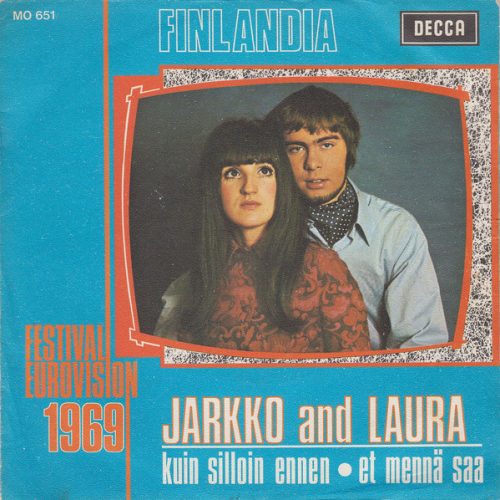
So the duo Jarkko ja Laura where the clear winners with the song “Kuin siloin ennen”. The duo was made up of Jarkko Antikainen and Laura Ruotsalo. The two met when they sang in a trio called The Hobbyguys. In 1966, they had their breakthrough as a duo, with a song Laura wrote: “Meidän laulumme“. A lot of hits followed, a Finnish version of Esther & Abi Ofarim’s “Cinderella Rockefella” (“Rakkahin Rokkefeller”) being one of the most remarkable ones. In 1974 they quit singing as a duo on a regular basis, as Jarkko started his own company. The two married in 1975. Laura made a solo album in 2004. The duo still performs every now and then.
1969 was the only time they took part in the national selections for the Eurovision Song Contest.

The song and performance

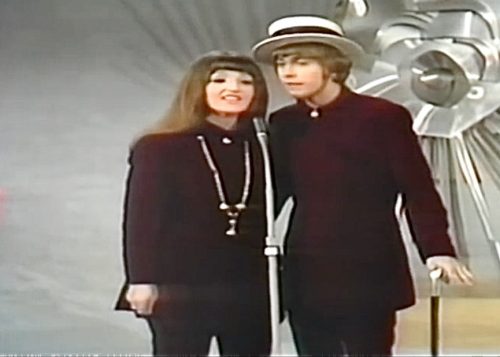
“Kuin silloin ennen” means “Like in those days”. “Like in those days, everyhting’s well again”, is what the duo sang. The full lyrics of the song can be found here. Both were dressed like “in those days”: both had a suit in burgundy. Laura had a necklace, Jarkko a straw had and a walking stick. The song contained a part where the sound of tap dancing could be heard. However, this tap dancing was not performed by the two.

Results

“Kuin silloin ennen” was not among the favorites in the 1969 Eurovision Song Contest. Six countries all awarded it with one vote: Luxembourg, Spain, Ireland, The Netherlands, Norway and Germany. This was enough for a 12th place. The results, however, were a controversy: four countries (Spain, the United Kingdom, The Netherlands and France) won the contest, countries that were already quite succesfull. Again, the Scandinavian countries did not reach the top. Finland was one of many countries that decided not to participate in the 1970 contest because of this result.
 

Related news

Eurovision 2026

Road to Vienna: Estonia

Road to Vienna: Estonia As we eagerly anticipate the Eurovision Song Contest in Basel, we continue our daily spotlight on this year’s contestants. Today, we focus on Estonia Vanilla Ninja: A Pop-Rock Comeback Story Vanilla Ninja is an Estonian girl band formed in 2002 in Tallinn. The original lineup—Maarja Kivi, Lenna Kuurmaa, Katrin Siska, and Piret Järvis—quickly gained attention with their energetic pop-rock sound. Their 2003 debut album introduced hits like “Club Kung Fu,” which became a fan favorite and boosted their popularity across Estonia and Central Europe. Eurovision Breakthrough and International Fame With the release of “Traces of Sadness” in 2004, the band expanded its reach. After a lineup change, they represented Switzerland at the Eurovision Song Contest 2005 with “Cool Vibes,” finishing 8th. Their third album, “Blue Tattoo,” and singles like “Tough Enough” helped establish them as one of Estonia’s biggest music exports. Lineup Changes and Musical Evolution Following more lineup changes, Vanilla Ninja continued as a trio and released “Love Is War” (2006), showcasing a more mature rock sound. Despite continued releases and performances, including the single “Crashing Through the Doors,” the band slowed down and went on hiatus by 2008. Hiatus and Solo Careers (2009–2019) During their long break from 2009 ’till 2019, members pursued individual careers. Lenna Kuurmaa found success as a solo artist and actress, while Maarja Kivi reinvented herself as rock singer Marya Roxx. Fans remained loyal, keeping hopes for a reunion alive. Reunion and New Music  Vanilla Ninja reunited in 2020, releasing their comeback album “Encore” in 2021. After further lineup changes, the band continued as a trio and remained active, releasing new music like. Eurovision Return (2026) In 2026, Vanilla Ninja made a major comeback by winning Eesti Laul with “Too Epic To Be True,” earning them a spot at the Eurovision Song Contest once again. To Epic to be true: A Love That Feels Larger Than Life To Epic to be true  tells the story of a romance that feels almost unreal. The narrator experiences a deep emotional connection that seems guided by fate. Love, destiny, and intensity are at the heart of the track, creating a cinematic and powerful atmosphere. Vulnerability and Self-Doubt Alongside passion, the song explores uncertainty. The narrator questions whether their feelings are too impulsive or naïve. Despite these doubts, they choose to trust their emotions, highlighting themes of honesty, risk, and emotional courage. From Chaos to Clarity A key element of the song is personal growth. The narrator reflects on a previously chaotic life, now transformed by love and stability. This contrast adds depth and shows how meaningful relationships can bring clarity and direction. A Story of Transformation By blending romance with self-discovery, the track delivers a relatable message. It shows how intense love can reshape identity and turn uncertainty into belief, making it both emotional and inspiring for listeners.   Estonia in the Eurovision Song Contest Estonia has participated in the Eurovision Song Contest since 1994 and secured its only victory in 2001 with “Everybody” performed by Tanel Padar, Dave Benton, and 2XL. Another top-3 songs was “Runaway” by Sahlene. She became 3rd. Over the years, Estonia has showcased a diverse range of musical styles, often earning praise for its innovative and bold entries. The country’s commitment to promoting its artists on the international stage remains steadfast, with Eesti Laul serving as a platform for both established and emerging talents. Last years entry, “Espresso Machiato” ended on place 3, in the grand final in Basel.  The Bookmakers Bookmakers are showing little confidence this year, with Estonia currently sitting at the bottom of the rankings. Their chances of reaching the final look quite slim.

Read More »
Eurovision 2026
Anja Kroeze

Road to Vienna: Estonia

Road to Vienna: Estonia As we eagerly anticipate the Eurovision Song Contest in Basel, we continue our daily spotlight on this year’s contestants. Today, we focus on Estonia Vanilla Ninja: A Pop-Rock Comeback Story Vanilla Ninja is an Estonian girl band formed in 2002 in Tallinn. The original lineup—Maarja Kivi, Lenna Kuurmaa, Katrin Siska, and Piret Järvis—quickly gained attention with their energetic pop-rock sound. Their 2003 debut album introduced hits like “Club Kung Fu,” which became a fan favorite and boosted their popularity across Estonia and Central Europe. Eurovision Breakthrough and International Fame With the release of “Traces of Sadness” in 2004, the band expanded its reach. After a lineup change, they represented Switzerland at the Eurovision Song Contest 2005 with “Cool Vibes,” finishing 8th. Their third album, “Blue Tattoo,” and singles like “Tough Enough” helped establish them as one of Estonia’s biggest music exports. Lineup Changes and Musical Evolution Following more lineup changes, Vanilla Ninja continued as a trio and released “Love Is War” (2006), showcasing a more mature rock sound. Despite continued releases and performances, including the single “Crashing Through the Doors,” the band slowed down and went on hiatus by 2008. Hiatus and Solo Careers (2009–2019) During their long break from 2009 ’till 2019, members pursued individual careers. Lenna Kuurmaa found success as a solo artist and actress, while Maarja Kivi reinvented herself as rock singer Marya Roxx. Fans remained loyal, keeping hopes for a reunion alive. Reunion and New Music  Vanilla Ninja reunited in 2020, releasing their comeback album “Encore” in 2021. After further lineup changes, the band continued as a trio and remained active, releasing new music like. Eurovision Return (2026) In 2026, Vanilla Ninja made a major comeback by winning Eesti Laul with “Too Epic To Be True,” earning them a spot at the Eurovision Song Contest once again. To Epic to be true: A Love That Feels Larger Than Life To Epic to be true  tells the story of a romance that feels almost unreal. The narrator experiences a deep emotional connection that seems guided by fate. Love, destiny, and intensity are at the heart of the track, creating a cinematic and powerful atmosphere. Vulnerability and Self-Doubt Alongside passion, the song explores uncertainty. The narrator questions whether their feelings are too impulsive or naïve. Despite these doubts, they choose to trust their emotions, highlighting themes of honesty, risk, and emotional courage. From Chaos to Clarity A key element of the song is personal growth. The narrator reflects on a previously chaotic life, now transformed by love and stability. This contrast adds depth and shows how meaningful relationships can bring clarity and direction. A Story of Transformation By blending romance with self-discovery, the track delivers a relatable message. It shows how intense love can reshape identity and turn uncertainty into belief, making it both emotional and inspiring for listeners.   Estonia in the Eurovision Song Contest Estonia has participated in the Eurovision Song Contest since 1994 and secured its only victory in 2001 with “Everybody” performed by Tanel Padar, Dave Benton, and 2XL. Another top-3 songs was “Runaway” by Sahlene. She became 3rd. Over the years, Estonia has showcased a diverse range of musical styles, often earning praise for its innovative and bold entries. The country’s commitment to promoting its artists on the international stage remains steadfast, with Eesti Laul serving as a platform for both established and emerging talents. Last years entry, “Espresso Machiato” ended on place 3, in the grand final in Basel.  The Bookmakers Bookmakers are showing little confidence this year, with Estonia currently sitting at the bottom of the rankings. Their chances of reaching the final look quite slim.

Read More »
Follow Us: