Team Eurovision 2021 hopes for scenario B

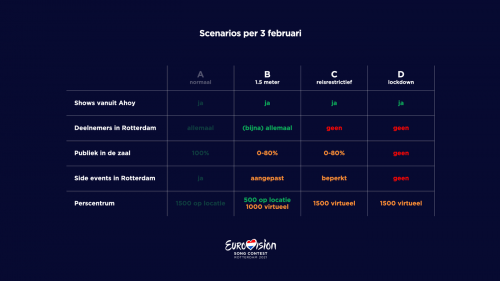
The Eurovision Song Contest continues and the organization strives, determined and realistic, for the highest possible edition. “Our ambition is scenario B: a Eurovision Song Contest edition at one and a half meters, with sharp corona measures whereby all 41 artists can perform in Rotterdam Ahoy. Whether the public can attend the shows and activities in the host city of Rotterdam will be decided at a later time, ” Sietse Bakker, executive producer of the Dutch Eurovision organization, stated.

After consultation of the organizing broadcasters NPO, NOS and AVROTROS and host city Rotterdam, the European Broadcasting Union has decided that organizing a “normal” Song Contest (scenario A) is not realistic under the current circumstances. “Our ambitions remain high. We will do everything we can to make it the best possible edition. The health and safety of all those involved are of course leading” Bakker says.
The show will take place

The Eurovision Song Contest will take place anyway. The semi-finals and the final will take place from Rotterdam Ahoy on 18, 20 and 22 May. Since the end of March last year, we have been working on four scenarios and an agile organization to fulfill that promise.

By now we will focus all energy on scenario B, the organizers remain optimistic and flexible and emphasize that further downscaling to scenario C and D is still possible. There are also, albeit limited, possibilities to scale up again in a number of areas, if this is possible in May.

The Eurovision Song Contest returns in May, despite the pandemic. Unfortunately, given the persistent circumstances, it is impossible to hold the event as we are used to” Martin Österdahl, Executive Supervisor of the Eurovision Song Contest, said.

We are grateful for the renewed commitment and support of the City of Rotterdam and the continued support of all participating broadcasters. We sincerely hope that we can come together in Rotterdam in May and will do everything we can to achieve this” Martin Österdahl stated.
In the upcoming time, the Dutch Eurovision organization hopes for the positive impact of an ever-increasing group of vaccinees, more and more options for quick and reliable testing and the spring weather. In addition, the organization is also cautiously optimistic thanks to various international pilots that show that events can also take place safely and responsibly during corona time. The Dutch FieldLab pilots, which will take place in February, will also contribute to this.

Eurovision councilor Said Kasmi, Municipality of Rotterdam: “The Eurovision Song Contest in Rotterdam, live from Ahoy, is a ray of hope to look forward to together. As a host city, we are optimistic, enthusiastic and realistic. Within the possibilities that are available, we will make the best of it together with partners! Let’s hope that this Eurovision Song Contest, which will be different from all 64 previous festivals, offers great new opportunities for partners and entrepreneurs in the city. Anyway: Rotterdam will open up again!

Safety and Health

An extensive safety and health plan has been developed to guarantee the maximum safety and health of everyone present at the Eurovision Song Contest. A special corona protocol has also been drawn up that can compete with the protocols of, for example, Formula 1 and UEFA.

Artists and delegations

In this scenario, all participants and their supporting delegations can still travel to Rotterdam. The maximum number of delegation members per participating country has been scaled down by the EBU. Persons from a country that may be subject to a travel restriction can enter on the basis of the Exception entry ban for professionals from the cultural and creative sector of the Ministry of Education, Culture and Science.

Tickets

All available tickets for the 3 live shows and 6 dress rehearsals were sold out last year. In order to guarantee the 1.5 meters in the hall, the space for the public in Rotterdam Ahoy will be reduced. Because pitches are not possible, it was decided to set up the floor completely as a green room, so that the artists in the green room can also keep their distance from each other.

Because the capacity is decreasing sharply and there is no prospect of expansion, the organization will start with a full refund of all ticket holders in February. These ticket holders will then receive a unique code with which they can later gain exclusive access to ticket sales for the 2021 shows, if the audience is allowed in the hall. It is therefore not possible to get tickets for the shows for people who do not already have a ticket for the canceled shows of 2020.

Press on the ESF

In scenario B, 500 journalists are present instead of 1,550. A virtual press center will be set up for press who cannot travel to Rotterdam as a result, where rehearsals and press conferences can be followed live. Journalistssts can participate as if they were physically present.

Jolanda Jansen, director of Rotterdam Ahoy: “We are pleased that all parties are jointly expressing the ambition to go for the most maximum scenario for the Eurovision Song Contest 2021, while at the same time all have the full awareness and realism that we are in a challenging time. . We feel the resilience and agility that characterizes our event sector and Rotterdam. We do everything we can to help the team in Hilversum to warmly and cordially welcome the delegations to Rotterdam Ahoy.

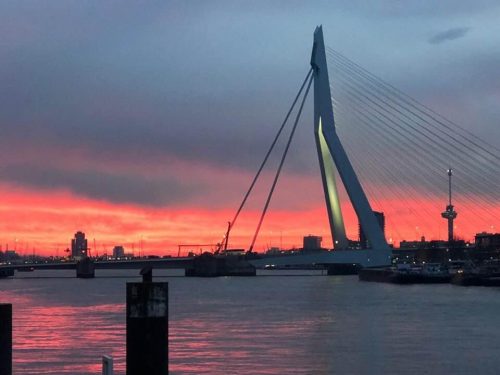
Photo: Mijn reiskennis Jeroen

Eurovision Village

In scenario B, Rotterdam has developed an alternative concept for the Eurovision Village, on the Binnenrotte. The amended plan takes into account, among other things, seated audience (at one and a half meters) and a scalable number of visitors per time block. The city is also investigating the other scenarios, should the audience not be able to be present or be very limited. Within all scenarios, the city strives to let fans and enthusiasts experience the unique Eurovision feeling as much as possible. More will be announced in the coming months about the precise details of the Eurovision Village.

source: songfestival.nl

Related news

Eurovision 2026

Road to Vienna: Armenia

Road to Vienna: Armenia As the Eurovision Song Contest 2026 in Vienna approaches, we continue our daily spotlight on this year’s contestants. Today, we focus on Armenia. Simón: Family man and Armenian Pop Singer Simón (born Simon Hovhannisyan on August 9, 1994) is an Armenian singer from Hrazdan. Raised in a family of doctors, he discovered his passion for music and dance at a young age. Inspired by Michael Jackson, he developed a high-energy performance style that blends vocals with choreography. By his late teens, he was already performing locally and sharing music online. Career Beginnings in Yerevan Simón gained experience in Yerevan’s entertainment scene, notably performing at Coba Yerevan. His dynamic stage presence and strong vocals helped him build recognition. In 2021, he expanded his reach through YouTube and social media, refining his craft and growing his fanbase. Breakthrough at Depi Evratesil 2025 His major breakthrough came with Depi Evratesil 2025, Armenia’s Eurovision selection show. Competing with “Ay Paparey Bye,” Simón won the jury vote but finished second overall. The same year, he served as a jury member for Eurovision 2025 and released “Paranoia,” confirming his status as a rising pop artist. Musical Style and Notable Songs Simón’s music blends upbeat Armenian pop with international influences. Tracks like “Ay Paparey Bye” and “Paranoia” showcase catchy melodies, dance rhythms, and expressive performances. His background in dance makes his live shows especially engaging. Personal Life Simón is married to Anush Avagyan, his producer, and they have twin sons. Despite his growing success, he remains grounded and credits his family for their support. Paloma Rumba: A Song About Freedom and Self-Expression Paloma Rumba tells the story of someone stuck in a repetitive work routine. Each day feels identical, filled with pressure and expectations. Over time, this lifestyle becomes exhausting, and the sense of purpose fades. The song captures the turning point where frustration leads to action—choosing freedom over routine and self-expression over obligation. A Reflection on Modern Work Culture The track connects with a wider conversation about today’s work culture. Long hours, constant communication, and repetitive tasks can make people feel trapped. “Paloma Rumba” highlights that quiet realization when someone questions their daily routine and starts imagining a different, more meaningful path. The Meaning Behind “Paloma Rumba” The title combines two symbolic elements: Paloma (dove) represents freedom, peace, and escape Rumba symbolizes rhythm, movement, and celebration Together, they create a powerful image of liberation—breaking free and celebrating life through music and movement. An Uplifting Message of Empowerment Instead of focusing on negativity, the song transforms frustration into empowerment. It presents leaving an unfulfilling life as a bold and positive choice. This perspective makes the track feel energetic and inspiring rather than critical. A Symbol of New Beginnings At its core, “Paloma Rumba” is about living authentically. It encourages listeners to step away from pressure, embrace creativity, and follow their own path. The song ultimately becomes a metaphor for freedom—letting go and dancing into a new beginning.   Armenia in the Eurovision Song Contest Armenia has participated in the Eurovision Song Contest 15 times since its debut in 2006. The country achieved its best results with fourth-place finishes in 2008, with Sirusho‘s “Qélé, Qélé,” and in 2014, with Aram Mp3‘s “Not Alone.” After withdrawing from the contest in 2021, Armenia returned in 2022 with Rosa Linn’s “Snap,” which, while placing 20th in the final, gained significant popularity post-contest. ​ The Bookmakers Ranked 23rd to win and 12th in the semi-final odds, Simón faces a tough Eurovision climb—but ‘Paloma Rumba’ proves it’s far from impossible.  

Read More »
Eurovision 2026
Anja Kroeze

Road to Vienna: Armenia

Road to Vienna: Armenia As the Eurovision Song Contest 2026 in Vienna approaches, we continue our daily spotlight on this year’s contestants. Today, we focus on Armenia. Simón: Family man and Armenian Pop Singer Simón (born Simon Hovhannisyan on August 9, 1994) is an Armenian singer from Hrazdan. Raised in a family of doctors, he discovered his passion for music and dance at a young age. Inspired by Michael Jackson, he developed a high-energy performance style that blends vocals with choreography. By his late teens, he was already performing locally and sharing music online. Career Beginnings in Yerevan Simón gained experience in Yerevan’s entertainment scene, notably performing at Coba Yerevan. His dynamic stage presence and strong vocals helped him build recognition. In 2021, he expanded his reach through YouTube and social media, refining his craft and growing his fanbase. Breakthrough at Depi Evratesil 2025 His major breakthrough came with Depi Evratesil 2025, Armenia’s Eurovision selection show. Competing with “Ay Paparey Bye,” Simón won the jury vote but finished second overall. The same year, he served as a jury member for Eurovision 2025 and released “Paranoia,” confirming his status as a rising pop artist. Musical Style and Notable Songs Simón’s music blends upbeat Armenian pop with international influences. Tracks like “Ay Paparey Bye” and “Paranoia” showcase catchy melodies, dance rhythms, and expressive performances. His background in dance makes his live shows especially engaging. Personal Life Simón is married to Anush Avagyan, his producer, and they have twin sons. Despite his growing success, he remains grounded and credits his family for their support. Paloma Rumba: A Song About Freedom and Self-Expression Paloma Rumba tells the story of someone stuck in a repetitive work routine. Each day feels identical, filled with pressure and expectations. Over time, this lifestyle becomes exhausting, and the sense of purpose fades. The song captures the turning point where frustration leads to action—choosing freedom over routine and self-expression over obligation. A Reflection on Modern Work Culture The track connects with a wider conversation about today’s work culture. Long hours, constant communication, and repetitive tasks can make people feel trapped. “Paloma Rumba” highlights that quiet realization when someone questions their daily routine and starts imagining a different, more meaningful path. The Meaning Behind “Paloma Rumba” The title combines two symbolic elements: Paloma (dove) represents freedom, peace, and escape Rumba symbolizes rhythm, movement, and celebration Together, they create a powerful image of liberation—breaking free and celebrating life through music and movement. An Uplifting Message of Empowerment Instead of focusing on negativity, the song transforms frustration into empowerment. It presents leaving an unfulfilling life as a bold and positive choice. This perspective makes the track feel energetic and inspiring rather than critical. A Symbol of New Beginnings At its core, “Paloma Rumba” is about living authentically. It encourages listeners to step away from pressure, embrace creativity, and follow their own path. The song ultimately becomes a metaphor for freedom—letting go and dancing into a new beginning.   Armenia in the Eurovision Song Contest Armenia has participated in the Eurovision Song Contest 15 times since its debut in 2006. The country achieved its best results with fourth-place finishes in 2008, with Sirusho‘s “Qélé, Qélé,” and in 2014, with Aram Mp3‘s “Not Alone.” After withdrawing from the contest in 2021, Armenia returned in 2022 with Rosa Linn’s “Snap,” which, while placing 20th in the final, gained significant popularity post-contest. ​ The Bookmakers Ranked 23rd to win and 12th in the semi-final odds, Simón faces a tough Eurovision climb—but ‘Paloma Rumba’ proves it’s far from impossible.  

Read More »
Follow Us: