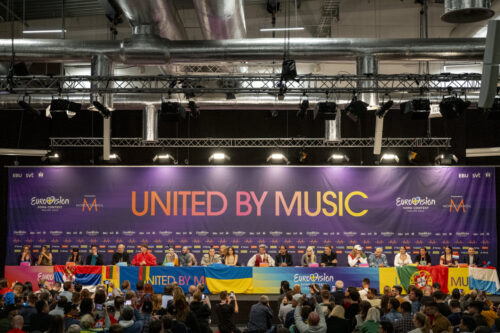
Malmö Messages: yesterday’s pressconference

photo: EBU/Sarah Louise Bennett

Yesterday, after winning the tickets to the final, the 10 winners headed to the winners’ pressconference. We of Eurovision Universe were present at this press conference.

Cyprus

Silia Kapsis said it was a huge opportunity to be here. She was super proud and super happy. About her country of birth, Australia, she said she was proud as well that the Australians showed their culture. It was her goal to make her country proud and after this, to grow as a pop artist.

Serbia

Teya Dora said it was crazy; the rehearsals, the performance; it was all super exciting and she was happy. She wants to make her country proud and give the best she can, with the best placement. She loves it that so many people watched her performance. And about Konstrakta, who was in the introduction film, she loved her amazing energy.

Lithuania

Silvester Belt thanks the audience. To all the bullies from the past he has a message: “I know you are struggling. And to the little boy I was: I love you so much”. The biggest challenge this week was sleeping. About singing in the Lithuanian language he said: “only Lithuanians wanted me to sing in English. Everybody else said I should sing in Lithuanian.”

Ireland

Bambie Thug said they are completely dissociated after this succes, but also that they are super proud. They have a small team and they are en independent artist, yet they reached this. And also, they are the first non binary artist in the contest. Bambie revealed that they met the rules of the EBU: texts like Ceasefire and Free Palestine were not allowed, so Crown The Witch was the only text left. On the question what made them special, Bambie answered “What makes me special is that I’m a queer”.

Ukraine

Alyona Alyona explained that she and Jerry Heil raised fund to rebuild Ukrainian schools. She called for donation. Half of the money is there, but you can donate via United24. “Children are our future”, Alyona Alyona stated. Jerry also stated that it was great to be in Malmö now. It was a super possibility to say thank you for your help. And yes, they felt pressure, because they felt Ukraine expected something from them.

Croatia

The performance was way better than the rehearsals. Before going on stage, Baby Lasagna tried to empty his mind, but before him Poland performed; that song got stuck in his mind. About his first place in the odds he said that odds are just numbers, it’s not over ’til it’s done. He felt comfortable in Malmö as Eurovision is, in his opinion, the next level of professional, with all the sound- and camerawork. The energy to him was fine.

Slovenia

Raiven said she was grateful. She was unsure about the result and doubting all the time. That meant going to the final was a huge surprise for her. When it comes to making music and visuals she went with her instinct. “The staging is really me, and I am very satisfied with it”, she said. About the fact that she was called Eurovision’s opera diva, she said that it is great to hear that people checked her background.

Finland

It was our own Kal (!!) who had the opportunity to ask windows95man a question. Due to the lyrics of the song “No rules”, Kal was interested to know which of the many rules of Eurovision had to go in his opinion. “More nakedness! For everybody!”, windows95man replied without any hesitation. Windows95man also told that he got help in preparing for the show. Before the show the men do some physical exercises.

Portugal

Iolanda from Portugal thinks that music can be whatever you like. She wrote the song in her grandmothers house. Her message is that you can do a lot with not so much money. She designed the act with the stage director and the choreographer. She also added that she believes music connects.

Luxembourg

“I nearly had a heart attack”, Tali explained, “It was brutal, but the camera was approaching and I thought…. maybe”. In Tali’s opinion Eurovision is a beautiful contet that unites. She was thrilled and was hoping to inspire other countries to return to Eurovision. “Music is my life, my therapy, my everything”, Tali stated.


Related news

History

70 years of Eurovision: it was a close call

The Eurovision Song Contest is celebrating its 70th anniversary. That is a wonderful milestone. We at Eurovision Universe love diving into the history of the contest. That is why we are taking a closer look at the contests of the past 70 years. 2002 For the first time, the Eurovision Song Contest was held in a Baltic state. The festival took place in a small hall, the Saku Suurhal in Tallinn, Estonia, hosted by an actor/singer (Marko Matvere) and an opera singer (Anneli Peebo). 24 countries participated. The songs Constantinos from Cyprus made a comeback. He was part of the boy band One, which had the honor of opening the festival and finished a respectable sixth. Not exactly a comeback, but still somewhat so: the German Corinna May. The blind singer had already won the national final in 1999 but was disqualified at the time. Now she was allowed to participate for real. Monica Anghel failed to make it through the audio preliminary round for Romania in 1996. Now, together with Marcel Pavel, she managed to finish 9th for Romania, the best score to date. Host country Estonia sent a Swedish singer, Sahlene. With her song “Runaway,” she finished third. Estonia had established itself as a successful nation at the Eurovision Song Contest. The United Kingdom also finished third with the ballad “Come Back” by Jessica Garlick. After a few less successful years for the British, this was a nice… er… comeback. Although the Netherlands was in the relegation zone and therefore did not participate, the Belgian entry still had a Dutch touch: Sergio & The Ladies participated on behalf of that country. Sergio was Belgian, but the ladies were definitely Dutch. Expectations in Belgium were very high. However, the Belgians’ self-confidence slowly but surely ebbed away, and ultimately they finished 13th instead of first. Ira Losco was the Maltese participant. She had previously participated in national finals but was now on the Eurovision stage for the first time. Ira came very close to winning the festival. However, Lithuania had to vote last and awarded 12 points to fellow Baltic state Estonia. Lithuania must not go unmentioned. The group B-Avarija had very high odds for a long time with the song “We All”. However, it turned out that the song had already appeared in Lithuanian on a B-Avarija record. It was disqualified. The popular group never managed to win for Lithuania again. Instead of them, Lithuania sent a boy with a song that wasn’t particularly strong, but above all with a very striking sweater. Marie N Her real name was Marija Naumova, but the winner was given the name Marie N for the international market. The lyrics of her song were written in such poor English that the entire thing had to be rewritten. And with success! “I wanna”, with an act in which Marie N initially dressed as a man but ended up in an evening gown, became the first and so far only Latvian victory. And so the Eurovision Song Contest remained within the Baltic states! 2003 Too many countries knocked at the door of the Eurovision Song Contest. This would be the last one that could be held on one single evening. Ukraine was admitted, the others had to wait a little longer. The contest was held in the Skonto Hall in Riga. Latvia had only participated three times. Two of the three participants took charge of the presentation: Renārs Kaupers from Brainstorm and winner Marie N. The songs None of the artists had participated before. However, there were a number of notable participants. Alf Poier represented Austria. By his own account, he did so to ridicule the Eurovision Song Contest. He was a Eurovision hater. It earned him a remarkable sixth place with “Weil der Mensch zählt”. Esther Hart participated for the Netherlands with her “One More Night”. Later, Esther Hart would become active in organizing J’aime La Vlie, an event featuring Eurovision participants on the Dutch Wadden Island of Vlieland. The group Ich Troje participated for Poland. They sang their song not only in Polish but also in Russian and German. With his purple-red hair, singer Michał Wiśniewski was a striking figure in any case. And then there was Urban Trad for Belgium. This group sang a song in a fake language: “Sanomi”. The folk song was not a favorite beforehand, but ultimately nearly won. And this despite the fact that quite a few things had been going on within the group. According to the Belgian secret service, singer Soetkin Collier had participated in far-right demonstrations and even attended a memorial service for Nazi leader Rudolf Hess. Such a person was not allowed to represent Belgium, and Soetkin had to stay home. The accusations all turned out to be false: she no longer harbored far-right sympathies, and the Rudolf Hess story turned out to be utter nonsense. But in 2003, everything revolved around t.A.T.u. The supposedly lesbian (in fact heterosexual) girl duo had been instructed to behave as annoyingly as possible. Spoiled to the core, they made it clear that they mainly thought the Eurovision Song Contest was stupid. But when they thought they were unobserved for a moment, a Russian journalist heard the girls say that they were actually very impressed by the big stage. They just missed out on winning. Sertab Erener Because after an exciting battle with Belgium and Russia, Turkey ultimately won. Already one of the pre-contest favorites, Sertab Erener took first place with her Türkpop song “Every Way That I Can”. The genre had become popular throughout Europe thanks to Tarkan, and Sertab was now reaping the benefits. Her song became a hit across Europe, and Sertab remains a major star to this day.

Read More »
History
Martijn

70 years of Eurovision: it was a close call

The Eurovision Song Contest is celebrating its 70th anniversary. That is a wonderful milestone. We at Eurovision Universe love diving into the history of the contest. That is why we are taking a closer look at the contests of the past 70 years. 2002 For the first time, the Eurovision Song Contest was held in a Baltic state. The festival took place in a small hall, the Saku Suurhal in Tallinn, Estonia, hosted by an actor/singer (Marko Matvere) and an opera singer (Anneli Peebo). 24 countries participated. The songs Constantinos from Cyprus made a comeback. He was part of the boy band One, which had the honor of opening the festival and finished a respectable sixth. Not exactly a comeback, but still somewhat so: the German Corinna May. The blind singer had already won the national final in 1999 but was disqualified at the time. Now she was allowed to participate for real. Monica Anghel failed to make it through the audio preliminary round for Romania in 1996. Now, together with Marcel Pavel, she managed to finish 9th for Romania, the best score to date. Host country Estonia sent a Swedish singer, Sahlene. With her song “Runaway,” she finished third. Estonia had established itself as a successful nation at the Eurovision Song Contest. The United Kingdom also finished third with the ballad “Come Back” by Jessica Garlick. After a few less successful years for the British, this was a nice… er… comeback. Although the Netherlands was in the relegation zone and therefore did not participate, the Belgian entry still had a Dutch touch: Sergio & The Ladies participated on behalf of that country. Sergio was Belgian, but the ladies were definitely Dutch. Expectations in Belgium were very high. However, the Belgians’ self-confidence slowly but surely ebbed away, and ultimately they finished 13th instead of first. Ira Losco was the Maltese participant. She had previously participated in national finals but was now on the Eurovision stage for the first time. Ira came very close to winning the festival. However, Lithuania had to vote last and awarded 12 points to fellow Baltic state Estonia. Lithuania must not go unmentioned. The group B-Avarija had very high odds for a long time with the song “We All”. However, it turned out that the song had already appeared in Lithuanian on a B-Avarija record. It was disqualified. The popular group never managed to win for Lithuania again. Instead of them, Lithuania sent a boy with a song that wasn’t particularly strong, but above all with a very striking sweater. Marie N Her real name was Marija Naumova, but the winner was given the name Marie N for the international market. The lyrics of her song were written in such poor English that the entire thing had to be rewritten. And with success! “I wanna”, with an act in which Marie N initially dressed as a man but ended up in an evening gown, became the first and so far only Latvian victory. And so the Eurovision Song Contest remained within the Baltic states! 2003 Too many countries knocked at the door of the Eurovision Song Contest. This would be the last one that could be held on one single evening. Ukraine was admitted, the others had to wait a little longer. The contest was held in the Skonto Hall in Riga. Latvia had only participated three times. Two of the three participants took charge of the presentation: Renārs Kaupers from Brainstorm and winner Marie N. The songs None of the artists had participated before. However, there were a number of notable participants. Alf Poier represented Austria. By his own account, he did so to ridicule the Eurovision Song Contest. He was a Eurovision hater. It earned him a remarkable sixth place with “Weil der Mensch zählt”. Esther Hart participated for the Netherlands with her “One More Night”. Later, Esther Hart would become active in organizing J’aime La Vlie, an event featuring Eurovision participants on the Dutch Wadden Island of Vlieland. The group Ich Troje participated for Poland. They sang their song not only in Polish but also in Russian and German. With his purple-red hair, singer Michał Wiśniewski was a striking figure in any case. And then there was Urban Trad for Belgium. This group sang a song in a fake language: “Sanomi”. The folk song was not a favorite beforehand, but ultimately nearly won. And this despite the fact that quite a few things had been going on within the group. According to the Belgian secret service, singer Soetkin Collier had participated in far-right demonstrations and even attended a memorial service for Nazi leader Rudolf Hess. Such a person was not allowed to represent Belgium, and Soetkin had to stay home. The accusations all turned out to be false: she no longer harbored far-right sympathies, and the Rudolf Hess story turned out to be utter nonsense. But in 2003, everything revolved around t.A.T.u. The supposedly lesbian (in fact heterosexual) girl duo had been instructed to behave as annoyingly as possible. Spoiled to the core, they made it clear that they mainly thought the Eurovision Song Contest was stupid. But when they thought they were unobserved for a moment, a Russian journalist heard the girls say that they were actually very impressed by the big stage. They just missed out on winning. Sertab Erener Because after an exciting battle with Belgium and Russia, Turkey ultimately won. Already one of the pre-contest favorites, Sertab Erener took first place with her Türkpop song “Every Way That I Can”. The genre had become popular throughout Europe thanks to Tarkan, and Sertab was now reaping the benefits. Her song became a hit across Europe, and Sertab remains a major star to this day.

Read More »
Follow Us: