Basel Bulletin: The Big 5 and Switzerland

The Big 5 and Switzerland are on today. We haven’t seen or heard anything so far about them but here they are! They rehearsed today!

EBU has decided to release photo’s of it only the day after. But still we can show you (if available) the national final performance or any other live performance so you got an idea what the artists are capable of. Disclaimer: for the description of the performance, we have to do it with what the EBU tells us.

🇩🇪 Germany

Germany’s first rehearsal for Eurovision 2025 featured Abor & Tynna performing their electro track “Baller.” This is Germany’s first entry in German since 2007. The duo, who are siblings, originate from a musical family based in Vienna. The performance begins with Abor playing a white LED-lit electric cello in front of a tall curtain. As the beat drops, the curtain falls to reveal Tynna standing atop a large 1980s-style boombox prop, about three metres high. She performs the first verse and chorus there before descending to the stage. Four dancers use handheld spotlights to illuminate her as they freestyle around her.

Tynna’s outfit includes black military-style shorts, a crop top, knee-high boots, and leather gloves. The visuals feature intense white and blue strobes, industrial-style graphics, and the word “BALLER” in large LED lettering. For the finale, she dances on the walkway while Abor plays above. The final chorus includes pyrotechnics and a firework display.

🇫🇷 France

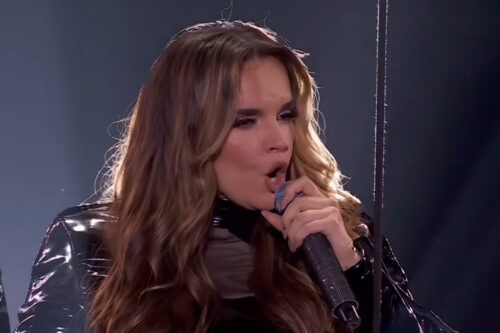
France’s Louane rehearsed her song “Maman” for the first time in Basel, presenting a minimalist and symbolic staging. She performs barefoot, wearing a long black lace dress, within a sand-covered circle at the center of the stage. Throughout the song, a steady stream of sand falls from above onto one side of the circle, representing the passage of time.

The performance includes a moment where Louane kneels and clears a patch of sand to reveal a mirror. Her movements are precisely timed with the musical arrangement and camera direction. The lighting builds gradually alongside orchestral strings, culminating in an intense sequence as the drumbeat grows louder.

All visuals are centered around the theme of time, with the hourglass imagery and falling sand reinforcing the song’s message about love, loss, and personal growth. The performance concludes with a wide, backlit shot, highlighting Louane’s stillness as the sand continues to fall.

🇬🇧 United Kingdom

The United Kingdom’s 2025 Eurovision rehearsal features vocal trio Remember Monday performing “What The Hell Just Happened?” The staging begins in a vintage-style boudoir on one side of the stage, designed to evoke the “morning after the night before.” A padded screen with a heart-shaped cut-out frames the trio as they begin the song in corseted dresses—pale blue (Lauren), pink (Holly-Anne), and yellow (Charlotte).

As the chorus hits, the group moves down the catwalk toward the main stage, where a large, tilted chandelier sits—around 2.5 to 3 metres tall—with candles and multi-coloured lighting. This prop represents the chaos referenced in the lyrics.

Throughout the performance, dynamic camerawork follows the trio’s movement, including overhead shots of the LED floor and a sweeping pan over the chandelier. The song concludes with the singers back in the boudoir, framed by the heart cut-out.

Pyrotechnics are expected in future rehearsals but were not included in this run.

🇨🇭 Switzerland

Switzerland’s first rehearsal for Eurovision 2025 features Zoë Më performing “Voyage” in an intimate, cinematic setting. The performance, set entirely in black space with sculptural lighting, is filmed in one continuous handheld shot. There are no cuts, choreography, props, or LED content. Instead, the camera moves gently and closely around Zoë, responding to her presence in real time.

She begins seated and remains alone on stage throughout, wearing an off-the-shoulder black silk dress printed with abstract florals in deep reds, purples, and blues. The performance is shot on vintage Zeiss Super Speed lenses, creating soft highlights and a shallow depth of field that isolates her in the frame.

During the bridge, the quiet atmosphere ruptures with smoke, wind, and overexposed flashes, while the camera continues uninterrupted. As the performance resolves, the audience appears with phone lights raised, before fading to black. The concept focuses entirely on emotional detail and visual restraint.

🇮🇹 Italy

Italy’s first rehearsal for Eurovision 2025 features Lucio Corsi performing his glam rock ballad Volevo Essere Un Duro. The 31-year-old singer-songwriter from Tuscany brings a 1970s aesthetic, both musically and visually, echoing Bowie-era piano ballads. The staging closely follows his Sanremo performance: Lucio begins seated at an extended piano, wearing a bright yellow, giant-shouldered bolero jacket and his signature white face makeup. He is joined on stage by guitarist and co-writer Tommaso Ottomano.

After the first third of the song, Lucio moves to the centre stage with his guitar. New for Eurovision are two large retro speaker props at the back—one square and approximately four metres high, the other slightly smaller. A sepia filter is applied to the broadcast, enhancing the vintage atmosphere, and English subtitles appear on-screen to support accessibility. A harmonica solo precedes the final chorus, one of the few live instrumental moments in this year’s contest.

🇪🇸 Spain

Spain’s first rehearsal for Eurovision 2025 features Melody performing her uptempo track Esa Diva. Known for her long-standing career in Spanish pop, Melody presents a completely reimagined staging compared to her Benidorm Fest performance. Previously seen elements such as the swing, throne, and neon pink visuals are no longer present. Instead, the new staging introduces a more refined and structured concept.

The performance is now divided into three distinct acts, each marked by a specific visual theme. First, Act One uses purple lighting and graphics. Then, Act Two shifts to red tones, adding intensity. Finally, Act Three transitions into pure white, blending with a mountain backdrop projected on the LED screen.

Throughout the performance, Melody is joined by five dancers—three male and two female—who perform different routines for each act. Additionally, her outfit features a black corseted design with sharp shoulders and hips, paired with a fedora and thigh-high boots. The performance opens in silhouette and concludes with a powerful, high-energy final dance sequence.


Related news

Eurovision 2026

Weekly Update

It’s Tuesday, December 9, 2025, and time for another weekly update! This week, the Eurovision world has been rocked by a single major story: the controversy surrounding Israel’s participation in Eurovision 2026 and the adoption of new contest rules. The European Broadcasting Union (EBU)’s decision on December 4 set off a chain reaction of boycotts and debates. As the road to the 70th Contest in Vienna turns turbulent, here are this week’s top stories: Israel Stays in Eurovision 2026 & New Rules Approved EBU Confirms Israel’s Participation At an EBU general assembly in Geneva on December 4, members decided not to hold a vote on Israel’s status, effectively confirming that Israel will remain in the Eurovision 2026 lineup. This came after some broadcasters had called for Israel’s exclusion over the Gaza war and alleged voting irregularities. The EBU decided there was “no need for a further vote”, so the contest will proceed with Israel included. Albeit with additional safeguards in place. The decision ended weeks of uncertainty and affirmed that Israel is cleared to compete next year, despite the controversy. Broadcasters Approve New Contest Rules Instead of voting Israel out, the EBU put forward a package of new rules to reinforce the contest’s neutrality and fairness. Members from 37 countries voted on reforms aimed at “strengthening trust” in Eurovision. 65% of delegates backed these changes. Key measures include the return of an expanded professional jury in the semi-finals and stricter guidelines to discourage any government or third-party from excessively promoting entries to sway the vote. The number of jurors per country will expand (from 5 to 7) with younger members added, and anti-fraud systems will be enhanced to detect suspicious voting. Additionally, audience vote limits are being halved to curb mass voting campaigns. These rule changes were approved in a secret ballot. The are designed to keep Eurovision a “neutral space” for music and prevent a repeat of last year’s controversies. Martin Green Spain, Ireland and Others Withdraw in Protest Following the EBU’s announcement, four countries immediately declared a boycott of Eurovision 2026. Public broadcasters from the Netherlands, Ireland, Slovenia, and Spain all said they will not send an entry to Vienna in protest of Israel’s inclusion. The Dutch broadcaster AVROTROS stated that under the current circumstances participation “cannot be reconciled with the public values” of their organization. AVROTROS cited Israel’s “proven interference” in the 2025 contest and crackdowns on press freedom during the war. Ireland’s RTÉ deemed participation “unconscionable” given the appalling loss of civilian life in Gaza. Slovenia’s RTV SLO likewise announced a pull-out “on behalf of the 20,000 children who died in Gaza”. They say Eurovision must stand for peace. Spain’s RTVE not only withdrew its delegation but also said it will not broadcast the contest. RTVE Secretary-General Alfonso Morales cited the situation in Gaza and accused Israel of using Eurovision for political aims. This makes it “difficult to keep Eurovision a neutral cultural event”. This marks Spain’s first absence from the contest since 1961. It’s a particularly heavy blow as Spain is one of the Big Five automatic finalists whose participation underpins the event’s funding. Melody, Spain 2025, EBU Mixed Reactions from Across Europe Not all countries are on board with a boycott. Germany had warned it would pull out if Israel were excluded essentially backing Israel’s right to compete. German Culture Minister Wolfram Weimer insisted that “Israel belongs in the Eurovision Song Contest”, opposing any move to bar the country. France also confirmed it will participate regardless of Israel’s presence. French officials rejected the idea of a cultural boycott. Foreign Minister Jean-Noël Barrot praised the EBU for not giving in to pressure and said he “deeply regrets that several European TV channels made a different choice”. Austria’s ORF, the host broadcaster for 2026, welcomed the decision as well. ORF’s Director-General Roland Weißmann argued the contest “is a competition for broadcasters, not governments”. He emphasized the importance of cultural dialogue and not “burning bridges” between participants. Meanwhile, Israeli officials applauded the outcome. President Isaac Herzog said Israel “deserves to be represented on every stage around the world”. The president expressed hope that Eurovision will remain a venue for music, friendship, and cross-border understanding. Israel’s public broadcaster KAN likened calls to exclude Israel to an unjust “cultural boycott”. They are celebrating the EBU’s decision to keep the country in. Outlook: A Fractured Contest Ahead? Eurovision now faces an unprecedented crisis heading into 2026. The slogan of Eurovision 2024 was “United by Music,” but experts warn the contest could be fractured by politics next year. Dr. Paul Jordan, a noted Eurovision expert, observed that the event is becoming “disunited through politics” as the fallout grows. Several broadcasters have yet to announce their stance. For example, Iceland’s RÚV is deliberating and will decide by next week. More countries could potentially join the boycott before the EBU’s mid-December participation deadline. The loss of multiple major countries is raising concerns about television ratings and the contest’s reach. Eurovision typically draws over 150 million viewers worldwide, but with some national networks refusing to air it, viewership in those markets will vanish. If the audience drops significantly, it will “raise alarm bells” for the organizers. Additionally, many fans and commentators on social media are calling for a broader global boycott of Eurovision 2026, accusing the EBU of a double standard. They note that the EBU swiftly banned Russia after its 2022 invasion of Ukraine, so they ask “why should Israel be any different?”. The EBU maintains that Eurovision must stay non-political. That’s hard to maintain, given Israeli President Herzog’s involvement in the contest. As the 70th Eurovision Song Contest in Vienna (12–16 May 2026) approaches, the contest’s unity and spirit of inclusivity will be under intense scrutiny. Will the Eurovision community find a way to come together again, or is this rift a sign of lasting changes to come? Only time will tell.

Read More »
Eurovision 2026
Martijn

Weekly Update

It’s Tuesday, December 9, 2025, and time for another weekly update! This week, the Eurovision world has been rocked by a single major story: the controversy surrounding Israel’s participation in Eurovision 2026 and the adoption of new contest rules. The European Broadcasting Union (EBU)’s decision on December 4 set off a chain reaction of boycotts and debates. As the road to the 70th Contest in Vienna turns turbulent, here are this week’s top stories: Israel Stays in Eurovision 2026 & New Rules Approved EBU Confirms Israel’s Participation At an EBU general assembly in Geneva on December 4, members decided not to hold a vote on Israel’s status, effectively confirming that Israel will remain in the Eurovision 2026 lineup. This came after some broadcasters had called for Israel’s exclusion over the Gaza war and alleged voting irregularities. The EBU decided there was “no need for a further vote”, so the contest will proceed with Israel included. Albeit with additional safeguards in place. The decision ended weeks of uncertainty and affirmed that Israel is cleared to compete next year, despite the controversy. Broadcasters Approve New Contest Rules Instead of voting Israel out, the EBU put forward a package of new rules to reinforce the contest’s neutrality and fairness. Members from 37 countries voted on reforms aimed at “strengthening trust” in Eurovision. 65% of delegates backed these changes. Key measures include the return of an expanded professional jury in the semi-finals and stricter guidelines to discourage any government or third-party from excessively promoting entries to sway the vote. The number of jurors per country will expand (from 5 to 7) with younger members added, and anti-fraud systems will be enhanced to detect suspicious voting. Additionally, audience vote limits are being halved to curb mass voting campaigns. These rule changes were approved in a secret ballot. The are designed to keep Eurovision a “neutral space” for music and prevent a repeat of last year’s controversies. Martin Green Spain, Ireland and Others Withdraw in Protest Following the EBU’s announcement, four countries immediately declared a boycott of Eurovision 2026. Public broadcasters from the Netherlands, Ireland, Slovenia, and Spain all said they will not send an entry to Vienna in protest of Israel’s inclusion. The Dutch broadcaster AVROTROS stated that under the current circumstances participation “cannot be reconciled with the public values” of their organization. AVROTROS cited Israel’s “proven interference” in the 2025 contest and crackdowns on press freedom during the war. Ireland’s RTÉ deemed participation “unconscionable” given the appalling loss of civilian life in Gaza. Slovenia’s RTV SLO likewise announced a pull-out “on behalf of the 20,000 children who died in Gaza”. They say Eurovision must stand for peace. Spain’s RTVE not only withdrew its delegation but also said it will not broadcast the contest. RTVE Secretary-General Alfonso Morales cited the situation in Gaza and accused Israel of using Eurovision for political aims. This makes it “difficult to keep Eurovision a neutral cultural event”. This marks Spain’s first absence from the contest since 1961. It’s a particularly heavy blow as Spain is one of the Big Five automatic finalists whose participation underpins the event’s funding. Melody, Spain 2025, EBU Mixed Reactions from Across Europe Not all countries are on board with a boycott. Germany had warned it would pull out if Israel were excluded essentially backing Israel’s right to compete. German Culture Minister Wolfram Weimer insisted that “Israel belongs in the Eurovision Song Contest”, opposing any move to bar the country. France also confirmed it will participate regardless of Israel’s presence. French officials rejected the idea of a cultural boycott. Foreign Minister Jean-Noël Barrot praised the EBU for not giving in to pressure and said he “deeply regrets that several European TV channels made a different choice”. Austria’s ORF, the host broadcaster for 2026, welcomed the decision as well. ORF’s Director-General Roland Weißmann argued the contest “is a competition for broadcasters, not governments”. He emphasized the importance of cultural dialogue and not “burning bridges” between participants. Meanwhile, Israeli officials applauded the outcome. President Isaac Herzog said Israel “deserves to be represented on every stage around the world”. The president expressed hope that Eurovision will remain a venue for music, friendship, and cross-border understanding. Israel’s public broadcaster KAN likened calls to exclude Israel to an unjust “cultural boycott”. They are celebrating the EBU’s decision to keep the country in. Outlook: A Fractured Contest Ahead? Eurovision now faces an unprecedented crisis heading into 2026. The slogan of Eurovision 2024 was “United by Music,” but experts warn the contest could be fractured by politics next year. Dr. Paul Jordan, a noted Eurovision expert, observed that the event is becoming “disunited through politics” as the fallout grows. Several broadcasters have yet to announce their stance. For example, Iceland’s RÚV is deliberating and will decide by next week. More countries could potentially join the boycott before the EBU’s mid-December participation deadline. The loss of multiple major countries is raising concerns about television ratings and the contest’s reach. Eurovision typically draws over 150 million viewers worldwide, but with some national networks refusing to air it, viewership in those markets will vanish. If the audience drops significantly, it will “raise alarm bells” for the organizers. Additionally, many fans and commentators on social media are calling for a broader global boycott of Eurovision 2026, accusing the EBU of a double standard. They note that the EBU swiftly banned Russia after its 2022 invasion of Ukraine, so they ask “why should Israel be any different?”. The EBU maintains that Eurovision must stay non-political. That’s hard to maintain, given Israeli President Herzog’s involvement in the contest. As the 70th Eurovision Song Contest in Vienna (12–16 May 2026) approaches, the contest’s unity and spirit of inclusivity will be under intense scrutiny. Will the Eurovision community find a way to come together again, or is this rift a sign of lasting changes to come? Only time will tell.

Read More »
Follow Us: