After the Eurovision Fame: Salvador Sobral

After the Eurovision Fame: Salvador Sobral

Salvador (Vilar Braamcamp) Sobral won the Eurovision Song Contest 2017 with “Amor pelos dois”, representing Portugal. What’s his story?

Early Years

Salvador Sobral was born on 28 December 1989 in Lisbon, the capital of Portugal. He comes from a family of Portuguese nobility.  He also is a descendant of Gerrit Braamcamp, an 18th-century Dutch distiller, timber trader, and renowned art collector. Portugal officially abolished nobility and its privileges in 1910 with the proclamation of the republic. Even so, people still informally call Sobral a count. His parents, Salvador Luís Cabral Braamcamp Sobral and Luísa Maria Cabral Posser Vilar, raised him in a musical family. His older sister, Luísa Sobral, built her own reputation as a Portuguese singer and songwriter

At the age of 10, Salvador appeared on the Portuguese TV program Bravo Bravíssimo, a talent show for young musical minds.  Around his twenties, he competed in Ídolos, the Portuguese version of Idols. He made it to the Top 10 finalists.

Salvador Sobral initially studied psychology at the ISPA Institute in Lisbon but left his studies to fully dedicate himself to music. Through the Erasmus program, he moved to Mallorca, where he performed in bars — an important formative experience that shaped his artistic path. He later pursued formal musical education at Taller de Músics in Barcelona, specializing in modern music and jazz, and graduated in 2014.

Eurovision and Heart Condition

When Salvador Sobral won the Eurovision Song Contest 2017 with “Amar pelos dois”, he already appeared fragile on stage. Behind the captivating smile and delicate voice was a heavy truth: the young Portuguese singer was battling a severe heart condition. His health often failed him, which meant he couldn’t always attend rehearsals.

Some fans began to see the lyrics of the song in a different light, since his sister Luísa had written it for him during his illness. The line my heart can love for both of us gained deeper meaning, as Salvador’s own heart was failing, and in a way, his sister was “loving for two.”

In his winner’s speech, Sobral criticized much of Eurovision’s music as “fast-food music without content”, emphasizing emotion over spectacle. While many praised his lyrical honesty, other, including fellow contestant Robin Bengtsson for Sweden, felt it came across as condescending.

He later expressed regret, calling those remarks “nonsense” and acknowledging that they were interpreted as arrogant. He also regretted labeling Eurovision participation as his “personal prostitution,” admitting he had been trying to seem funny and  rebellious


In September of that year, Sobral announced a forced pause in his career. He needed all his energy for treatment and recovery. The tension surrounding his situation grew, and it became clear that a major operation was inevitable.

On 8 December 2017, the crucial step followed: a heart transplant in a Lisbon hospital. The surgery was successful and literally gave Salvador a new rhythm. A month later, in January 2018, he was released from hospital. His recovery, however, came with strict rules: no hugs, no crowds, and above all: rest.

Sobral described this second chance at life as a rebirth. His voice, long affected by heavy medication, remained fragile, but he hoped to regain his full vocal strength.

Behind the medical journey lay an emotional one. Before the surgery, Salvador, uncertain of the outcome, wrote a sort of will on his phone. His wish: to be cremated and have his ashes scattered into the sea near Mallorca. A quiet but powerful testament to how close he was to death.

He has never made any statements about the precise nature of his congenital heart defect.


After Eurovision Fame

In April 2018, Salvador and his sister Luísa received the “Order of Merit”, awarded by the Portuguese president in recognition of their contribution to culture. Shortly afterward, Salvador made an impressive comeback at the Eurovision final in Lisbon. Together with Brazilian legend Caetano Veloso, he performed “Amar pelos dois”and his new song “Mano a Mano” It was a symbolic return: an artist singing with a new heart, literally and figuratively.

With renewed life and energy, Sobral embarked on a creative journey that took him from Lisbon to Paris, across Latin America, and finally to Barcelona. His path since 2019 reveals an artist constantly reinventing himself while staying true to his authenticity.

In February 2024, Salvador made history again: he performed at the prestigious Goya Awards alongside Spanish singer Sílvia Pérez Cru; the first Portuguese artist ever to do so. Their collaboration grew into an intimate artistic project that culminated in the 2025 album “Sílvia & Salvador”, recorded in analogue. The record captures their voices in honest dialogue; without embellishment, pure and deeply human.

That same year, Sobral chose a new home base: Barcelona. For him, it was more than a move; it was a chance to begin again, far from the shadows of illness and recovery.

Private Life

In December 2018, Salvador married French actress Jenna Thiam. No grand spectacle, no flashing cameras, just an intimate ceremony in Lisbon with close family and friends. Jenna became not only his life partner but also his rock during the turbulent years after his transplant.

Together they welcomed a daughter, who gave Salvador’s life a new dimension. For a man who had stood so close to death, fatherhood became a gift.

In March 2024, Sobral once again showed courage and vulnerability: he revealed that he is intersex. His body does not naturally produce testosterone, a reality he had kept private for many years. By speaking openly, he not only shared his truth but also offered recognition and strength to others in similar situations.

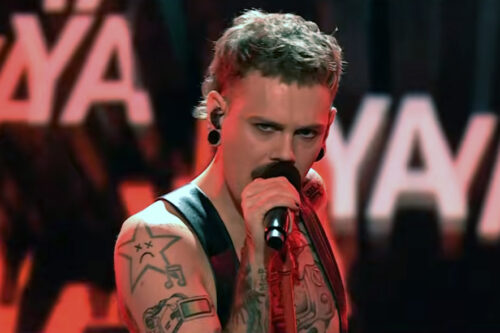
 

Today, Salvador Sobral lives between music, love, and fatherhood. Once known primarily for his fragile health, he now radiates strength and serenity. His private life, marriage, fatherhood, openness about his identity, and his move to Barcelona, shows that he is not only a great artist but also a man who has embraced his second chance at life with both hands.

Related news

History

Austria in the Eurovision Song Contest, part 6

This year’s Eurovision Song Contest has been won by Austria. It was the 57th Austrian entry. Reason for us to go back to all the Austrian entries in history! For the sixth episode, we look back at the nineties. With Tony Wegas’ double, and a total of three top-10 scores, the hard times began for Austria in the Eurovision Song Contest. 1992: Tony Wegas – “Zusammen geh’n” Tony Wegas, an Austrian singer and television actor, represented Austria at Eurovision 1992 with the power ballad “Zusammen geh’n”. Dieter Bohlen composed the music and Joachim Horn-Bernges wrote the lyrics, giving the song a classic pop-ballad style. Wegas delivered an emotive performance of this German-language track on the Malmö stage. “Zusammen geh’n” earned 63 points, securing a 10th place finish for Austria at the 1992 contest. 1993: Tony Wegas – “Maria Magdalena” Tony Wegas returned in 1993 to represent Austria with “Maria Magdalena,” a dramatic pop song with biblical references. He was selected internally, and presented 7 songs. Wegas, known for his singing career and TV acting, gave an engaging performance of this German-language track about Mary Magdalene. Christian Kolonovits and Johann Bertl composed the music, while Thomas Spitzer penned the lyrics, infusing the song with theatrical flair. Despite its uptempo style compared to the previous year, “Maria Magdalena” scored 32 points and placed 14th out of 25 entries at Eurovision 1993. 1994: Petra Frey – “Für den Frieden der Welt” Eight artists and songs competed in the national final. Simone participated but did not win. Petra Frey, only 16 years old at the time, represented Austria at Eurovision 1994 in Dublin with the ballad “Für den Frieden der Welt” (translated as “For the Peace of the World”). Alfons Weindorf composed the music, and brothers Karl & Johann Brunner wrote the lyrics, creating a heartfelt pop ballad calling for world peace. The song showcased Frey’s strong vocals, honed from her early schlager music career, and delivered a sincere message on stage. Austria’s 1994 entry earned 19 points, finishing in 17th place among 25 countries. 1995: Stella Jones – “Die Welt dreht sich verkehrt” Stella Jones, an Austrian singer with jazz and soul roots, took the stage in 1995 with “Die Welt dreht sich verkehrt” (meaning “The World Turns Upside Down”). Jones delivered a funky, blues-infused pop performance that reflected her versatile musical background. Michael W. Krausz both wrote the lyrics and composed the music for this entry, a song which stood out amid a contest often dominated by ballads. The Austrian entry scored 67 points, achieving a 13th place finish in the 1995 Eurovision final. 1996: George Nussbaumer – “Weil’s dr guat got” George Nussbaumer, a blind Austrian blues musician, brought a unique gospel-blues flair to Eurovision 1996 with “Weil’s dr guat got”. Sung in his native Vorarlberg dialect (the title roughly means “Because You’re Doing Well”), the song blended upbeat soul and pop elements. Nussbaumer co-wrote the entry himself. He composed the music and co-authored the lyrics with Michael W. Krausz and infused it with authentic blues style. His uplifting performance in Oslo resonated with the juries, as Austria earned 68 points and a 10th place finish at the 1996 contest. 1997: Bettina Soriat – “One Step” Bettina Soriat, an Austrian singer and stage performer, stepped into the spotlight in 1997 with “One Step.” Having been a backing vocalist for Austria’s 1996 entry, Soriat brought an upbeat dance-pop routine to Eurovision 1997. Marc Berry (stage name of Marcus Dlugaiczyk) wrote the song’s lyrics and co-composed the music with Ina Siber, crafting a catchy tune with playful choreography. Despite the energetic performance and its fun pop appeal, “One Step” received just 12 points, placing 21st out of 25 entries in the Dublin final. 1999: Bobbie Singer – “Reflection” Bobbie Singer (born Tina Schosser), an 18-year-old Austrian pop singer, returned for Eurovision 1999 after Austria’s one-year absence. She performed “Reflection,” a contemporary English-language pop song that projected a youthful, radio-friendly vibe. Dave Moskin wrote and composed “Reflection”, providing a modern pop sound accompanied by a live band on stage. Bobbie’s engaging performance in Jerusalem gave Austria a fresh image in the contest. The entry scored 65 points, achieving a 10th place finish out of 23 countries – Austria’s best Eurovision result of the 1990s.        

Read More »
History
Martijn

Austria in the Eurovision Song Contest, part 6

This year’s Eurovision Song Contest has been won by Austria. It was the 57th Austrian entry. Reason for us to go back to all the Austrian entries in history! For the sixth episode, we look back at the nineties. With Tony Wegas’ double, and a total of three top-10 scores, the hard times began for Austria in the Eurovision Song Contest. 1992: Tony Wegas – “Zusammen geh’n” Tony Wegas, an Austrian singer and television actor, represented Austria at Eurovision 1992 with the power ballad “Zusammen geh’n”. Dieter Bohlen composed the music and Joachim Horn-Bernges wrote the lyrics, giving the song a classic pop-ballad style. Wegas delivered an emotive performance of this German-language track on the Malmö stage. “Zusammen geh’n” earned 63 points, securing a 10th place finish for Austria at the 1992 contest. 1993: Tony Wegas – “Maria Magdalena” Tony Wegas returned in 1993 to represent Austria with “Maria Magdalena,” a dramatic pop song with biblical references. He was selected internally, and presented 7 songs. Wegas, known for his singing career and TV acting, gave an engaging performance of this German-language track about Mary Magdalene. Christian Kolonovits and Johann Bertl composed the music, while Thomas Spitzer penned the lyrics, infusing the song with theatrical flair. Despite its uptempo style compared to the previous year, “Maria Magdalena” scored 32 points and placed 14th out of 25 entries at Eurovision 1993. 1994: Petra Frey – “Für den Frieden der Welt” Eight artists and songs competed in the national final. Simone participated but did not win. Petra Frey, only 16 years old at the time, represented Austria at Eurovision 1994 in Dublin with the ballad “Für den Frieden der Welt” (translated as “For the Peace of the World”). Alfons Weindorf composed the music, and brothers Karl & Johann Brunner wrote the lyrics, creating a heartfelt pop ballad calling for world peace. The song showcased Frey’s strong vocals, honed from her early schlager music career, and delivered a sincere message on stage. Austria’s 1994 entry earned 19 points, finishing in 17th place among 25 countries. 1995: Stella Jones – “Die Welt dreht sich verkehrt” Stella Jones, an Austrian singer with jazz and soul roots, took the stage in 1995 with “Die Welt dreht sich verkehrt” (meaning “The World Turns Upside Down”). Jones delivered a funky, blues-infused pop performance that reflected her versatile musical background. Michael W. Krausz both wrote the lyrics and composed the music for this entry, a song which stood out amid a contest often dominated by ballads. The Austrian entry scored 67 points, achieving a 13th place finish in the 1995 Eurovision final. 1996: George Nussbaumer – “Weil’s dr guat got” George Nussbaumer, a blind Austrian blues musician, brought a unique gospel-blues flair to Eurovision 1996 with “Weil’s dr guat got”. Sung in his native Vorarlberg dialect (the title roughly means “Because You’re Doing Well”), the song blended upbeat soul and pop elements. Nussbaumer co-wrote the entry himself. He composed the music and co-authored the lyrics with Michael W. Krausz and infused it with authentic blues style. His uplifting performance in Oslo resonated with the juries, as Austria earned 68 points and a 10th place finish at the 1996 contest. 1997: Bettina Soriat – “One Step” Bettina Soriat, an Austrian singer and stage performer, stepped into the spotlight in 1997 with “One Step.” Having been a backing vocalist for Austria’s 1996 entry, Soriat brought an upbeat dance-pop routine to Eurovision 1997. Marc Berry (stage name of Marcus Dlugaiczyk) wrote the song’s lyrics and co-composed the music with Ina Siber, crafting a catchy tune with playful choreography. Despite the energetic performance and its fun pop appeal, “One Step” received just 12 points, placing 21st out of 25 entries in the Dublin final. 1999: Bobbie Singer – “Reflection” Bobbie Singer (born Tina Schosser), an 18-year-old Austrian pop singer, returned for Eurovision 1999 after Austria’s one-year absence. She performed “Reflection,” a contemporary English-language pop song that projected a youthful, radio-friendly vibe. Dave Moskin wrote and composed “Reflection”, providing a modern pop sound accompanied by a live band on stage. Bobbie’s engaging performance in Jerusalem gave Austria a fresh image in the contest. The entry scored 65 points, achieving a 10th place finish out of 23 countries – Austria’s best Eurovision result of the 1990s.        

Read More »
Follow Us: