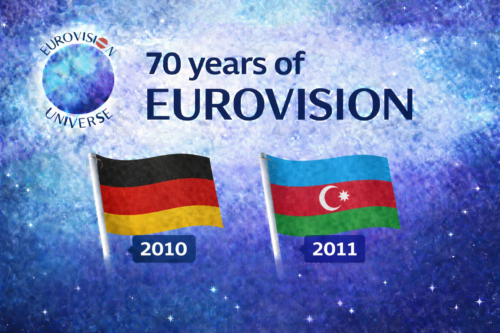
70 years of Eurovision: from a volcano to a housewife

The Eurovision Song Contest is celebrating its 70th anniversary. That is a wonderful milestone. We at Eurovision Universe love diving into the history of the contest. That is why we are taking a closer look at the contests of the past 70 years.

2010

In 2010, the entire Eurovision Song Contest hung by a thread for a moment. That had everything to do with Iceland. Not with the contestant, Hera Björk. No, with a volcano: Eyjafjallajökull. It erupted. This resulted in an impenetrable ash cloud. Airspace in no fewer than 14 countries was closed on April 15. If it remained closed, the entire festival could not go ahead. Fortunately, everything ended without serious consequences.

The song contest was held in Oslo. Erik Solbakken, Nadia Hasnaoui, and Haddy N’jie hosted the show. Georgia participated again, but Andorra, the Czech Republic, Hungary, and Montenegro dropped out.

The songs

The female group Femminem, a previous participant for Bosnia and Herzegovina, now represented Croatia. Former winner Niamh Kavanagh made a new attempt for Ireland.

Sweden chose a girl with a guitar: Anna Bergendahl. And what had never happened before (and would never happen again): Sweden did not make it to the final! Anna participated in Melodifestivalen several more times later on, but the Swedes still didn’t dare to send her again.

The performance of the Spanish candidate Daniel Diges in the final was disrupted. Jimmy Jump, who often appears in places where he is not allowed to be, placed among the dancers. After he was removed from the stage, Diges was given the chance to sing his song again.

Moldova made Eurovision history. Not because of the high score of Sunstroke Project, but because of the sax solo from the song. Over the years, it grew to mythical proportions. There is even a ten-hour compilation of just this sax solo to be found on YouTube. The saxophonist from the group was therefore given the nickname ‘epic sax guy’.

Then there was Tom Dice from Belgium. He, too, was among the favorites. For a moment, it really seemed like he was going to finish in the top 3, but ultimately he ended up being a sixth place. The group Manga came second for Turkey. Fireworks weren’t enough for this group: a grinding tool was even used in the act.The Ukrainian entry was the third choice. The winner of the national final was deemed not good enough by the Ukrainian broadcaster. A new national final had to be held. But the song that won back then turned out to already exist and was disqualified. The winning singer, Alyosha, was now allowed to come up with an alternative.

Duos

Paula Seling and the Romanian-Norwegian (or Norwegian-Romanian?) Ovi, seated at the piano, had great success with their duet “Playing with fire”. The song came in an impressive third place! The two finished just above another duo: Chanée and N’Evergreen from Denmark. With “In A Moment Like This,” they confessed their love to each other. Love that didn’t actually exist; the two could have killed each other. But as is often the case, that very fact led to great success.

Lena

No one knew Lena Meyer-Landruth from Hanover. As a completely unknown German girl, she had entered Unser Star Für Oslo, the German national selection. Surprisingly, she emerged as the winner. With her distinctive English accent, she sang the song “Sattelite” to first place. Upon her return home, she was welcomed as a heroine. Hanover airport was packed.

The producer of the program was Stefan Raab, who himself was on stage in a glitter suit back in 2000. At the winners’ press conference, he already suggested that Lena would defend her title in 2011. And so it happened. And so, after Lys Assia and Corrie Brokken, Lena was the third contestant to participate again immediately after her victory.

2011

Not Hanover, not Berlin, but Düsseldorf became the venue. Stefan Raab was the host, together with Anke Engelke and Judith Rakers. Four countries returned: Austria, San Marino, Hungary and, surprisingly enough, Italy. The lobbying by singer Raffaella Cara, among others, had worked.

The songs

As mentioned, Lena represented Germany and thereby defended her title. But the entry was not as successful as the previous one, with ‘just’ a tenth place. She was not the only former winner: Israel fielded Dana International. Her glory years were clearly over; it was not enough for a place in the final. The Bosnian Dino Merlin, who was also present in 1999, did better with a sixth place.

San Marino came with Senit, an Italian of Eritrean descent. Nowadays she calls herself Senhit, and this year she will take the Eurovision stage again. The main eye-catchers were the twin brothers from Ireland: Jedward. With red suits and enormous quiffs, the two stood out quite a bit. Their song “Lipstick” was sung along to by everyone in Düsseldorf and the surrounding area. Jedward knew how to put on a show. Eric Saade performed for Sweden. He spent his time in Düsseldorf among other things arguing with the Russian Alexey Vorobyov, and vice versa.

The British hit machine Blue represented the United Kingdom with an act featuring towering portraits of the four group members on stage. “I Can” did not become the success that was expected of it. The same thing happened to France. Amaury Vassili sang “Sognu,” a classic ballad, entirely in Corsican. He sang perfectly during all rehearsals, except when it really mattered. Amaury finished 15th.

Singer Sjonni Brink was supposed to participate in the Icelandic national final but passed away unexpectedly just before it was held. As a tribute, a group of friends decided to sing the song “Coming Home” in his place. Of course, they won by a wide margin. During the winners press conference, there was joy at reaching the final, but traces of a very different emotion were clearly visible as well.

Ell & Nikki

As the rehearsal week progressed, it became increasingly clear that Azerbaijan stood a chance. Although they politely stated in an interview with the undersigned, “We first have to get over the hurdle of the semi-final,” they quickly became the favorites. Eldar Gasimov and Nigar Gammal, as they are actually called, came more or less out of nowhere. They participated separately in the national final; only later were they joined as a duo. “Last week I was just a housewife, and now I win the Eurovision Song Contest,” a stunned Nikki exclaimed after winning the song contest.


 

Related news

Eurovision 2026

Road to Vienna: Czechia

  Road to Vienna: Czechia We are very looking forward to the Eurovision Song Contest in Vienna.                                                                We will highlight one participating country each day. Today, we turn our attention to Czechia   Daniel Žižka: A Fresh Voice in Czech Pop & Indie Music Daniel Žižka, born in 2003 in the Czech Republic, is a singer, songwriter, and actor who showed early talent in both music and performance. He began writing songs at just 10 years old and recorded his first track by 15. His passion for the arts led him to study musical theater at the Jaroslav Ježek Conservatory in Prague, where he developed strong vocal and stage skills. Music Career and Breakthrough Starting under the name “Daniell,” he released early singles like Wrong (2019) and Go On (2020), gaining attention on Czech radio. Transitioning to his real name, Daniel Žižka continued building his reputation with tracks such as Pierrot (2023) and Talk (2024). In 2025, he reached a major milestone with 23:23, performed live with the Czech Radio Symphony Orchestra in Prague. His music blends pop and indie-pop with emotional vocals and atmospheric sounds, further strengthened by collaborations with international producers. Acting Career and TV Appearances Alongside music, Daniel has built a solid acting career. He gained early recognition in the TV film Rašín (2018) and appeared in popular Czech series like Modrý kód. His later roles in shows such as Špunti na cestě and Taneční (2024) expanded his presence on screen. A Promising Talent in Czechia With a unique mix of musical talent and acting experience, Daniel Žižka stands out as a rising star in the Czech entertainment industry. His growing discography and on-screen work position him as an artist to watch in the coming years. Crossroads: A Dive into Self-Discovery and Emotion Crossroads captures the essence of navigating life without a clear direction. The track reflects the tension between curiosity and caution, as it explores the challenges of making choices and finding meaning in an unpredictable world. Themes of Growth and Connection At its heart, the song focuses on personal growth, emotional resilience, and human relationships. It highlights the balance between independence and connection, offering a relatable perspective on how people deal with shared experiences, pain, and change. A Layered Musical Experience Musically, Crossroads blends atmospheric melodies with rich instrumentation, creating an immersive and emotional soundscape. The dynamic composition mirrors the journey of self-discovery, balancing moments of reflection with a sense of movement and exploration.   Czechia in the Eurovision Song Contest Czechia, formerly known as the Czech Republic in the contest, debuted in Eurovision in 2007. After initial challenges, the country withdrew in 2010 but returned in 2015. Since then, Czechia has achieved notable success, including a sixth-place finish in 2018 with Mikolas Josef‘s “Lie to Me” and a tenth-place finish in 2023 with Vesna‘s “My Sister’s Crown.” ​                                                                                                                                                      Last year, Czechia, represented by ADONXS, did not manage to qualify for the final. The bookmakers At 12th place with the bookmakers, a spot in the final is firmly back within reach this year.  

Read More »
History
Martijn

70 years of Eurovision: from a volcano to a housewife

The Eurovision Song Contest is celebrating its 70th anniversary. That is a wonderful milestone. We at Eurovision Universe love diving into the history of the contest. That is why we are taking a closer look at the contests of the past 70 years. 2010 In 2010, the entire Eurovision Song Contest hung by a thread for a moment. That had everything to do with Iceland. Not with the contestant, Hera Björk. No, with a volcano: Eyjafjallajökull. It erupted. This resulted in an impenetrable ash cloud. Airspace in no fewer than 14 countries was closed on April 15. If it remained closed, the entire festival could not go ahead. Fortunately, everything ended without serious consequences. The song contest was held in Oslo. Erik Solbakken, Nadia Hasnaoui, and Haddy N’jie hosted the show. Georgia participated again, but Andorra, the Czech Republic, Hungary, and Montenegro dropped out. The songs The female group Femminem, a previous participant for Bosnia and Herzegovina, now represented Croatia. Former winner Niamh Kavanagh made a new attempt for Ireland. Sweden chose a girl with a guitar: Anna Bergendahl. And what had never happened before (and would never happen again): Sweden did not make it to the final! Anna participated in Melodifestivalen several more times later on, but the Swedes still didn’t dare to send her again. The performance of the Spanish candidate Daniel Diges in the final was disrupted. Jimmy Jump, who often appears in places where he is not allowed to be, placed among the dancers. After he was removed from the stage, Diges was given the chance to sing his song again. Moldova made Eurovision history. Not because of the high score of Sunstroke Project, but because of the sax solo from the song. Over the years, it grew to mythical proportions. There is even a ten-hour compilation of just this sax solo to be found on YouTube. The saxophonist from the group was therefore given the nickname ‘epic sax guy’. Then there was Tom Dice from Belgium. He, too, was among the favorites. For a moment, it really seemed like he was going to finish in the top 3, but ultimately he ended up being a sixth place. The group Manga came second for Turkey. Fireworks weren’t enough for this group: a grinding tool was even used in the act.The Ukrainian entry was the third choice. The winner of the national final was deemed not good enough by the Ukrainian broadcaster. A new national final had to be held. But the song that won back then turned out to already exist and was disqualified. The winning singer, Alyosha, was now allowed to come up with an alternative. Duos Paula Seling and the Romanian-Norwegian (or Norwegian-Romanian?) Ovi, seated at the piano, had great success with their duet “Playing with fire”. The song came in an impressive third place! The two finished just above another duo: Chanée and N’Evergreen from Denmark. With “In A Moment Like This,” they confessed their love to each other. Love that didn’t actually exist; the two could have killed each other. But as is often the case, that very fact led to great success. Lena No one knew Lena Meyer-Landruth from Hanover. As a completely unknown German girl, she had entered Unser Star Für Oslo, the German national selection. Surprisingly, she emerged as the winner. With her distinctive English accent, she sang the song “Sattelite” to first place. Upon her return home, she was welcomed as a heroine. Hanover airport was packed. The producer of the program was Stefan Raab, who himself was on stage in a glitter suit back in 2000. At the winners’ press conference, he already suggested that Lena would defend her title in 2011. And so it happened. And so, after Lys Assia and Corrie Brokken, Lena was the third contestant to participate again immediately after her victory. 2011 Not Hanover, not Berlin, but Düsseldorf became the venue. Stefan Raab was the host, together with Anke Engelke and Judith Rakers. Four countries returned: Austria, San Marino, Hungary and, surprisingly enough, Italy. The lobbying by singer Raffaella Cara, among others, had worked. The songs As mentioned, Lena represented Germany and thereby defended her title. But the entry was not as successful as the previous one, with ‘just’ a tenth place. She was not the only former winner: Israel fielded Dana International. Her glory years were clearly over; it was not enough for a place in the final. The Bosnian Dino Merlin, who was also present in 1999, did better with a sixth place. San Marino came with Senit, an Italian of Eritrean descent. Nowadays she calls herself Senhit, and this year she will take the Eurovision stage again. The main eye-catchers were the twin brothers from Ireland: Jedward. With red suits and enormous quiffs, the two stood out quite a bit. Their song “Lipstick” was sung along to by everyone in Düsseldorf and the surrounding area. Jedward knew how to put on a show. Eric Saade performed for Sweden. He spent his time in Düsseldorf among other things arguing with the Russian Alexey Vorobyov, and vice versa. The British hit machine Blue represented the United Kingdom with an act featuring towering portraits of the four group members on stage. “I Can” did not become the success that was expected of it. The same thing happened to France. Amaury Vassili sang “Sognu,” a classic ballad, entirely in Corsican. He sang perfectly during all rehearsals, except when it really mattered. Amaury finished 15th. Singer Sjonni Brink was supposed to participate in the Icelandic national final but passed away unexpectedly just before it was held. As a tribute, a group of friends decided to sing the song “Coming Home” in his place. Of course, they won by a wide margin. During the winners press conference, there was joy at reaching the final, but traces of a very different emotion were clearly visible as well. Ell & Nikki As the rehearsal week progressed, it became increasingly clear that Azerbaijan stood a chance. Although

Read More »
Follow Us: