🇩đŸ‡č Austria in the Eurovision Song Contest – final episode

đŸ“· EBU/Corinne Cumming

In this final episode of our series on Austria in the Eurovision Song Contest, we cover the years 2019–2025. We’ll look at each Austrian entry’s national selection process (if any), the song’s lyricists and composers, musical style, Eurovision score, and a few facts about the artist.

2019 – PÆNDA – “Limits”

In 2019, Austria internally selected singer-songwriter PÆNDA (Gabriela Horn) to perform the song “Limits” at Eurovision. PÆNDA wrote and composed the song herself; a minimalist electro-pop ballad that highlights her ethereal vocals and emotional songwriting. The lyrics describe pushing oneself too far and hitting personal limits. Despite its intimate staging and artistic vibe, Limits failed to advance from the semi-finals, placing 17th in Semi-Final 2. PÆNDA, a native of Styria, is an EDM-pop producer who launched her project in 2016. She blends underground electronic beats with catchy pop elements, and her Eurovision entry appeared on her 2019 album Evolution II. 

2020 – Vincent Bueno – “Alive”

For Eurovision 2020, ORF internally selected Vincent Bueno to represent Austria. “Alive” is an upbeat pop track with R&B and funk influences. Vincent co-wrote the song with a team including David “Davey” Yang and Felix van Göns. The track’s groovy bassline and falsetto riffs convey a message of liberation. It’s about feeling truly “alive” by letting go of one’s ego. Vincent is an Austrian-Filipino singer who first found fame by winning ORF’s musical talent show in 2008. He also performed in theater productions, showcasing his stage experience. Sadly, Eurovision 2020 was cancelled due to the pandemic. As a result, “Alive” never reached the Rotterdam stage and received no final score.

2021 – Vincent Bueno – “Amen”

In 2021, Austria kept faith with Vincent Bueno, who returned with the power ballad “Amen”. ORF again internally selected Vincent after 2020’s cancellation. A trio of songwriters – Tobias Carshey, Ashley Hicklin, and Jonas Thander – crafted “Amen”. The entry starts as a gentle pop ballad and swells into a gospel-tinged climax, allowing Vincent to showcase soulful vocal runs. Lyrically, it’s an emotional farewell to a failed relationship, with the title evoking a final prayer or conclusion. Vincent’s performance in Rotterdam featured minimalist staging to match the song’s sincerity. However, “Amen” did not qualify for the Grand Final, placing 12th in its semi-final with 66 points. Vincent Bueno’s experience in show business, he’s a Musical! Die Show 2008 winner and skilled performer, was evident in his poised delivery, even if Austria missed out on the final.

2022 – LUM!X feat. Pia Maria – “Halo”

For 2022, Austrian DJ LUM!X (Luca Michlmayr) teamed up with newcomer Pia Maria for the high-energy song “Halo”. ORF internally selected the duo for Eurovision 2022. A songwriting team including LUM!X himself, Italian DJ Gabry Ponte, Norwegian producer Anders Nilsen, Swedish songwriter Rasmus Flyckt, and Canadian singer-songwriter Sophie Simmons wrote “Halo”. The track is a high-BPM dance number with a pulsating beat and a catchy hook. On stage in Turin, LUM!X worked the DJ decks while Pia Maria sang amid vibrant neon visuals. Despite the song’s hit potential, the live vocals were shaky and Austria failed to reach the final. “Halo” finished 15th in its semi-final (42 points). At the time, LUM!X was only 19 and already had viral hits like “Monster.” Meanwhile, 18-year-old Pia Maria was a newcomer making her live TV debut.

2023 – Teya & Salena – “Who the Hell Is Edgar?”

Austria took a witty turn in 2023 with “Who the Hell Is Edgar?”, a satirical electropop duet by Teya & Salena. The pair – Teodora “Teya” Ơpirić and Selina “Salena” Edbauer – were internally selected by ORF. They had written the song together at a songwriting camp. Teya, Salena, Czech producer Ronald Janeček, and Swiss songwriter Pele Loriano co-wrote “Who the Hell Is Edgar?”. It’s an up-tempo track with tongue-in-cheek lyrics about being “possessed” by the ghost of Edgar Allan Poe. This is a metaphor for the struggles of female songwriters in the music industry. The catchy “Poe, Poe, Poe” hook and quirky choreography made it one of that year’s most memorable entries. Teya & Salena’s charismatic performance carried Austria to the Grand Final in Liverpool, where they finished 15th with 120 points. The song also sparked conversations about streaming royalties and sexism – topics cleverly referenced in its lyrics.

2024 – Kaleen – “We Will Rave”

In 2024, Austria sent Kaleen (Marie-Sophie Kreissl) to Eurovision with the song “We Will Rave”. ORF held an internal selection with live auditions to choose Kaleen. “We Will Rave” is a techno-pop banger written by Anderz Wrethov, Jimmy “Joker” Thörnfeldt, Julie Aagaard (Kill J), and Thomas Stengaard. Its thumping bass and EDM drops created a rave-like atmosphere on stage. Kaleen delivered a flashy, dance-heavy performance befitting her background as a professional dancer. Austria ultimately struggled in the Grand Final – “We Will Rave” finished 24th (second-last) with only 24 points. Kaleen was already a five-time world dance champion and had worked on Eurovision shows as a choreographer and creative director. Yet 2024 was her first time stepping into the Eurovision spotlight as a singer.

2025 – JJ – “Wasted Love”

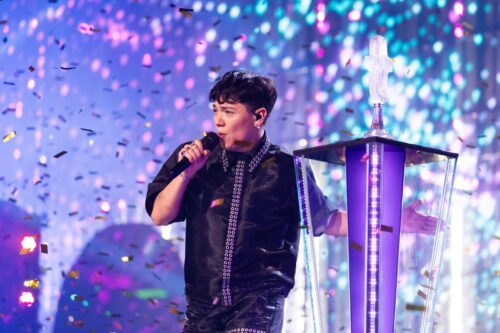
Austria achieved a historic victory in 2025 when JJ took the Eurovision crown with “Wasted Love”. ORF internally selected JJ (born Johannes Pietsch) to represent Austria. He co-wrote this operatic pop ballad with Teodora Ơpirić (Teya, see 2023) and composer Thomas Thurner. Orchestral strings and a melody that builds to a powerful climax make the song a perfect showcase for JJ’s soaring countertenor vocals. The lyrics lament lost love, delivered with the emotional intensity of a classical aria. “Wasted Love” captivated the audience, ultimately winning the Eurovision 2025 final with 436 points. At 24, JJ was already performing as a countertenor at the Vienna State Opera and had been a finalist on ORF’s Starmania in 2021. This triumph marked Austria’s third-ever Eurovision win.

sources: Eurovision.tv, de.wikipedia.org, en.wikipedia.org

Related news

Uncategorized

70 years of Eurovision: An audio selection and a hit

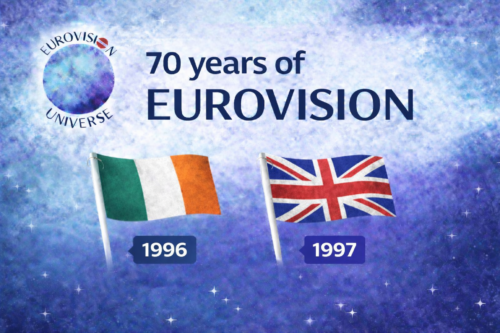
The Eurovision Song Contest is celebrating its 70th anniversary. That is a wonderful milestone. We at Eurovision Universe love diving into the history of the contest. That is why we are taking a closer look at the contests of the past 70 years. 1996 Thirty countries wanted to participate in the Eurovision Song Contest in Oslo. That did not happen. All countries, except host country Norway, therefore had to fight for a spot. This took place via an audio selection round. Denmark, Germany, Hungary, Israel, debuting Macedonia, Romania, and Russia did not make it through. The contest was presented by Ingvild Bryn and the famous Morten Harkett, singer of A-ha. During the broadcast, extensive use was made of virtual reality, allowing Ingvild Bryn to easily walk between the sections of the scoreboard, or even through it. The songs Marianna Efstratou participated for Greece for the second time. Elisabeth Andreassen performed for no less than the fourth time, but for the first time solo. Notable was LĂșcia Moniz, who represented Portugal. Her “O meu coração nĂŁo tem cor” finished sixth, which for a long time was the best score ever for the Portuguese. Maarja-Liis Illus and Ivo Linna really caught the eye of Estonia. She was 15, he 46. The duo sang a sweet song titled “Kaelakee hÀÀl”. And what Finland failed to achieve in all those years, Estonia did effortlessly: walking straight into the top 5 with a song in a Finno-Ugric language. There was also a major difference between the two Dutch duo partners, Maxine and Franklin Brown. However, in this case, it concerned the length. The Dutch entry “De eerste keer” is one of the few that rose in the rankings ĂĄfter the Eurovision Song Contest. The Spanish jury had, or so people thought, said “Poland, 6 points”. But the somewhat nasal-speaking jury chairwoman had said “Holland, 6 points”. People only found out about that later. It is not for nothing that this country ought to be called The Netherlands. Austria (“Weil’s dr guat got” in Vorarlberg) and France “Diwanit bugale” in Breton both sang in a minority language. The new generation after ABBA was also making its appearance. Peter Grönvall was one of the members of the group One More Time. And he was the son of Benny Andersson of ABBA. The group had already had a major hit in Europe with “Highland”. Singer Nanne Grönvall would participate in the Swedish Melodifestivalen a number of times, and even once in the British national final. Eimear Quinn Around this time, the Belgian documentary filmmaker Herman Molle made a documentary titled “How do I win the Eurovision Song Contest?”. Molle’s main recommendation: become Irish. Because Ireland won again. Eimear Quinn had sung with AnĂșna, the choir that accompanied River Dance. With her song “The Voice”, she effortlessly secured the seventh victory for Ireland. “You’re bringing it back too soon,” Morten Harkett grumbled briefly. But the party in Ireland was no less big for it. Nor was the nervous breakdown among the people at the Irish broadcaster RTÉ. 1997 The Eurovision Song Contest practically resided in the Point Theatre in Dublin. However, the audio pre-selection had been scrapped. The relegation zone was back, so a number of countries swapped places again. Italy returned after a three-year absence. Also new: televoting. In five countries, the public was allowed to cast their vote. The Eurovision Song Contest was presented by Carrie Crowley and, once again, someone from a boy band: Ronan Keating of Boyzone. The songs ƞebnem Parker participated for Turkey for the second consecutive time. Her “Dinle” was roughly at the bottom in the odds, but surprisingly finished third in the final ranking. Celebrations in Turkey, which now finally dared to dream of a victory. Young Maarja-Liis Illus from Estonia also returned after a year, this time solo. And Alma ČardĆŸić from Bosnia and Herzegovina also took a second try. Tor Endresen participated for Norway. He had competed in the Norwegian national final almost every year and had finally won. How disappointing that he finished with zero points. The duo Jalisse competed for Italy. The two finished fourth. It didn’t really help: Italy dropped out immediately afterwards. Bianca Shomburg had won the Soundmixshow in Germany, where she imitated Celine Dion. However, she did not do that in terms of the result at the Eurovision Song Contest. Russia sent the country’s biggest star. For years, Alla Pugacheva had been unmatched. There was no sign of that at the Eurovision Song Contest. The rest of Europe appreciated her with a fifteenth place. And then there was Paul Oscar. He represented Iceland. Lying on a sofa, surrounded by female beauty (which he had no eye for in real life), he sang his song. At the end of the song, he made a ‘gun gesture’ with his hand, shooting himself in the mouth. It was striking that Oscar received points exclusively from televoting countries. Katrina & The Waves An unwritten rule is that when an established name participates, they can finish very high but do not win. Katrina & The Waves did not adhere to this. In the 80s, they had a big hit with “Walking On Sunshine”. The song “Love Shine A Light” was originally intended as an anthem for Samaritans in recognition of the thirtieth anniversary of the Swindon branch of that organization. Nevertheless, it ended up at the Eurovision Song Contest, where it won effortlessly. Katrina & The Waves had an international hit with it. The song remains a Eurovision classic to this day. In 2020, it took center stage in the replacement broadcast for the canceled Song Contest: Eurovision Shine A Light.

Read More »
Uncategorized
Martijn

70 years of Eurovision: An audio selection and a hit

The Eurovision Song Contest is celebrating its 70th anniversary. That is a wonderful milestone. We at Eurovision Universe love diving into the history of the contest. That is why we are taking a closer look at the contests of the past 70 years. 1996 Thirty countries wanted to participate in the Eurovision Song Contest in Oslo. That did not happen. All countries, except host country Norway, therefore had to fight for a spot. This took place via an audio selection round. Denmark, Germany, Hungary, Israel, debuting Macedonia, Romania, and Russia did not make it through. The contest was presented by Ingvild Bryn and the famous Morten Harkett, singer of A-ha. During the broadcast, extensive use was made of virtual reality, allowing Ingvild Bryn to easily walk between the sections of the scoreboard, or even through it. The songs Marianna Efstratou participated for Greece for the second time. Elisabeth Andreassen performed for no less than the fourth time, but for the first time solo. Notable was LĂșcia Moniz, who represented Portugal. Her “O meu coração nĂŁo tem cor” finished sixth, which for a long time was the best score ever for the Portuguese. Maarja-Liis Illus and Ivo Linna really caught the eye of Estonia. She was 15, he 46. The duo sang a sweet song titled “Kaelakee hÀÀl”. And what Finland failed to achieve in all those years, Estonia did effortlessly: walking straight into the top 5 with a song in a Finno-Ugric language. There was also a major difference between the two Dutch duo partners, Maxine and Franklin Brown. However, in this case, it concerned the length. The Dutch entry “De eerste keer” is one of the few that rose in the rankings ĂĄfter the Eurovision Song Contest. The Spanish jury had, or so people thought, said “Poland, 6 points”. But the somewhat nasal-speaking jury chairwoman had said “Holland, 6 points”. People only found out about that later. It is not for nothing that this country ought to be called The Netherlands. Austria (“Weil’s dr guat got” in Vorarlberg) and France “Diwanit bugale” in Breton both sang in a minority language. The new generation after ABBA was also making its appearance. Peter Grönvall was one of the members of the group One More Time. And he was the son of Benny Andersson of ABBA. The group had already had a major hit in Europe with “Highland”. Singer Nanne Grönvall would participate in the Swedish Melodifestivalen a number of times, and even once in the British national final. Eimear Quinn Around this time, the Belgian documentary filmmaker Herman Molle made a documentary titled “How do I win the Eurovision Song Contest?”. Molle’s main recommendation: become Irish. Because Ireland won again. Eimear Quinn had sung with AnĂșna, the choir that accompanied River Dance. With her song “The Voice”, she effortlessly secured the seventh victory for Ireland. “You’re bringing it back too soon,” Morten Harkett grumbled briefly. But the party in Ireland was no less big for it. Nor was the nervous breakdown among the people at the Irish broadcaster RTÉ. 1997 The Eurovision Song Contest practically resided in the Point Theatre in Dublin. However, the audio pre-selection had been scrapped. The relegation zone was back, so a number of countries swapped places again. Italy returned after a three-year absence. Also new: televoting. In five countries, the public was allowed to cast their vote. The Eurovision Song Contest was presented by Carrie Crowley and, once again, someone from a boy band: Ronan Keating of Boyzone. The songs ƞebnem Parker participated for Turkey for the second consecutive time. Her “Dinle” was roughly at the bottom in the odds, but surprisingly finished third in the final ranking. Celebrations in Turkey, which now finally dared to dream of a victory. Young Maarja-Liis Illus from Estonia also returned after a year, this time solo. And Alma ČardĆŸić from Bosnia and Herzegovina also took a second try. Tor Endresen participated for Norway. He had competed in the Norwegian national final almost every year and had finally won. How disappointing that he finished with zero points. The duo Jalisse competed for Italy. The two finished fourth. It didn’t really help: Italy dropped out immediately afterwards. Bianca Shomburg had won the Soundmixshow in Germany, where she imitated Celine Dion. However, she did not do that in terms of the result at the Eurovision Song Contest. Russia sent the country’s biggest star. For years, Alla Pugacheva had been unmatched. There was no sign of that at the Eurovision Song Contest. The rest of Europe appreciated her with a fifteenth place. And then there was Paul Oscar. He represented Iceland. Lying on a sofa, surrounded by female beauty (which he had no eye for in real life), he sang his song. At the end of the song, he made a ‘gun gesture’ with his hand, shooting himself in the mouth. It was striking that Oscar received points exclusively from televoting countries. Katrina & The Waves An unwritten rule is that when an established name participates, they can finish very high but do not win. Katrina & The Waves did not adhere to this. In the 80s, they had a big hit with “Walking On Sunshine”. The song “Love Shine A Light” was originally intended as an anthem for Samaritans in recognition of the thirtieth anniversary of the Swindon branch of that organization. Nevertheless, it ended up at the Eurovision Song Contest, where it won effortlessly. Katrina & The Waves had an international hit with it. The song remains a Eurovision classic to this day. In 2020, it took center stage in the replacement broadcast for the canceled Song Contest: Eurovision Shine A Light.

Read More »
Follow Us: