Vienna, 12 points: Animals and a groom on stage

Day six of rehearsals at the 70th Eurovision Song Contest in Vienna is the one that the Grand Final delegations have been waiting for. While the semi-finalists spent the past week breaking in the Wiener Stadthalle, Italy, Germany, France, the United Kingdom and host country Austria stepped onto that same stage for the very first time today. First rehearsals remain closed to press. Each delegation receives a 30-minute slot on stage, with official photographs released approximately 24 hours after each performance. The official EBU live blog on the Eurovision subreddit is the primary source of real-time descriptions; Eurovision Universe has supplemented those accounts with broadcaster statements, social media posts from the artists, and national press coverage.

Second rehearsals for all five countries follow on Saturday, 9 May. All five compete directly in the Grand Final on Saturday, 16 May.


🇮🇹 Italy — Sal Da Vinci, “Per Sempre Sì”

Running order: Grand Final position TBC | First rehearsal: 7 May, 13:00–13:25 CEST | Second rehearsal: 9 May

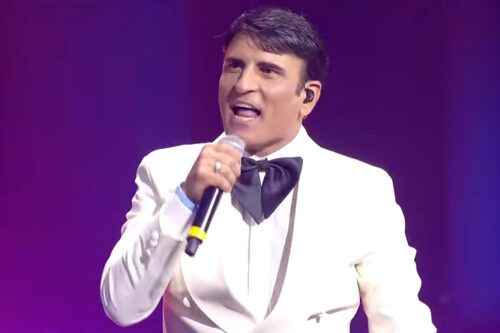
The performance opens with a suit fitting. A pair of groomsmen assist a happy fellow choosing threads for his impending special day, while Sal performs at the front of the stage dressed in a white suit, modern in style but representative of Neapolitan design, made especially for him by a Neapolitan designer.

For the next scene, a chandelier is lowered as Sal ushers the audience into an extravagant ballroom. An excited groom and his best men showcase choreography, including backflips, as the wedding reception begins to take shape. Then comes the big moment. The blushing bride walks slowly up the catwalk of the stage, while Sal himself moonlights as the marriage officiant. The song closes with the wedding reception itself. It’s set among lemon trees and lights, with fireworks depicted on the LED graphics. 

Sal Da Vinci, born Salvatore Michael Sorrentino in 1969, is one of the most recognised voices of the Neapolitan pop scene, with a career spanning theatre, television and chart music. He secured his place in Vienna by winning the Festival di Sanremo 2026 with “Per Sempre Sì”, a victory that marked a full-circle moment in his long relationship with the festival. Italy’s second rehearsal takes place on Saturday, 9 May.
Sources: EBU official live blog / RAI / Instagram @saldavinciofficial


🇩🇪 Germany — Sarah Engels, “Fire”

Running order: Grand Final position TBC | First rehearsal: 7 May, 15:00–15:25 CEST | Second rehearsal: 9 May

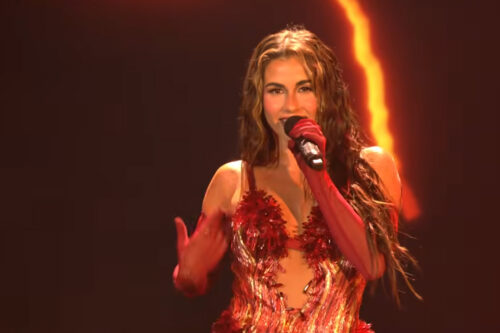
The centrepiece of the staging is a cube-shaped prop that gives Engels her own elevated performance platform. According to the official Eurovision subreddit live blog, she opens the performance lying on top of it, delivering a piano-ballad version of “Fire” directly to the camera positioned above her. It is a moment of stillness and control. However, it does not last long. The track ignites, the banger takes over, and Sarah Engels is off.

The outfit is gold, head to toe. A bodysuit with a corset section designed to resemble roaring flames, with sparkling rhinestones scattered across it like golden embers. Four dancers join her on stage, also dressed in gold. The Reddit live blog notes that some staging surprises have been kept under wraps at the delegation’s request. What it can confirm is that the performance closes with a pyrotechnic finale. Given the song is called “Fire”, it could hardly end any other way.

Sarah Engels first rose to national recognition in 2011 through Deutschland Sucht Den Superstar. She has since built one of Germany’s most varied careers across Let’s Dance, The Masked Singer, Dancing on Ice and her current lead role as Satine in Moulin Rouge! She won Das Deutsche Finale on 28 February 2026. Germany’s second rehearsal takes place on Saturday, 9 May.
Sources: r/eurovision official live blog / ARD-SWR / Instagram @sarahengelsofficial


🇫🇷 France — Monroe, “Regarde !”

Running order: Grand Final position TBC | First rehearsal: 7 May, 15:35–16:00 CEST | Second rehearsal: 9 May

At just 17 years old, Monroe is one of the youngest artists ever to carry the French flag at Eurovision. The delegation around her has made one thing clear: “Regarde !” is a full theatrical event, not simply a televised pop performance.

Head of delegation Alexandra Redde-Amiel has pushed the staging in a more theatrical direction than France’s recent entries, with the team working extensively on the song’s dramaturgy to bridge lyrical music with pop and musical theatre elements. The central phrase, “look at me”, reaches beyond the song’s lyrical meaning and functions as a directive for the entire visual concept.

The French delegation has deliberately withheld staging details ahead of rehearsals, reinforcing the idea that this performance will only fully reveal itself in the moment. Five performers join Monroe on stage. For her first ever live performance of “Regarde !”, she brought over a dozen dancers. Eurovision’s stage rules cap the total to six, Monroe included.

Monroe Vata Rigby, born 19 November 2008, grew up between France and the United States, discovered her love of classical music singing in a church choir, and won the eleventh season of Prodiges on France Télévisions in early 2025. France Télévisions selected her internally on 6 March 2026. France’s second rehearsal takes place on Saturday, 9 May.

Sources: EBU official live blog / France Télévisions / Instagram @monroe.musique


🇬🇧 United Kingdom — LOOK MUM NO COMPUTER, “Eins, Zwei, Drei”

Running order: Grand Final position TBC | First rehearsal: 7 May, 16:10–16:35 CEST | Second rehearsal: 9 May

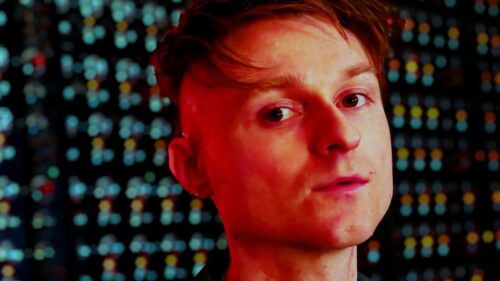
The British entry arrives at the Wiener Stadthalle with a supersized office that explodes into a synthesiser wonderland. As the song begins, rows of desks occupy the stage. Joining LOOK MUM NO COMPUTER for his shift are four co-workers.They are wearing computer monitors for heads. These co-workers embody precisely how the artist feels about the soul-crushing drudgery of office life.

As the track kicks in, LOOK MUM NO COMPUTER breaks free and escapes. The office desks become a choreography centrepiece. Before long a stage makeover reveals his signature synthesisers and keyboard. The props were built by LOOK MUM NO COMPUTER himself. For his outfit, he is wearing his trademark boiler suit, upgraded to a dusky pink with silver zips, completed with Doc Marten boots.

The staging is directed by Fredrik “Benke” Rydman, whose Eurovision credits include Nemo with “The Code”, Käärijä with “Cha Cha Cha”, and Måns Zelmerlöw with “Heroes”. Sam Battle, known as LOOK MUM NO COMPUTER, is an English musician, YouTuber and electronics enthusiast. He became widely known through building unusual synthesisers and musical instruments. That’s including the famous Furby organ and his own Kosmo modular system, with which “Eins, Zwei, Drei” was written entirely. The United Kingdom’s second rehearsal takes place on Saturday, 9 May.
LOOK MUM NO COMPUTER – Eins Zwei Drei

Sources: EBU official live blog / BBC / Instagram @lookmumnocomputer


🇦🇹 Austria — Cosmó, “Tanzschein”

Running order: 25 (Grand Final closer) | First rehearsal: 7 May, 16:45–17:10 CEST | Second rehearsal: 9 May

The performance opens with Cosmó and a crowd of animal characters lying flat on the stage floor. Nighttime has fallen. The club awaits. The words “Dance away your inner animal” appear written on the stage. That phrase doubles as a mission statement for everything that follows.

Tanzschein has its dance routine, and that choreography sits firmly at the heart of the staging. Cosmó and his animal companions perform it in a line, and then again atop huge climbing frames lowered from the arena ceiling onto the stage floor. The message is clear: he wants the audience at home to join in. 

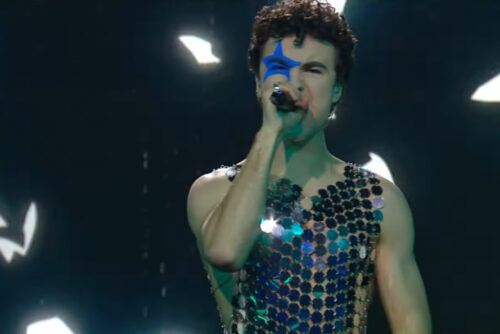
Cosmó wears black leather trousers, a black rhinestone shirt, and a mirrorball-inspired breastplate with matching disco armour running down his left arm. The performance ends at the club, with multi-coloured strobe lights pulsating behind him.

Cosmó, born Benjamin Gedeon on 18 June 2006 in Budapest, won the Austrian national final Vienna Calling – Wer singt für Österreich? on 20 February 2026. After visiting the stage ahead of rehearsals, he described the Stadthalle as “huge” yet full of attention to detail, and said the proximity of the audience gave it a personal feeling of togetherness. As the host country’s entry and the Grand Final’s closing act, Austria performs last of all 25 finalists on 16 May. Austria’s second rehearsal takes place on Saturday, 9 May.
Sources: r/eurovision official live blog / ORF / Instagram @cosmomachtmusik


Photographs/videos

Official rehearsal photographs for all five countries will be published on the Eurovision Song Contest’s Instagram and Facebook channels approximately 24 hours after today’s sessions. Second rehearsals for Italy, Germany, France, the United Kingdom and Austria take place on Saturday, 9 May. The Grand Final of the 70th Eurovision Song Contest takes place on Saturday, 16 May 2026 at the Wiener Stadthalle in Vienna.

Related news

Eurovision 2026

Vienna 12 points: from eighties music to progressive metal

Five more countries start their second rehearsals. As we still don’t have access to the rehearsals, we will do something else. Per entry, we highlight one subject and give you some more information. That can be something about the artist, the song, the lyrics or even something completely different.  Belgium – Essyla, “Dancing on the Ice” Running order: 11 | Rehearsal: 10:30–10:55 CEST During Belgium’s second rehearsal in Vienna, with ESSYLA carrying the flag in 2026, another Belgian Eurovision story returns to the spotlight. Forty years ago, Sandra Kim won the contest in Bergen with “J’aime la vie”, giving Belgium its first and so far only victory. Her triumph, however, has always carried an unusual footnote. In the song she sang that she was fifteen. At the time, the public was told she was fourteen. Later, Sandra Kim admitted she had actually been only thirteen when she stepped onto the Eurovision stage. The revelation made her the youngest winner in contest history, a record that can no longer be broken under today’s age rules. While ESSYLA rehearses for a new Belgian chapter, Kim’s story remains a reminder of Eurovision’s unpredictable past: a bright, youthful performance that became both a national celebration and a lasting controversy for fans across Europe and beyond, even today.  Lithuania – Lion Ceccah, “Sólo Quiero Más” Running order: 12 | Rehearsal: 11:05–11:30 CEST Six languages in the Lithuanian entry may sound like a Eurovision record, but the multilingual crown still belongs to Norway. In 1973, the Bendik Singers performed “It’s Just A Game” in Luxembourg and packed an extraordinary twelve languages into one playful pop song. English and French carried most of the lyrics, but the performance also included brief phrases in Spanish, Italian, Dutch, German, Irish, Serbo-Croatian, Hebrew, Finnish, Swedish and Norwegian. The result was more than a gimmick: the song’s jazzy vocal exchanges and theatrical delivery made it stand out in a year when Eurovision had just introduced the free-language rule. Norway finished seventh with 89 points, its best result for several years. Today, “It’s Just A Game” remains a fascinating reminder that Eurovision’s love of linguistic experiments is not new. Long before Lion Ceccah, Bendik Singers had already turned the contest into a multilingual playground and a lasting Eurovision curiosity.  San Marino – Senhit feat. Boy George, “Superstar” Running order: 13 | Rehearsal: 11:40–12:05 CEST ulture Club may be a household name for older pop fans, but many people watching Eurovision this year might not know the band, for a simple reason: they were not born yet when the group ruled the charts. Formed in London in 1981, Culture Club became one of the defining acts of the 1980s. With Boy George as their charismatic frontman, the band stood out with a colourful image and a sound that mixed pop, soul, reggae and new wave. Their breakthrough came with “Do You Really Want to Hurt Me”, followed by international hits such as “Karma Chameleon” and “Time (Clock of the Heart)”. Culture Club’s impact went beyond record sales. They helped shape the look and feel of 1980s pop and challenged expectations around fashion, identity and performance. For younger Eurovision viewers, this is a chance to discover an influential chapter in British pop history for themselves today.  Poland – Alicja, “Pray” Running order: 14 | Rehearsal: 12:20–12:45 CEST Hit Hit Hurra! was a Polish music talent show aimed at young performers, broadcast on TVP1. The format gave children and teenagers a national stage, combining competitive performances with professional guidance and live musical backing. Its jury included well-known figures from the Polish music scene, among them Eurovision 1994 runner-up Edyta Górniak, music journalist Hirek Wrona and vocal coach Bartek Caboń. One of the programme’s most notable winners was Alicja Szemplińska. In 2016, at just 14, she won the first edition after impressing viewers and the jury with her performance of Beyoncé’s “Listen”. Her victory became an early milestone in a career that later led her to The Voice of Poland and to Eurovision. Alicja rehearses today for the Eurovision Song Contest in Vienna. Today, Hit Hit Hurra! is remembered as an important stepping stone for young Polish talent and future pop stars nationwide.  Serbia – Lavina, “Kraj mene” Running order: 15 | Rehearsal: 12:55–13:20 CEST Progressive metal is built on ambition. The genre takes the power of heavy metal and combines it with complex rhythms, extended song structures and influences from progressive rock, classical music and jazz. Instead of relying only on short, direct hooks, progressive metal often develops slowly, moving through different moods and dramatic contrasts. That makes it a natural fit for artists who want to tell a story on stage. At this year’s Eurovision Song Contest in Vienna, Serbia’s Lavina brings that approach into a very different arena. The six-member band from Niš, formed in 2020, represents Serbia with “Kraj Mene”. Their music, rooted in metal and rock influences, adds a darker, theatrical edge to a contest often associated with pop. For viewers less familiar with the genre, Lavina’s rehearsal today offers a chance to hear how progressive metal can be emotional, technical and accessible at the same time for audiences watching live.  

Read More »
Eurovision 2026
Martijn

Vienna, 12 points: Animals and a groom on stage

Day six of rehearsals at the 70th Eurovision Song Contest in Vienna is the one that the Grand Final delegations have been waiting for. While the semi-finalists spent the past week breaking in the Wiener Stadthalle, Italy, Germany, France, the United Kingdom and host country Austria stepped onto that same stage for the very first time today. First rehearsals remain closed to press. Each delegation receives a 30-minute slot on stage, with official photographs released approximately 24 hours after each performance. The official EBU live blog on the Eurovision subreddit is the primary source of real-time descriptions; Eurovision Universe has supplemented those accounts with broadcaster statements, social media posts from the artists, and national press coverage. Second rehearsals for all five countries follow on Saturday, 9 May. All five compete directly in the Grand Final on Saturday, 16 May. 🇮🇹 Italy — Sal Da Vinci, “Per Sempre Sì” Running order: Grand Final position TBC | First rehearsal: 7 May, 13:00–13:25 CEST | Second rehearsal: 9 May The performance opens with a suit fitting. A pair of groomsmen assist a happy fellow choosing threads for his impending special day, while Sal performs at the front of the stage dressed in a white suit, modern in style but representative of Neapolitan design, made especially for him by a Neapolitan designer. For the next scene, a chandelier is lowered as Sal ushers the audience into an extravagant ballroom. An excited groom and his best men showcase choreography, including backflips, as the wedding reception begins to take shape. Then comes the big moment. The blushing bride walks slowly up the catwalk of the stage, while Sal himself moonlights as the marriage officiant. The song closes with the wedding reception itself. It’s set among lemon trees and lights, with fireworks depicted on the LED graphics.  Sal Da Vinci, born Salvatore Michael Sorrentino in 1969, is one of the most recognised voices of the Neapolitan pop scene, with a career spanning theatre, television and chart music. He secured his place in Vienna by winning the Festival di Sanremo 2026 with “Per Sempre Sì”, a victory that marked a full-circle moment in his long relationship with the festival. Italy’s second rehearsal takes place on Saturday, 9 May. Sources: EBU official live blog / RAI / Instagram @saldavinciofficial 🇩🇪 Germany — Sarah Engels, “Fire” Running order: Grand Final position TBC | First rehearsal: 7 May, 15:00–15:25 CEST | Second rehearsal: 9 May The centrepiece of the staging is a cube-shaped prop that gives Engels her own elevated performance platform. According to the official Eurovision subreddit live blog, she opens the performance lying on top of it, delivering a piano-ballad version of “Fire” directly to the camera positioned above her. It is a moment of stillness and control. However, it does not last long. The track ignites, the banger takes over, and Sarah Engels is off. The outfit is gold, head to toe. A bodysuit with a corset section designed to resemble roaring flames, with sparkling rhinestones scattered across it like golden embers. Four dancers join her on stage, also dressed in gold. The Reddit live blog notes that some staging surprises have been kept under wraps at the delegation’s request. What it can confirm is that the performance closes with a pyrotechnic finale. Given the song is called “Fire”, it could hardly end any other way. Sarah Engels first rose to national recognition in 2011 through Deutschland Sucht Den Superstar. She has since built one of Germany’s most varied careers across Let’s Dance, The Masked Singer, Dancing on Ice and her current lead role as Satine in Moulin Rouge! She won Das Deutsche Finale on 28 February 2026. Germany’s second rehearsal takes place on Saturday, 9 May. Sources: r/eurovision official live blog / ARD-SWR / Instagram @sarahengelsofficial 🇫🇷 France — Monroe, “Regarde !” Running order: Grand Final position TBC | First rehearsal: 7 May, 15:35–16:00 CEST | Second rehearsal: 9 May At just 17 years old, Monroe is one of the youngest artists ever to carry the French flag at Eurovision. The delegation around her has made one thing clear: “Regarde !” is a full theatrical event, not simply a televised pop performance. Head of delegation Alexandra Redde-Amiel has pushed the staging in a more theatrical direction than France’s recent entries, with the team working extensively on the song’s dramaturgy to bridge lyrical music with pop and musical theatre elements. The central phrase, “look at me”, reaches beyond the song’s lyrical meaning and functions as a directive for the entire visual concept. The French delegation has deliberately withheld staging details ahead of rehearsals, reinforcing the idea that this performance will only fully reveal itself in the moment. Five performers join Monroe on stage. For her first ever live performance of “Regarde !”, she brought over a dozen dancers. Eurovision’s stage rules cap the total to six, Monroe included. Monroe Vata Rigby, born 19 November 2008, grew up between France and the United States, discovered her love of classical music singing in a church choir, and won the eleventh season of Prodiges on France Télévisions in early 2025. France Télévisions selected her internally on 6 March 2026. France’s second rehearsal takes place on Saturday, 9 May. Sources: EBU official live blog / France Télévisions / Instagram @monroe.musique 🇬🇧 United Kingdom — LOOK MUM NO COMPUTER, “Eins, Zwei, Drei” Running order: Grand Final position TBC | First rehearsal: 7 May, 16:10–16:35 CEST | Second rehearsal: 9 May The British entry arrives at the Wiener Stadthalle with a supersized office that explodes into a synthesiser wonderland. As the song begins, rows of desks occupy the stage. Joining LOOK MUM NO COMPUTER for his shift are four co-workers.They are wearing computer monitors for heads. These co-workers embody precisely how the artist feels about the soul-crushing drudgery of office life. As the track kicks in, LOOK MUM NO COMPUTER breaks free and escapes. The office desks become a choreography centrepiece. Before long a stage makeover reveals his signature synthesisers and keyboard. The

Read More »
Follow Us: