Basel Bulletin: from wisdom teeth to red strobe lights

From wisdom teeth to red strobe lights, that is where it was about this afternoon. All the participants of the first semifinal have their second rehearsal. We have no liveblog from EBU, however we are expecting 30 seconds videos later today. We also have pictures.

đŸ‡”đŸ‡č Portugal

Following their first rehearsal in Basel on May 3, Portugal’s Eurovision 2025 representatives, NAPA, have shared insights into their performance and the message behind their song “Deslocado”. Youtube

In a recent interview, NAPA discussed the inspiration behind their song, which reflects their journey from Madeira to Lisbon in search of greater opportunities. They emphasized that the staging aims to translate the song’s message of displacement and longing for home. The band stated, “We wanted the performance to convey the emotional weight of leaving one’s homeland and the hope of finding a new place to belong.” Eurovisionworld

Regarding betting odds, NAPA’s chances of qualifying from Semi-Final 1 are currently estimated at 22%, placing them 14th among the 15 acts in their semi-final. This indicates a challenging path ahead, but the band remains optimistic about connecting with the audience through their heartfelt performance.
đŸ“· EBU/Corinne Cumming

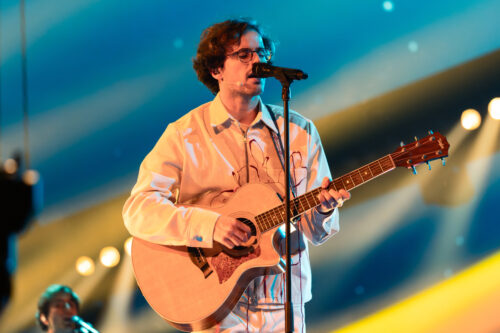
🇳🇮 Norway

Following his first rehearsal in Basel on May 3, Norway’s Eurovision 2025 representative, Kyle Alessandro, faced an unexpected health challenge. Experiencing escalating pain from a wisdom tooth, he managed to complete his rehearsal with the aid of strong painkillers. Subsequently, he underwent emergency dental surgery to remove the problematic tooth. Advised by medical professionals, Kyle is resting until May 7, leading to the cancellation of scheduled rehearsals and press engagements.

Despite this setback, Kyle remains optimistic about his performance of “Lighter.” The staging draws inspiration from Norwegian medieval times, featuring Viking runestones and fire elements to symbolize resilience and inner strength. Choreography blends Norwegian folk dance with contemporary influences, aiming to deliver a powerful visual impact.

As of early May, Norway’s Eurovision 2025 entry, Kyle Alessandro’s “Lighter,” is positioned 23rd in the overall betting odds, with bookmakers assigning it a winning probability of approximately 0.6%. This placement indicates a modest chance of victory, reflecting a slight improvement from earlier standings. 

đŸ“· EBU/Corinne Cumming

🇧đŸ‡Ș Belgium

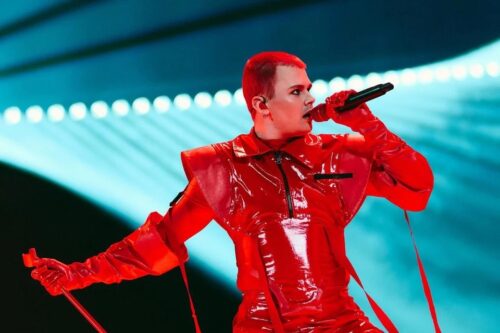
Following his first rehearsal in Basel on May 3, Belgium’s Eurovision 2025 representative, Red Sebastian, expressed his enthusiasm and vision for the performance. In an interview with EurovisionFun, he described the stage as “the ground where I hope to make history,” highlighting the emotional significance of this moment in his career. He characterized the performance as a “red rave club,” aiming to deliver a powerful blend of energy, light, and style. source: Eurovision Fun.

The staging of “Strobe Lights” features dynamic lighting and choreography, creating an immersive experience that resonates with both the audience and juries. Red Sebastian’s outfit, designed by Bert De Coninck, incorporates his signature red color and complements the song’s vibrant theme. He is accompanied on stage by three backing dancers and backing vocalist Lani Pellegrini, aiming to deliver a cohesive and engaging performance.

data-end=”1206″>Regarding betting odds, as of early May, Belgium’s “Strobe Lights” is considered a dark horse in the competition. Bookmakers have placed the entry at odds ranging between 20/1 and 40/1, indicating a moderate chance of winning.
đŸ“· Alma Bengtsson/EBU

🇩🇿 Azerbaijan

On social media, Mamagama shared their excitement about the rehearsal. In a recent Instagram post, they expressed gratitude for the support and anticipation for the upcoming performances.

Regarding betting odds, as of May 7, Azerbaijan’s “Run With U” holds an 11th place position in the Semi-Final 1 qualification odds, with a 42% chance of advancing to the Grand Final. This places them just outside the top 10, indicating a competitive but challenging path ahead. In the overall winner odds, Azerbaijan is considered a long shot, with bookmakers offering odds ranging from 200/1 to 750/1, reflecting a modest chance of clinching the title.
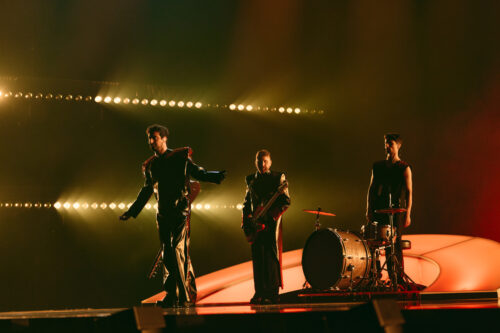
đŸ“· Alma Bengtsson/EBU

🇾đŸ‡Č San Marino

Following his first rehearsal on May 3, Gabry Ponte, representing San Marino at Eurovision 2025 with “Tutta l’Italia,” has not made any public comments or given interviews specifically addressing the rehearsal. His social media channels have not featured posts related to the rehearsal. No new interviews discussing it have been published.

However, earlier in April, Ponte expressed his enthusiasm about participating in Eurovision. Ponte stated, “When the invitation from San Marino arrived, I knew I had to go for it. It felt like the perfect opportunity, and I knew it could even lead to Eurovision.” He added, “Now that I’m here, I’m bringing ‘Tutta L’Italia’ to the Eurovision stage with a performance that’s full of energy, passion and, of course, a lot of dancing.” Radio Times

Regarding betting odds, as of May 7, San Marino’s “Tutta l’Italia” is ranked 24th in the overall Eurovision 2025 winner odds, with a winning probability of approximately 9%. In the Semi-Final 1 qualification odds, San Marino is predicted to secure the final spot in the top 10, indicating a competitive but challenging path to the Grand Final.
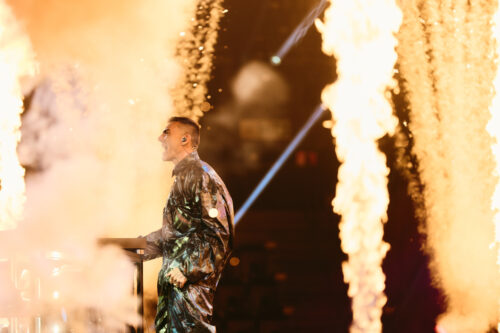
đŸ“· Alma Bengtsson/EBU


Related news

History

70 years of Eurovision: CĂ©line Dion and…. eh… who?

The Eurovision Song Contest is celebrating its 70th anniversary. That is a wonderful milestone. We at Eurovision Universe love diving into the history of the contest. That is why we are taking a closer look at the contests of the past 70 years. 1988 For the second time, the Royal Dublin Society was the venue. Two hosts were in charge: Pat Kenny and Michelle Rocca. Cyprus had to withdraw. The Cypriot entry turned out to have already participated in the national final four years earlier. That came out so late that Cyprus could not find a new song in time. Tommy Körberg participated for Sweden. He did that back in 1969 as well. Back then, there were two winners in the national final: Tommy and Jan Malmsjö. After a runoff, Tommy was allowed to go to the Eurovision Song Contest. And lo and behold, in 1988 he was the replacement for…. that very same Jan Malmsjö! Yardena Arazi participated for Israel. She did so in 1976, but in 1979 she was the host. It is the first and only time that a former host participated. MFÖ represented Turkey for the second time. Furthermore, the duo Hot Eyes was present for the third time. This time, singer Kirsten Siggaard was pregnant for no less than eight months! And then there was Dora. She had participated for Portugal before, and now again. Many big stars traveled to Dublin. Scott Fitzgerald had already had a worldwide hit with “If I Had Words” and now sang “Go” for the United Kingdom. Gerard Joling, who had just completed a tour of Asia, was the Dutch candidate. And France also came up with a big star: GĂ©rard Lenorman. Unfortunately, there was little attention for his “Chanteur de charme”. And then there was the Belgian Lara Fabian. She represented Luxembourg with the song “Croire”. At that time she was still unknown; later she would score many hits.   CĂ©line Dion It was nail-bitingly exciting. The United Kingdom and Switzerland constantly swapped first place. Until the very last point, it was unclear who would win. It was ultimately CĂ©line Dion for Switzerland. This Canadian singer sang “Ne partez pas sans moi”. It didn’t become a big hit everywhere. But a year later, she got to open the festival and sang “Where Does My Heart Beat Now”. It became her first international hit, but certainly not the last. Her absolute biggest success was “My Heart Will Go On”, but she scored many hits. Due to illness, she was unable to perform for a long time. So there was admiration when she did sing during the Olympic Games in Paris. And recently she announced that she will start performing again. 1989 The Eurovision Song Contest was held in Lausanne. Once again, there was a duo presentation: Jacques Descheneaux and Lolita Morena. Cyprus was back after a long absence. Not a single participant had been on the Eurovision stage before. However, two very young participants were striking and controversial. 12-year-old Gili Netanel participated for Israel as half of the duo Gili & Galit. For France, the even younger, 11-year-old Nathalie PĂąque took the stage. This makes her the youngest soloist ever. Many people disagreed with the participation of such young children. A year later, a minimum age was therefore introduced. The show opened with the occasional duo Anna Oxa and Fausto Leali. Two big names in Italian music, who now finished ninth together with “Avrei voluto”. One of the favorites competed for the Netherlands: Justine Pelmelay. But Justine missed a high final note and did not finish as high as expected at all. Birthe KjĂŠr (Denmark) and Anneli Saaristo (Finland) had both tried to represent their country several times before. Now that the time had finally come, both were very successful. With a bright red dress and a swinging song, Birthe came third. Anneli was accompanied by Spanish guitar sounds and sang her song to a seventh place. The Icelandic DanĂ­el was also notable. During the national final, then still with a shaved head, he seemed unable to crack a smile after his victory. As if participating in the Eurovision Song Contest was a severe punishment for the Icelandic singer. Once in Lausanne, now with hair, the Icelander failed to secure even a single point. Riva For the third consecutive time, the duo Stevo Cvikić and Rajko Dujmić wrote the entry. Always following the same recipe: a group with a female singer and a cheerful trifle. As there was no other clear favorite, the group Riva won for Yugoslavia with “Rock Me”. In Yugoslavia, people were happy, but in the rest of Europe, incomprehension prevailed. This wasn’t the best song, was it? What had the jury done!? During the afterparty, a number of participating artists huddled together for a jam session. Among those on stage were the Spanish Nina and the Dutch Justine. Friend and foe alike agreed that this was all much better than the winning song.

Read More »
2026
Anja Kroeze

Road to Vienna: Germany

Road to Vienna: Germany We cannot wait for the Eurovision Song Contest in Vienna. Therefore, we take a closer look at one of the contestants each day. Today, we highlight Germany Sarah Engels: From Talent Show Contestant to Eurovision 2026 Sarah Engels was born on October 15, 1992, in Cologne and raised in HĂŒrth. She discovered her passion for music early, performing at school events and local festivals. Despite taking singing lessons for years, her first attempts at Deutschland sucht den Superstar in 2009 and 2010 ended in early elimination. Still, these setbacks helped shape her determination. Breakthrough on DSDS and Chart Success Her breakthrough came in 2011 during her third attempt at DSDS. After an initial elimination, she returned to the competition and finished as runner-up behind Pietro Lombardi. Soon after, she achieved major chart success with “Call My Name” and “I Miss You,” while her debut album Heartbeat reached number 2 in Germany and earned an Echo nomination. Expanding Career in Music and Television Following DSDS, Sarah Engels built a strong presence in both music and TV. Together with Pietro Lombardi, she released successful duo albums. At the same time, she became a familiar TV personality, finishing second on Let’s Dance and winning shows like The Masked Singer. This phase expanded her audience beyond music. From 2018 onward, Sarah explored a broader sound with albums like ZurĂŒck zu mir and Im Augenblick. She blended pop, schlager, and modern radio music, proving her ability to evolve. Her participation in the Free European Song Contest 2020 further strengthened her position in the German music scene. Acting, Musical Theatre, and New Projects In addition to music, Sarah moved into acting and voice work. She appeared in Das Traumschiff and voiced a character in Miraculous: Ladybug & Cat Noir – Der Film. In 2025, she released Strong Girls Club and took on a leading role in the musical Moulin Rouge! in Cologne, highlighting her versatility as a performer. Eurovision 2026: Representing Germany In 2026, Sarah Engels reached a new milestone by winning Germany’s national selection for the Eurovision Song Contest 2026 with her song “Fire.” The track delivers a message of empowerment and self-confidence. Her journey—from early setbacks to international representation—shows her growth into a complete artist. Fire: A Bold Message About Honesty   Fire is a powerful pop track about confronting lies in a relationship. With a catchy chorus and direct lyrics, the song captures the moment someone refuses to accept dishonesty any longer. From the start, the lyrics show strength and clarity. The singer rejects emotional games and chooses honesty over pretending. This creates a relatable message about self-respect and emotional independence. The Meaning Behind “Fire” The recurring image of “fire” symbolizes inner strength, passion, and confidence. In contrast, the “vampire” metaphor highlights a dishonest partner who hides the truth. Together, these images make the song emotionally impactful and easy to connect with. More Than a Breakup Song Fire goes beyond heartbreak. It focuses on self-worth and personal growth. The message is clear: don’t repeat toxic patterns and know when to walk away.     Germany in the Eurovision Song Contest Germany has been a steadfast participant in the Eurovision Song Contest since its inception in 1956, missing only one edition in 1996 due to elimination in a pre-qualification round. The country has secured two victories: in 1982 with Nicole‘s “Ein bißchen Frieden” and in 2010 with Lena‘s “Satellite.” In recent years, Germany has faced challenges, often placing lower on the scoreboard, with notable exceptions like Michael Schulte‘s fourth-place finish in 2018. As a member of the “Big Five,” Germany automatically qualifies for the Grand Final. The Bookmakers This year as well, the outlook for Germany isn’t very promising. Currently sitting at 23rd place with the bookmakers, it seems likely that Germany could once again finish in the lower ranks of the scoreboard.

Read More »
Follow Us: