Liverpool live: eyes, a typewriter and a car

The third day of rehearsals is already halfway. We are looking at the last six entries we haven’t heard and seen yet (except the Big Five and Ukraine).

photo credits: EBU/Sarah Luise Bennett/Corinne Cumming

Georgia

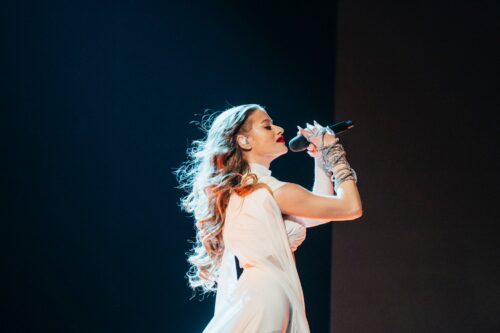
Iru wears a white dress, and what is very remarkable on her looks is the huge bracelet she is wearing on her right arm. Iru is standing on a raised platform in the middle of the stage. She stands there during the entire performance. The LED screeen shows smoke that twirls and turbulent weather. And if you see that, there is only one thing you need: indeed, a wind machine! And it’s there! And of course Iru is surrounded by smoke.
San Marino

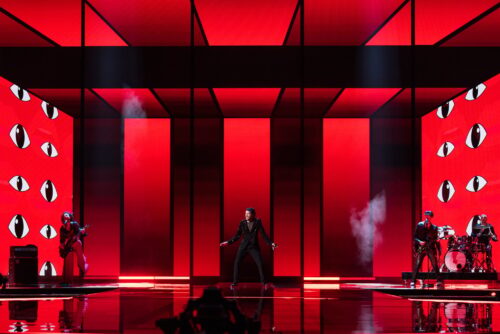
Singer E-King wears a glitter jacket while the rest of the band Piqued Jacks wear black. On stage we have the huge LED wall that spots a lot of red: we see eyes, we see lips, all in a cartoon way. Piqued Jacks use the whole stage, E-King appears as the clear frontman. At several moments, he even lies down on the floor while singing.
Austria

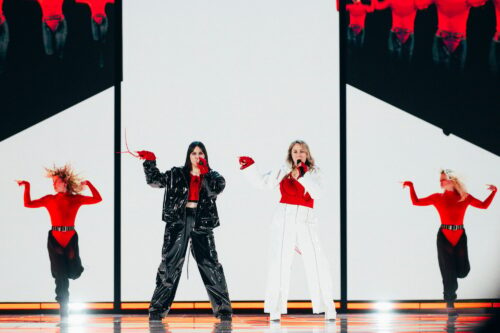
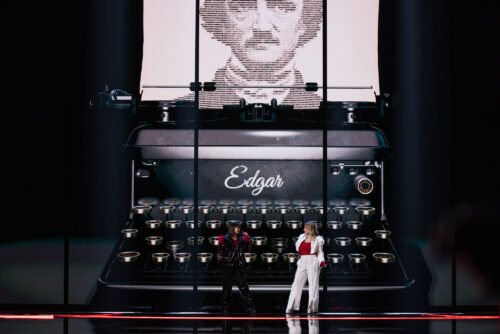
Teya and Salena are wearing opposite colours: Teya wears black and Salena white, both with red blouses. The LED-screens play the main role in the Austrian act. It looks like Teya and Salena start their performance in front of a huge oldfashioned typewriter. In the typewriter a piece of paper with a picture of Edgar Allan Poe. Later we see the two ladies in red and with sunglasses on the screen, and Edgar in red.
Albania

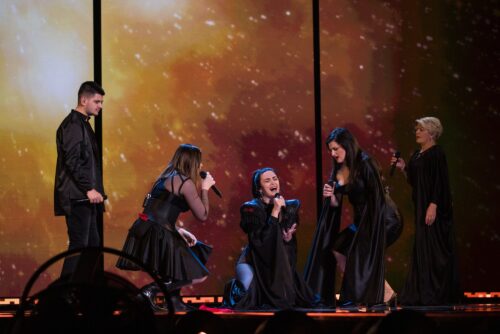
Albina and the Kelmendi family all wear black. The colours at the LED screen are also black…. and red, the colours of the Albanian flag. Many flames during the Albanian performance. This song has quite an emotional performans. Albina sits on the floor for a moment, family members surround her with raised hands. Sacha Jean Baptiste did the staging for this entry.
Lithuania

Monika Linkytė wears an orange suit. She is surrounded by the four backings who all wear black. First she stands on a red background. Later we see half a circle, black, with indian like signs projected on it. She and the backing vocals are standing still at some moments, but walk around later, especially when the “Čiūto Tūto” part is sung.

Australia

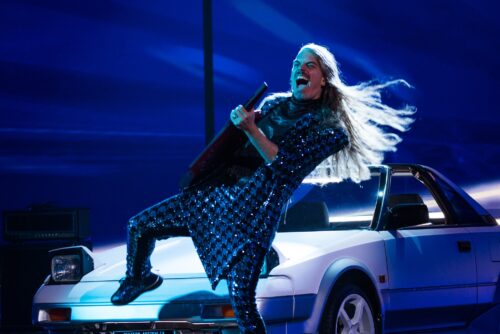
Australia is the last country to perform. Voyager singer Daniel Estrin wears a blue suit with a chequered pattern. The band has a car on stage, a Toyota MR2, a car from the eighties and nineties. On the LED-screens we see a road, mountains and a setting sun. Red fireworks are visible at the end of the song.
in collaboration with Eurovision Artists

Related news

Uncategorized

🇧🇪 Essyla is the Belgian entry for Vienna

photo: EBU/RTBF Belgium has chosen Essyla to represent the country at the Eurovision Song Contest 2026. The announcement was made on 19 February 2026 by Belgian broadcaster RTBF, who revealed both the artist and the song for this year’s contest in Vienna, Austria. Essyla will perform the song “Dancing on the Ice” on the Eurovision stage in May. The track was co‑written by Essyla alongside Nicolas d’Avell and Emil Stengele, with lyrics by Essyla and Barbara Petitjean. It carries a message of hope and resilience, framed around youth and the determination to keep moving forward despite challenges. From The Voice Belgique to Eurovision Originally from Perwez in Walloon Brabant, Essyla first became known to the public during the ninth season of The Voice Belgique, where she reached the final. Her early musical journey began with forming her own band at a young age and later studying voice at the IMEP music institute in Namur. Her style blends influences from French chansons, jazz, folk, rock and funk, creating a distinct pop‑centric sound that has attracted attention across Belgium. Before Eurovision, Essyla released singles like Let You Go and Not My Kind of Dude, and followed these with her debut EP I’ll Be Okay. Through her lyrics, she often explores themes of personal identity, empowerment and emotional honesty. A Significant Selection for Belgium Essyla’s selection marks a notable moment for Belgium at Eurovision. She is the first solo female artist to represent the country at the contest this decade, following a series of male solo artists. The 2026 contest also carries symbolic weight: it marks the 70th anniversary of Belgium’s participation in Eurovision, having debuted in the very first contest in 1956. Belgium’s sole win came in 1986 with J’aime la Vie by Sandra Kim. In May, Belgium will compete in the Eurovision semi‑finals with hopes of securing a place in the Grand Final and showcasing Essyla’s ambitious and uplifting entry on the international stage.

Read More »
Uncategorized
Martijn

🇧🇪 Essyla is the Belgian entry for Vienna

photo: EBU/RTBF Belgium has chosen Essyla to represent the country at the Eurovision Song Contest 2026. The announcement was made on 19 February 2026 by Belgian broadcaster RTBF, who revealed both the artist and the song for this year’s contest in Vienna, Austria. Essyla will perform the song “Dancing on the Ice” on the Eurovision stage in May. The track was co‑written by Essyla alongside Nicolas d’Avell and Emil Stengele, with lyrics by Essyla and Barbara Petitjean. It carries a message of hope and resilience, framed around youth and the determination to keep moving forward despite challenges. From The Voice Belgique to Eurovision Originally from Perwez in Walloon Brabant, Essyla first became known to the public during the ninth season of The Voice Belgique, where she reached the final. Her early musical journey began with forming her own band at a young age and later studying voice at the IMEP music institute in Namur. Her style blends influences from French chansons, jazz, folk, rock and funk, creating a distinct pop‑centric sound that has attracted attention across Belgium. Before Eurovision, Essyla released singles like Let You Go and Not My Kind of Dude, and followed these with her debut EP I’ll Be Okay. Through her lyrics, she often explores themes of personal identity, empowerment and emotional honesty. A Significant Selection for Belgium Essyla’s selection marks a notable moment for Belgium at Eurovision. She is the first solo female artist to represent the country at the contest this decade, following a series of male solo artists. The 2026 contest also carries symbolic weight: it marks the 70th anniversary of Belgium’s participation in Eurovision, having debuted in the very first contest in 1956. Belgium’s sole win came in 1986 with J’aime la Vie by Sandra Kim. In May, Belgium will compete in the Eurovision semi‑finals with hopes of securing a place in the Grand Final and showcasing Essyla’s ambitious and uplifting entry on the international stage.

Read More »
Follow Us: