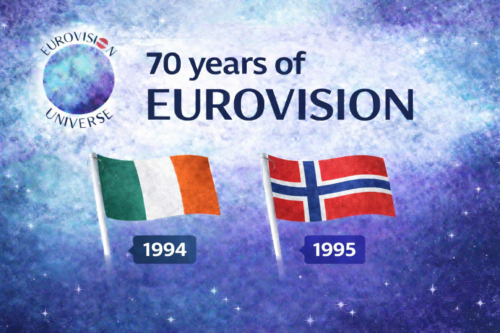
The Eurovision Song Contest is celebrating its 70th anniversary. That is a wonderful milestone. We at Eurovision Universe love diving into the history of the contest. That is why we are taking a closer look at the contests of the past 70 years. 1994 The EBU was frantically searching for a new system. The countries with the worst scores from the previous year had to sit on the sidelines for a year. They had to make way for Estonia, Hungary, Lithuania, Poland, Romania, Russia, and Slovakia. Proud Ireland hosted the Song Contest again, this time simply in Dublin, at the Point Theatre. The hosts were Cynthia Ní Mhurchú and Gerry Ryan. The interval act was the most talked-about ever: River Dance. A dance written by Bill Whelan, but which later grew into an internationally acclaimed act. The songs Marie Bergman represented Sweden, in a duet with Roger Pontare. Marie had also participated in 1971 and 1972. Evridiki returned for Cyprus. Former Bobbysocks member Elisabeth Andreasson sang, also in a duet, for Norway. And the Icelandic Sigga, who had participated in a group twice, now took part solo. That was quite a challenge. Her duo partner from two years earlier, Sissa, was actually supposed to sing the song “Nætur,” but she was sidelined by the Icelandic broadcaster. Portugal caught attention with Sara Tavares. She had won a singing competition in her own country; back then, she imitated Whitney Houston. Her song “Chamar a musica” impressed the audience. Germany opted more for a lot of cheerfulness. The all-female trio Mekado, formed especially for the occasion, performed the cheerful “Wir geben ‘ner Party.” It was sung in German, but with many international terms. And it was a song by Ralph Siegel and Bernd Meinunger. The aforementioned Elisabeth Andreasson sang a duet with the much younger (and sadly enough deceased very young) Jan Werner Danielsen: “Duett,” a mystical song. Friderika Bayer from Hungary sang the serene “Kinek mondjam el vétkeimet?” For a moment, it seemed Hungary was going to win. The first juries all gave their 12 to the debuting country. Ultimately, Friderika finished fourth. Youddiph also came from Eastern Europe. She represented Russia with “Vechny strannik,” but above all with her dress. She constantly changed it into a different dress, keeping the viewer mesmerized and focused on it. The Polish Edyta Górniak had dressed much more simple. The song, too, stood out for its simplicity. It came in second. Because Ireland won, of course. That was how it was done in those days. Paul Harrington & Charlie McGettigan Rumour has it that Ireland had sent two middle-aged men with a ballad because they didn’t want to win again. If that was the case, that plan was not exactly successful. For it was precisely as anti-heroes that Paul Harrington and Charlie McGettigan made a huge impression. Halfway through the voting, they took a lead with their “Rock ‘n’ roll kids” that they never relinquished. The crowd went wild; Ireland was celebrating one big party. Except perhaps at the Irish broadcaster RTÉ, which now found itself facing the organization of the contest once again. Charlie McGettigan recently made the news by wanting to return his trophy, following in the footsteps of Nemo (2024). He, too, could not live with Israel’s participation. However, he could not find his trophy. Understandable, because anyone who looks closely at the award ceremony will see that only composer Brendan Graham received a trophy. 1995 Once again, a number of countries had to make way so that others could return. However, Italy and Luxembourg, both on the reserve bench the previous year, did not return. 23 countries participated in this festival. It was hosted by Mary Kennedy. The songs Arzu Ece participated for Turkey for the second time, having entered the Eurovision stage six years earlier as a member of the group Pan. She was the only artist returning. Justyna Steczkowska participated for Poland. Although she did not finish high, she did attract attention due to the atonal singing during her song. Also noteworthy: Eddie Friel for Ireland. His song “Dreamin’” was such a shameless copy of Julie Felix’s “Moonlight” (just listen to the two songs) that disqualification loomed. Anabel Conde was the participant for Spain. She finished in second place. The group Magazin represented Croatia, with opera singer Lidija Horváth as an additional vocalist. Whereas all group members sang at the national final, now only Lidija and group singer Danijela were visible. The rest had faded into the background. Danijela would not stay with Magazin for much longer. And then there was Alexandros Panayi: he was the fan favorite for Cyprus with “Sti fotia”. He would later often travel with Greece and Cyprus as a backing vocalist or vocal coach. One of the favorites was the Swede Jan Johansen with the ballad “Se på mej”. Another notable ballad was that of Slovenia, “Prisluhni mi”. Neither song won. And then we do not want to leave Iceland unmentioned. After many attempts in national finals, the broadcaster there had selected Bo Halldórsson. He sang the beautiful ballad “Núna”. Later, his daughter Svala would also represent her country. We mention him because Bo Halldórsson passed away last week at 74. Secret Garden Norway won with a remarkable song. The winning “Nocturne” contained only 25 words. The group, Secret Garden, was built around Rolf Løvland, who wrote the winning song 10 years earlier, and his girlfriend Fionualla Sherry. As a violinist, she played a leading role in the song. Singer Gunnhild Tvinnereim, along with the other group members, had only a supporting role. Remarkably: although Ireland did not win, Fionualla Sherry was indeed Irish. And so Ireland won again, but then without winning.