📷 EBU/Alma Bengtsson
About
Biography
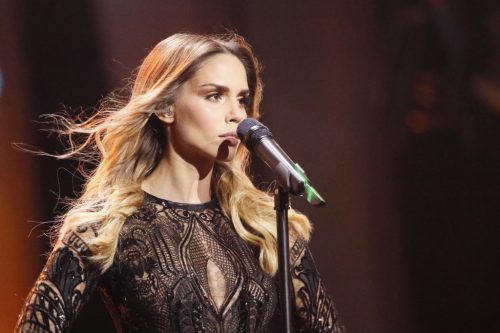
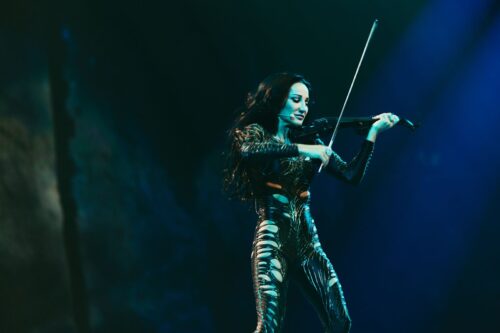
Justyna Maria Steczkowska, born on August 2, 1972, in Rzeszów, Poland, is a renowned Polish singer, songwriter, photographer, and actress. She hails from a musically inclined family, being the fourth of nine children to Danuta and Stanisław Steczkowski, a music teacher and conductor. Her early musical journey involved playing the violin in a family band before transitioning to a solo singing career. Notably, Steczkowska possesses an impressive four-octave vocal range.
Steczkowska’s rise to fame began in 1994 when she won the television talent show “Szansa na sukces” with her rendition of Maanam’s “Buenos Aires.” The following year, she represented Poland in the Eurovision Song Contest with the song “Sama,” securing the 18th position. Over the years, she has released numerous albums, including “Dziewczyna Szamana” (1996), “Naga” (1997), and “Daj mi chwilę” (2007), many of which have achieved gold and platinum status.
In addition to her music career, Steczkowska has ventured into acting, appearing in films such as “Na koniec świata” (1999) and “Billboard” (1998). She has also participated in various television programs, serving as a coach on multiple seasons of “The Voice of Poland” and co-hosting the Polish edition of “Dancing on Ice.” Her contributions to the arts have been recognized with several awards, including six Fryderyk Awards and the Bronze Medal for Merit to Culture Gloria Artis.
In 2000, she released the album “Dzień i Noc,” which showcased electronic influences and expanded her musical repertoire. Two years later, in 2002, she unveiled “Alkimja,” an album featuring traditional Jewish songs performed in Polish, reflecting her deep appreciation for diverse musical traditions.
Steczkowska continued to explore various musical styles with the release of “Femme Fatale” in 2004, an album comprising covers of songs by iconic artists such as Ewa Demarczyk, Dalida, Marilyn Monroe, and Édith Piaf. This project highlighted her ability to reinterpret classic works with her unique vocal prowess. In 2007, she released “Daj mi chwilę,” featuring her original compositions, which achieved gold certification in Poland.
Demonstrating her versatility, Steczkowska ventured into children’s music with “Puchowe Kołysanki” in 2008, a collection of lullabies dedicated to her children. She revisited this genre in 2013 with “Puchowe Kołysanki 2,” continuing to enchant young audiences.
In 2009, she released “To mój czas,” an album that embraced pop sensibilities and resonated with a broad audience. Her collaborative spirit was evident in 2011 when she partnered with Maciej Maleńczuk for “Mezalianse,” an album featuring songs from the renowned Polish cabaret “Kabaret Starszych Panów.” Further showcasing her collaborative efforts, she teamed up with Boban Marković in 2015 for “I na co mi to było?,” an album infused with Balkan rhythms.
Steczkowska’s 2014 album “Anima” delved into spiritual and mystical themes, blending trip-hop elements with her signature vocal style. In 2019, she released “Maria Magdalena. All Is One,” her first English-language album, which combined symphonic and electronic sounds, marking a significant milestone in her international endeavors.
Beyond her recording projects, Steczkowska participated in various television programs. She was a runner-up in the sixth season of the Polish edition of “Dancing with the Stars” in 2007 and co-hosted the Polish version of “Dancing on Ice” in 2008. Her expertise was further recognized through her role as a coach on multiple seasons of “The Voice of Poland,” where she mentored emerging talents.
In 2024, Steczkowska finished second in Poland’s national selection for the Eurovision Song Contest with the song “Witch-er Tarohoro.” Undeterred, she returned in 2025 and won the national preselection, earning the opportunity to represent Poland once again at the Eurovision Song Contest with her song “Gaja,” marking a significant return 30 years after her initial participation.
Entries
Gaja
Country
🇵🇱 Poland
Year
2025
Language
Polish
Lyrics
Emilian Waluchowski
Justyna Steczkowska
Patryk Kumór
Music
Emilian Waluchowski
Justyna Steczkowska
Patryk Kumór
Dominic Buczkowski-Wojtaszek
Dancers
Jakub Walica
Krzysztof Jagodziński
Milena Zdzuj
Piotr Musiałkowski
Results Semi 1
Points: 85
Position: 7
Running order: 2
Results Finals
Points: 156
Position: 14
Running order: 15