About
Biography
Early Life and Musical Training
Darja Švajger was born in 1965 in Maribor, Slovenia. After finishing secondary school, she pursued formal music studies in Graz, Austria. Švajger majored in classical solo singing, jazz, and music pedagogy. She graduated magna cum laude in 1997, earning credentials as a professor of solo singing. During her studies, Švajger began performing as a solo vocalist with jazz bands and symphony orchestras. By 1992, she was also involved in musical theatre projects at the Slovene National Theatre in Maribor, appearing in productions such as Fiddler on the Roof and Don Quixote.
Her first big break came in 1993, when she won first prize at the Melodije morja in sonca (Melodies of the Sea and Sun) music festival in Koper. In the same year, she was the runner up in EMA, the Slovenian national final for the Eurovision Song Contest. These successes led to the release of her debut album V objemu noči (In the Arms of the Night) in 1994.
Eurovision Song Contest 1995
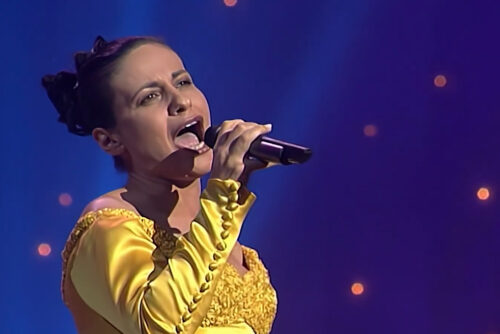
Švajger’s national prominence soared in 1995 when she represented Slovenia at the Eurovision Song Contest in Dublin. Performing the powerful ballad “Prisluhni mi” (Listen to Me), she achieved an impressive seventh-place finish. This top-ten placement put Slovenia on the Eurovision map and made Švajger a household name at home. As a result of her Eurovision success, she won Slovenia’s Pop Singer of the Year awards in both 1995 and 1996. Building on this momentum, Švajger remained very active in the music scene. She released her second album Trenutki (Moments) in 1998en.wikipedia.org, further cementing her status as one of the country’s leading pop vocalists.
Eurovision Comeback in 1999
By the end of the decade, Švajger set her sights on Eurovision again. In 1997 and 1998, she entered EMA, Slovenia’s national song competition. Švajger won it in 1999, earning the right to return to the Eurovision Song Contest. For her second appearance, she performed the sweeping ballad “For a Thousand Years” (the English version of Še tisoč let) on the Eurovision stage in Jerusalem. Despite high hopes, the song finished in 11th place in the final, with a total of 50 points. While not as high as her first outing, this result still solidified Švajger’s reputation for delivering strong performances.
Continued Musical Career and Achievements
Following her Eurovision experiences, Švajger continued to thrive as a recording artist and live performer. She released a string of albums through the 2000s, showcasing her vocal versatility and longevity. These included Še tisoč let in 1999 and Plameni (Flames) in 2001. In 2005, she celebrated over a decade of success with a greatest-hits compilation Najlepše uspešnice (“Most Beautiful Hits”). Her next studio album, Moji obrazi (My Faces), followed in 2008, demonstrating that her popularity had not waned. In addition to recording, Švajger remained a prominent figure in Slovenia’s music festivals. She won the prestigious Slovenska Popevka festival in 2010 with the song “Otok ljubezni” (Island of Love), taking the event’s grand prize.
A few years later, she earned the audience choice award at the 2014 Popevka festival for her uplifting song “Sončen dan” (Sunny Day). Švajger also stayed connected to Eurovision-related events. For example, she served as a juror on the Slovenian national selection (EMA 2016). These accomplishments underscore her lasting influence and adaptability in the Slovenian music industry.
Academic Contributions and Teaching
In addition to her performance career, Darja Švajger has made significant academic contributions to music. She laid a strong educational foundation early on by studying voice and music pedagogy. Later in her career she continued to hone her expertise. In 2013, Švajger completed a master’s degree at the University of Ljubljana’s Academy for Theatre, Radio, Film and Television (AGRFT). Her artistic achievements were formally recognized in 2015, when she received a special award from the University of Ljubljana’s Academy of Music for important artistic works. With her extensive experience and education, Švajger turned to mentoring the next generation of performers. Since 2020, she has been a lecturer at both the Academy of Music and the Academy of Theatre, Radio, Film and Television in Ljubljana. She is teaching vocal performance and stagecraft. Even as an educator, she continues to perform and share her music with audiences.