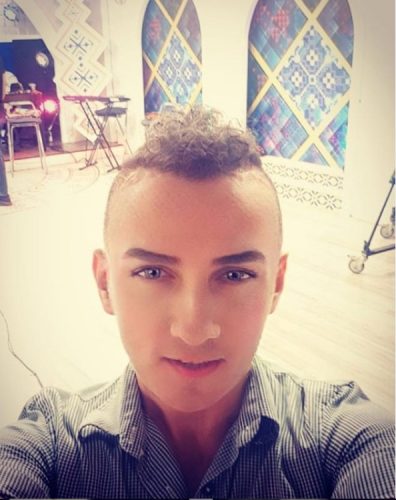
🇷🇴 Blast from the Past: Romania 2006

We know a lot about Eurovision and we want to share this knowledge with you! Therefore we’d like to bring you a blast from the past. Today: Mihai Trăistariu, who represented Romania in the 2006 contest with “Tornero”.

Romania in the Eurovision Song Contest

Romania made its debut in the Eurovision Song Contest in 1994. The country has mostly participated every year, missing out only a few times. One notable absence was in 2016, when the country was disqualified due to unpaid debts to the European Broadcasting Union.
Romania has achieved several respectable placements throughout the years, but, so far, the country hasn’t won the contest. Romania’s best results were third place, achieved in 2005 with the song “Let Me Try” by Luminița Anghel & Sistem and in 2010 with the song “Playing with Fire” by Paula Seling & Ovi. Romania is known for bringing a variety of music genres to the contest, from pop and rock to folk and traditional. Some entries, like “Zaleilah” by Mandinga in 2012, featured a mix of Romanian folk sounds with modern beats, giving it a distinct flavor.
This year, unfortunately, Romania was facing their worst score ever, getting no points at all in the semifinal for “D.G.T. (Off and on)” by Theodor Andrei.
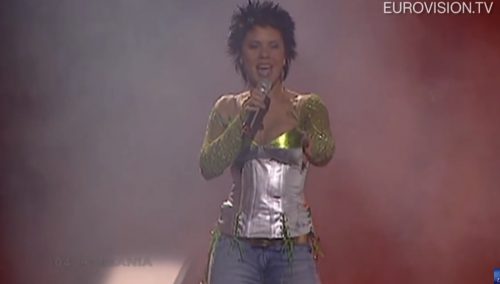
Luminița Anghel

Selecția Națională 2006

The Romanian national final always has the name Selecția Națională, also in 2006. Two semifinals and a final took place, three days in a row. The final, containing twelve songs, was held on February 26th.

  1. “Hey a hey”, Gina Pop Band, 4 pts, 10th
  2. “Se tu vuoi”, Linda, 10 pts, 6th
  3. “It’s our world”, Maria Radu & Mike Peterson, 5 pts, 8th
  4. “Sunshine”, Jasmine, 5 pts, 8th
  5. “Jokero”, Akcent & Nico, 20 pts, 2nd
  6. “Brand new feeling”, Dora, 13 pts, 3rd
  7. “Sagapo”, MiDo, 3 pts, 12th
  8. “Tornero”, Mihai Trăistariu, 22 pts, 1st
  9. “Be my boyfriend”, Indiggo, 6 pts, 7th
  10. “I believe in my star”, Laurențiu Cazan, 12 pts, 4th
  11. “Gândești prea high”, Delia, 4 pts, 10th
  12. “The universe”, Tony Poptămaș and Desperado, 12 pts, 4th

Note that not only “Tornero” was a success.  “Jokero” by Akcent and Nico also became an international hit.

Aksent – Jokero

Mihai Trăistariu

Born on December 16, 1979, in Piatra Neamț, Romania, Mihai displayed an early passion for music. He began his music education at the Carmen Sylva Art School in Piatra Neamț and later graduated from the Bucharest Academy of Music.

Mihai’s breakthrough came with his participation in various music festivals. In 1999 Mihai joined the group Valahia. They took part in the national final for the Eurovision Song Contest in 2000 with the song “Why” and reached a 2nd place. Also in 2002 (“Mother”, 4rd), and in 2004 (“Friends are friends”, 3rd). In 2005 he also took part, now in duet with Nico, “All the time”. It was the same year that Mihai’s debut album was released. But his rise to international fame was cemented with his Eurovision entry. In 2006, he performed the song “Tornero,” a catchy pop track infused with operatic elements. The song finished in 4th place, one of Romania’s highest rankings in the contest, and subsequently became a hit across Europe.
In total, Mihai released four albums. Also, he took part in Selecția Națională numerous times. His most successful participation, apart from “Tornero”, was “I won’t surrender” in 2017, which reached a 2nd place. In 2019 Mihai withdrew, because he did not agree with Romanian television on the way the contest was organized. He had taken part in a show on another tv-station (Your Face Sounds Familiar) and stated “I do not trust the objectivity of the Eurovision Romania organisers, regarding the unclear situation about the competitors — those who qualified through the pre-selection and those who were later favoured — I decided to withdraw.”
Nowadays, Mihai Trăistariu has another career….. he is, as far as we know, the only Eurovision participant with an OnlyFans page.
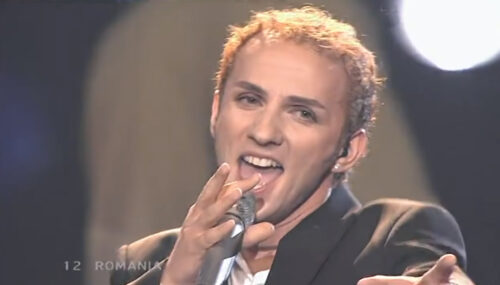
Tornero

The song stood out due to Mihai’s powerful vocal range and its infectious pop-opera blend. At the contest, held in Athens, Greece, “Tornero” managed to achieve 4th place with 172 points. This ranking is one of the highest Romania has achieved in the contest. The track is a pop song with operatic elements, and its title, “Tornero,” is an Italian word meaning “I will return.” The song is about a man who promises his love that he will return to her. “Tornero” was well-received, not just within the Eurovision community, but also among general music enthusiasts. After the contest, it charted in several European countries and became a notable hit.



Related news

Eurovision 2026

Vienna 12 points: From MUSEXPO to Musical

Several countries start their second rehearsals in Vienna. As we still don’t have access to the rehearsals, we will do something else. Per entry, we highlight one subject and give you some more information. That can be something about the artist, the song, the lyrics or even something completely different.  Switzerland — Veronica Fusaro, “Alice” Running order: 7 | Rehearsal: 8 May, 15:00–15:25 CEST MUSEXPO is one of the music industry’s key meeting places, where artists, labels, publishers, managers and media professionals come together to discover new talent and discuss the future of music. Founded by A&R Worldwide, the event combines panels, networking sessions, awards and live showcases. It has been held in Los Angeles and has also had European editions, including London, making it a truly international platform. For Eurovision fans, MUSEXPO is interesting because it often gives rising artists a stage before a wider breakthrough. Singer Veronica Fusaro performed at MUSEXPO in London and Los Angeles, showing how the event can connect young talent with influential people from the global music business. Unlike a traditional festival, MUSEXPO is mainly aimed at professionals. Its goal is not only entertainment, but also discovery, cooperation and new opportunities across the music, media and technology world, especially for artists ready to grow internationally today.  Cyprus — Antigoni, “Jalla” Running order: 8 | Rehearsal: 8 May, 15:35–16:00 CEST Tsifteteli is a lively dance style from Greece, Cyprus, Turkey and the wider eastern Mediterranean. The name comes from the Turkish çiftetelli, often linked to a “double string” musical style. In Greek culture, tsifteteli is known for fluid hip movements, expressive arms and a sensual, celebratory feeling. It is often compared with belly dancing, but it also belongs to everyday social life: people dance it at parties, weddings and festivals, not only on stage. That background gives extra colour to Antigoni’s Eurovision lyric “Shake my hips to tsifteteli”. As a British artist with Greek-Cypriot roots, she uses the word as a cultural reference, not just as a dance instruction. In “Jalla”, tsifteteli helps create a Mediterranean party atmosphere, mixing modern pop energy with sounds and movements that many Greek and Cypriot listeners will instantly recognise. For international fans, it is a small word with big cultural meaning at Eurovision 2026 in Vienna.  Latvia — Atvara, “Ēnā” Running order: 9 | Rehearsal: 8 May, 16:10–16:35 CEST Ēnā meaning is central to Latvia’s Eurovision 2026 entry by Atvara. In Latvian, ēna means “shadow” or “shade”, while ēnā means “in the shadow” or “in the shade”. That small grammatical change gives the title extra weight, because the song places its main character inside darkness, not just near it. The lyrics show someone losing confidence, hiding feelings and drifting away from the light. Atvara links this image to the pain of growing up around another person’s addiction, which gives “Ēnā” a personal and emotional meaning. For Eurovision viewers, the title explains the dark atmosphere of Latvia’s entry. This song does not tell a simple story about sadness. It explores fear, family pressure and the courage someone needs to step out of darkness in Vienna at Eurovision 2026. That makes it a strong title for a dramatic performance. “Ēnā” proves how one Latvian word can carry emotion, memory and resilience.  Denmark — Søren Torpegaard Lund, “Før vi går hjem” Running order: 10 | Rehearsal: 8 May, 16:45–17:10 CEST Matador musical brings one of Denmark’s best-loved classics to the stage. The story comes from DR’s “Matador”, with scripts by Lise Nørgaard and direction by Erik Balling, and takes audiences back to the fictional town of Korsbæk. There, banker Hans Christian Varnæs and newcomer Mads Skjern represent two families, two social worlds and a changing Denmark before and during the Second World War. In 2024, One & Only Musicals presented a new original version with songs by Lise Cabble and Burhan G. The production mixed nostalgia, humour, ambition and family drama with a fresh musical sound. Søren Torpegaard Lund played Daniel Skjern, the son of Mads and Ingeborg Skjern. His role gave him a touching solo moment with “En dreng som mig”, a song about expectations and identity. For Eurovision fans, Matador shows the theatre background behind Denmark’s 2026 artist and adds context to his performance skills on the Eurovision stage in Vienna.  

Read More »
Eurovision 2026
Martijn

Vienna 12 points: From MUSEXPO to Musical

Several countries start their second rehearsals in Vienna. As we still don’t have access to the rehearsals, we will do something else. Per entry, we highlight one subject and give you some more information. That can be something about the artist, the song, the lyrics or even something completely different.  Switzerland — Veronica Fusaro, “Alice” Running order: 7 | Rehearsal: 8 May, 15:00–15:25 CEST MUSEXPO is one of the music industry’s key meeting places, where artists, labels, publishers, managers and media professionals come together to discover new talent and discuss the future of music. Founded by A&R Worldwide, the event combines panels, networking sessions, awards and live showcases. It has been held in Los Angeles and has also had European editions, including London, making it a truly international platform. For Eurovision fans, MUSEXPO is interesting because it often gives rising artists a stage before a wider breakthrough. Singer Veronica Fusaro performed at MUSEXPO in London and Los Angeles, showing how the event can connect young talent with influential people from the global music business. Unlike a traditional festival, MUSEXPO is mainly aimed at professionals. Its goal is not only entertainment, but also discovery, cooperation and new opportunities across the music, media and technology world, especially for artists ready to grow internationally today.  Cyprus — Antigoni, “Jalla” Running order: 8 | Rehearsal: 8 May, 15:35–16:00 CEST Tsifteteli is a lively dance style from Greece, Cyprus, Turkey and the wider eastern Mediterranean. The name comes from the Turkish çiftetelli, often linked to a “double string” musical style. In Greek culture, tsifteteli is known for fluid hip movements, expressive arms and a sensual, celebratory feeling. It is often compared with belly dancing, but it also belongs to everyday social life: people dance it at parties, weddings and festivals, not only on stage. That background gives extra colour to Antigoni’s Eurovision lyric “Shake my hips to tsifteteli”. As a British artist with Greek-Cypriot roots, she uses the word as a cultural reference, not just as a dance instruction. In “Jalla”, tsifteteli helps create a Mediterranean party atmosphere, mixing modern pop energy with sounds and movements that many Greek and Cypriot listeners will instantly recognise. For international fans, it is a small word with big cultural meaning at Eurovision 2026 in Vienna.  Latvia — Atvara, “Ēnā” Running order: 9 | Rehearsal: 8 May, 16:10–16:35 CEST Ēnā meaning is central to Latvia’s Eurovision 2026 entry by Atvara. In Latvian, ēna means “shadow” or “shade”, while ēnā means “in the shadow” or “in the shade”. That small grammatical change gives the title extra weight, because the song places its main character inside darkness, not just near it. The lyrics show someone losing confidence, hiding feelings and drifting away from the light. Atvara links this image to the pain of growing up around another person’s addiction, which gives “Ēnā” a personal and emotional meaning. For Eurovision viewers, the title explains the dark atmosphere of Latvia’s entry. This song does not tell a simple story about sadness. It explores fear, family pressure and the courage someone needs to step out of darkness in Vienna at Eurovision 2026. That makes it a strong title for a dramatic performance. “Ēnā” proves how one Latvian word can carry emotion, memory and resilience.  Denmark — Søren Torpegaard Lund, “Før vi går hjem” Running order: 10 | Rehearsal: 8 May, 16:45–17:10 CEST Matador musical brings one of Denmark’s best-loved classics to the stage. The story comes from DR’s “Matador”, with scripts by Lise Nørgaard and direction by Erik Balling, and takes audiences back to the fictional town of Korsbæk. There, banker Hans Christian Varnæs and newcomer Mads Skjern represent two families, two social worlds and a changing Denmark before and during the Second World War. In 2024, One & Only Musicals presented a new original version with songs by Lise Cabble and Burhan G. The production mixed nostalgia, humour, ambition and family drama with a fresh musical sound. Søren Torpegaard Lund played Daniel Skjern, the son of Mads and Ingeborg Skjern. His role gave him a touching solo moment with “En dreng som mig”, a song about expectations and identity. For Eurovision fans, Matador shows the theatre background behind Denmark’s 2026 artist and adds context to his performance skills on the Eurovision stage in Vienna.  

Read More »
Follow Us: