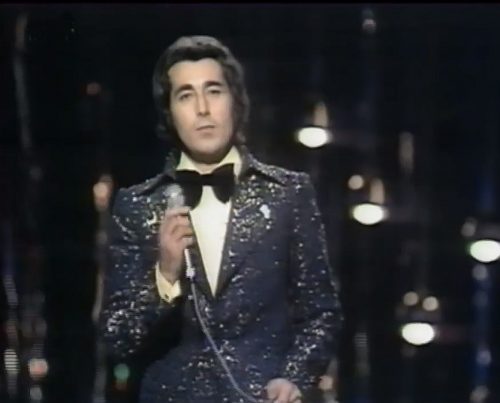
Blast from the past: Monaco 1974

We know a lot about Eurovision and we want to share this knowledge with you! Therefore we’d like to bring you a blast from the past. Today, we go back to 1974, when Romuald represented Monaco with the song “Celui qui reste et celui qui s’en va”.

Monaco in the Eurovision Song Contest

Monaco debuted in 1959 and quickly became a mini‑state powerhouse: ten top‑five finishes and a lone victory in 1971, when Séverine won with “Un banc, un arbre, une rue”. Though champions, the principality never hosted the contest. Other standout results include François Deguelt’s runner‑up in 1962 and third places for François Deguelt (1960), Romuald (1964) and Mary Christy (1976), with fourths from Michèle Torr (1977) and Caline & Olivier Toussaint (1978). 

After 1979, Monaco withdrew until a short‑lived comeback. The 2004–06 entries all fell in the semi‑final: Märyon’s “Notre planète” (19th, 10), Lise Darly’s “Tout de moi” (24th, 22) and Séverine Ferrer’s “La coco‑dance” (21st, 14), the first Eurovision song to include Tahitian. Citing voting patterns, TMC withdrew, and the microstate has not returned since. Monaco’s last Grand Final appearance remains 1979, yet compact history looms large: French‑language pop, performers and staging that helped Monaco punch above its size.

Séverine

Internal selection Monaco 1974

Monaco’s national selection for the Eurovision Song Contest 1974 was handled internally by broadcaster TMC, continuing the principality’s preference for inviting established Francophone artists rather than staging a public national final. Veteran singer Romuald was appointed as Monaco’s act, performing “Celui qui reste et celui qui s’en va”, a chanson ballad with music by Jean‑Pierre Bourtayre and lyrics by Michel Jourdan. Contemporary and retrospective listings describe the 1974 process as internal, with no televised competition and no alternate candidates publicly documented. Eurovision records show Monaco’s entry details and broadcaster credit accordingly. 

Timing‑wise, the artist confirmation and song unveiling occurred in early 1974 ahead of the Brighton contest. The single was issued on Mercury as a 7″ 45 rpm, underscoring that the track was Monaco’s official entry. For researchers of Monaco’s Eurovision history, the 1974 campaign illustrates how a compact, broadcaster‑led selection, artist first, song second, could deliver a cohesive package without a public national final, a model Monaco often used in that era.


Romuald

Romuald Figuier (born 9 May 1938 in Saint‑Pol‑de‑Léon, Brittany) is a French singer best known to Eurovision fans as Romuald, noted for chanson repertoire. He began his career at the Théâtre des Variétés, appearing in Robert Dhéry’s revue La Grosse Valse (1962–64). He first appeared at the Contest for Monaco in 1964, finishing third with “Où sont‑elles passées?”, composed by Francis Lai with lyrics by Pierre Barouh. Five years later he represented Luxembourg with “Catherine”, placing 11th in Madrid. He returned to Monaco in 1974 with “Celui qui reste et celui qui s’en va”, which finished fourth in Brighton and remains one of the principality’s strongest results.

Beyond Eurovision, Romuald worked on the international festival circuit. He represented Luxembourg at Sopot in 1968 and France at Viña del Mar in 1973 with “Laisse‑moi le temps”, a Michel Jourdan/Caravelli composition later adapted by Paul Anka and Sammy Cahn as “Let Me Try Again”, recorded by Frank Sinatra. Alongside singles in several languages, he also maintained a career on French television, stage and radio. Taken together, his three Eurovisions chart a rare cross‑border story: a French artist trusted by two microstates, and a performer who secured two top‑four finishes a decade apart.

Celui qui reste et celui qui s’en va

“Celui qui reste et celui qui s’en va” (Monaco 1974) is a classic French chanson ballad. Sung by Romuald, it finished fourth with 14 points, tying with Luxembourg and the United Kingdom. Music by Jean‑Pierre Bourtayre and lyrics by Michel Jourdan, the entry unfolds as an elegant break‑up narrative: the one who stays versus the one who leaves. Orchestral strings and subtle drum accents support Romuald’s burnished tenor, while backing voices add warmth and lift in the refrain. Conducted by Raymond Donnez, the performance balances restraint and drama, shaping a cinematic arc that gracefully swells to a poised, dignified climax.


Related news

Uncategorized

Israel Eurovision 2025 Participation Sparks Boycott

Israel Eurovision 2025 Participation Sparks Boycott Israel’s participation in the Eurovision Song Contest 2025 has ignited a major controversy. After organizers decided to allow Israel to remain in the competition, four countries, the Netherlands, Spain, Ireland, and Slovenia, announced their withdrawal from Eurovision 2026 in protest. This rare Eurovision boycott has turned the contest into a political flashpoint. Background: Israel in Eurovision 2025 Israel finished second at Eurovision 2025, a strong result driven by public votes. However, several countries complained that Israel had artificially boosted its tally through a broad advertising campaign urging Europeans to vote for its entry. The dispute unfolded amid the Gaza war, pushing the ostensibly apolitical contest into an uncomfortable spotlight. In response, the European Broadcasting Union (EBU) rolled out new measures to protect Eurovision’s neutrality. Government-led promotion campaigns were discouraged under the updated rules. In early December, EBU members reviewed these changes and decided not to hold a vote on Israel’s status. With this, they effectively confirmed Israel would remain in Eurovision 2026. Four Countries Withdraw in Protest Following the EBU decision to keep Israel in the contest, four national broadcasters promptly confirmed their withdrawal from Eurovision 2026. Ireland’s RTÉ deemed participation “unconscionable” amid Gaza’s civilian death toll. Spain’s RTVE and the Netherlands’ AVROTROS also pulled out after the Geneva vote, arguing that taking part was incompatible with their public service values. Slovenia likewise confirmed it would boycott the contest, as it had vowed if Israel stayed. Impact and Reactions The boycott is especially significant because it includes Spain. The country is one of Eurovision’s “Big Five” nations that provide major funding and automatic finalist spots. Organizers warn that losing multiple major countries could dent the show’s global audience (typically around 150 million viewers) and deter sponsors. Israeli officials, meanwhile, welcomed the EBU’s decision. President Isaac Herzog said Israel “deserves to be represented on every stage around the world”. This saga presents Eurovision with an unprecedented challenge: upholding its spirit of musical unity in the face of deep geopolitical divides.

Read More »
Uncategorized
Martijn

Israel Eurovision 2025 Participation Sparks Boycott

Israel Eurovision 2025 Participation Sparks Boycott Israel’s participation in the Eurovision Song Contest 2025 has ignited a major controversy. After organizers decided to allow Israel to remain in the competition, four countries, the Netherlands, Spain, Ireland, and Slovenia, announced their withdrawal from Eurovision 2026 in protest. This rare Eurovision boycott has turned the contest into a political flashpoint. Background: Israel in Eurovision 2025 Israel finished second at Eurovision 2025, a strong result driven by public votes. However, several countries complained that Israel had artificially boosted its tally through a broad advertising campaign urging Europeans to vote for its entry. The dispute unfolded amid the Gaza war, pushing the ostensibly apolitical contest into an uncomfortable spotlight. In response, the European Broadcasting Union (EBU) rolled out new measures to protect Eurovision’s neutrality. Government-led promotion campaigns were discouraged under the updated rules. In early December, EBU members reviewed these changes and decided not to hold a vote on Israel’s status. With this, they effectively confirmed Israel would remain in Eurovision 2026. Four Countries Withdraw in Protest Following the EBU decision to keep Israel in the contest, four national broadcasters promptly confirmed their withdrawal from Eurovision 2026. Ireland’s RTÉ deemed participation “unconscionable” amid Gaza’s civilian death toll. Spain’s RTVE and the Netherlands’ AVROTROS also pulled out after the Geneva vote, arguing that taking part was incompatible with their public service values. Slovenia likewise confirmed it would boycott the contest, as it had vowed if Israel stayed. Impact and Reactions The boycott is especially significant because it includes Spain. The country is one of Eurovision’s “Big Five” nations that provide major funding and automatic finalist spots. Organizers warn that losing multiple major countries could dent the show’s global audience (typically around 150 million viewers) and deter sponsors. Israeli officials, meanwhile, welcomed the EBU’s decision. President Isaac Herzog said Israel “deserves to be represented on every stage around the world”. This saga presents Eurovision with an unprecedented challenge: upholding its spirit of musical unity in the face of deep geopolitical divides.

Read More »
Follow Us: