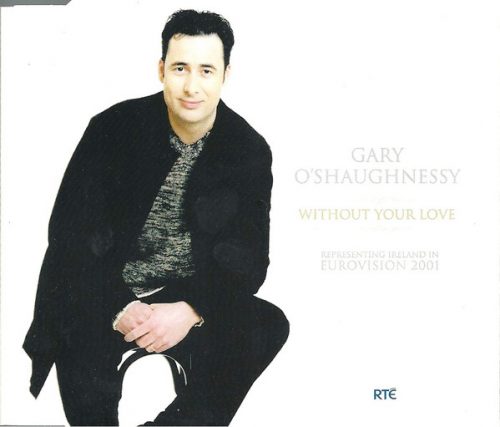
Blast from the past: Ireland 2001

We know a lot about Eurovision; this is knowledge we want to share with you. Therefore we’d like to bring you a blast from the past. Back to 2001, the Irish entry: “Without your love” by Gary O’Shaughnessy.

Ireland in the Eurovision Song Contest

The nineties were thé decade for Ireland in the Eurovision Song Contest with no less than four victories and a second place. However, Dawn Martin (1998) and The Mullans (1999) did not make it to the top. Eamonn Toal (2000) became 6th… nice, but not as good as it was for Ireland. Something had to happen to get Ireland back on top.

Eurosong 2001

The national final for the contest was called ‘Eurosong 2001’. Seven artists competed in Eurosong. On February 25, Louise Loughman hosted the contest. The winner was chosen by televoting through 7 regional juries.

  1. James Peake sang “Who said I pray“, 5th with 41 pts
  2. InFocus sang “Every kiss is a lie”, 2nd with 70 pts
  3. Gavin McCormack sang “I’ll be with you“, 6th with 34 pts
  4. David Murphy sang “Katie lovely“, 7th with 31 pts
  5. Fe-Mail sang “Undertow“, 3rd with 63 pts
  6. Gary O’Shaughnessy sang “Without your love“, 1st with 74 pts
  7. Emma Reynolds sang “The innocent days“, 4th with 51 pts

It was a close call, and in total the boyband InFocus even received the most televotes while placing 2nd.

Gary O’Shaughnessy

Gary O’Shaughnessy is an Irish singer and songwriter. Besides singing, he plays guitar, bass guitar and keyboards. O’Shaughnessy started studying at age of 12 for four years with Irish jazz guitarist Eugene Macari. In 1989, he formed a band with his brother Brian and together they toured IrelandSpain and the UK. In 1995, the two brothers performed as the duo “2 of a kind” which became very popular in cabarets, clubs and pubs. 
Gary O’Shaugnessy took part in the Irish National Song Contest in 19971999 and 2001. The last one he won and so he represented Ireland in the Eurovision Song Contest. His cousin Ryan O’Shaughnessy did the same in 2018.

Without your love

The song “Without your love” is written and composed by Pat Sheridan. “Without your love, without your heart, I’d be lost here, in the dark”, Gary sang. You can read the full lyrics here. “Without your love” was a typical song in the tradition of Irish ballads.

Results

The Eurovision Song Contest was not a success for Gary O’Shaughnessy. To be honest: it became the worst Irish score so far. Only the United Kingdom (5 points) and Portugal (1 point) kept “Without your love” away from the zero points. O’Shaughnessy became 21st.

Related news

History

🇦🇹 Austria in the Eurovision Song Contest, part 3

📷 Waterloo & Robinson This year’s Eurovision Song Contest has been won by Austria. It was the 57th Austrian entry. Reason for us to go back to all the Austrian entries in history! For the third episode, we will look back at the seventies. Austria entered the top-5 twice. They also sang in a minority language. They also had some deviant entries. 1971 – Marianne Mendt – Musik Austria returned to the Eurovision Song Contest in 1971 after a two-year absence . They boycotted the Franco-ruled 1969 contest and protesting the four-way tie of 1969 by skipping 1970. Marianne Mendt performed “Musik.” Mendt, a jazz-pop singer from Vienna, delivered the song in her native Viennese German dialect, a rarity at Eurovision. Richard Schönherz and Manuel Rigoni composed “Musik” and also wrote its lyrics, giving the entry a swinging, soulful vibe about the power of music. At the contest in Dublin, “Musik” scored 66 points and finished 16th out of 18 entries. 1972 – The Milestones – Falter im Wind The Austrian rock band The Milestones represented the country at the Eurovision Song Contest 1972 in Edinburgh with “Falter im Wind” (“Butterfly in the Wind”). Composers Richard Schönherz and Manuel Rigoni teamed up with lyricist Heinz Unger to craft this folk-tinged pop song addressed to a butterfly. They reflected on life’s impermanence. The song’s gentle melody and rich harmonies resonated with the juries. Austria earned 100 points and achieved 5th place. This was the country’s best Eurovision result since its 1966 victory, showcasing a high point for Austria before a brief mid-’70s withdrawal from the contest. 1976 – Waterloo & Robinson – My Little World After skipping the contest from 1973 to 1975, Austria returned at the Eurovision Song Contest 1976 in The Hague with pop duo Waterloo & Robinson performing “My Little World.” The duo was already popular at home. They presented an upbeat, feel-good song that songwriter Gerhard Heinz had composed. Sung in English, “My Little World” celebrates the simple joys of love and life. It earned 80 points and reached 5th place, matching Austria’s 1972 success. This strong result followed ORF’s mid-’70s Eurovision hiatus, which was reportedly due to dissatisfaction with the contest’s scoring system at the time. 1977 – Die Schmetterlinge – Boom Boom Boomerang Austria took a daring turn at the Eurovision Song Contest 1977 in London with the group Schmetterlinge and their song “Boom Boom Boomerang.” Known for their political cabaret style, Schmetterlinge delivered a satirical pop performance. In that performance they lampooned the commercial music industry, complete with nonsense “international” lyrics and zany on-stage antics. Group members like Georg “Schurli” Herrnstadt and Willi Resetarits wrote the music, while Lukas Resetarits provided tongue-in-cheek lyrics skewering formulaic pop. Despite the bold concept and humor, the entry earned only 11 points, placing 17th out of 18 countries. Notably, two members of Schmetterlinge had been part of The Milestones (Austria’s 1972 act), adding a nod to the country’s earlier Eurovision experience. 1978 – Springtime – Mrs. Caroline Robinson In 1978, Austria was represented by Springtime, a pop trio formed by brothers Walter and Gerhard Markel with bassist Norbert Niedermayer. Their song “Mrs. Caroline Robinson” was an upbeat schlager-pop number with a humorous twist. It was written by the trio themselves. The lyrics told the quirky story of Caroline Robinson, the “top-witch of this town” who captivates everyone with her charm. Springtime’s performance in Paris was fun and energetic, and the song even became a hit at home. It earned a gold record in Austria. On the Eurovision scoreboard, however, “Mrs. Caroline Robinson” earned 14 points, finishing 15th out of 20 countries in 1978. 1979 – Christina Simon – Heute in Jerusalem Austria’s 1979 entry was the soulful “Heute in Jerusalem” (“Today in Jerusalem”), performed by singer Christina Simon. Christina had a background as a jazz vocalist. This reflective ballad was composed by Peter Wolf with lyrics by Austrian artist André Heller. Musically it blended contemporary jazz and blues influences, and its lyrics carried a heartfelt plea for peace in Jerusalem. That was quite fittingly, the contest was held in Jerusalem just days after the Israel–Egypt peace treaty. Simon’s emotional delivery brought gravitas to the stage. Unfortunately, “Heute in Jerusalem” received only 5 points, ending up in 18th (last) place at the 1979 contest. 

Read More »
History
Martijn

🇦🇹 Austria in the Eurovision Song Contest, part 3

📷 Waterloo & Robinson This year’s Eurovision Song Contest has been won by Austria. It was the 57th Austrian entry. Reason for us to go back to all the Austrian entries in history! For the third episode, we will look back at the seventies. Austria entered the top-5 twice. They also sang in a minority language. They also had some deviant entries. 1971 – Marianne Mendt – Musik Austria returned to the Eurovision Song Contest in 1971 after a two-year absence . They boycotted the Franco-ruled 1969 contest and protesting the four-way tie of 1969 by skipping 1970. Marianne Mendt performed “Musik.” Mendt, a jazz-pop singer from Vienna, delivered the song in her native Viennese German dialect, a rarity at Eurovision. Richard Schönherz and Manuel Rigoni composed “Musik” and also wrote its lyrics, giving the entry a swinging, soulful vibe about the power of music. At the contest in Dublin, “Musik” scored 66 points and finished 16th out of 18 entries. 1972 – The Milestones – Falter im Wind The Austrian rock band The Milestones represented the country at the Eurovision Song Contest 1972 in Edinburgh with “Falter im Wind” (“Butterfly in the Wind”). Composers Richard Schönherz and Manuel Rigoni teamed up with lyricist Heinz Unger to craft this folk-tinged pop song addressed to a butterfly. They reflected on life’s impermanence. The song’s gentle melody and rich harmonies resonated with the juries. Austria earned 100 points and achieved 5th place. This was the country’s best Eurovision result since its 1966 victory, showcasing a high point for Austria before a brief mid-’70s withdrawal from the contest. 1976 – Waterloo & Robinson – My Little World After skipping the contest from 1973 to 1975, Austria returned at the Eurovision Song Contest 1976 in The Hague with pop duo Waterloo & Robinson performing “My Little World.” The duo was already popular at home. They presented an upbeat, feel-good song that songwriter Gerhard Heinz had composed. Sung in English, “My Little World” celebrates the simple joys of love and life. It earned 80 points and reached 5th place, matching Austria’s 1972 success. This strong result followed ORF’s mid-’70s Eurovision hiatus, which was reportedly due to dissatisfaction with the contest’s scoring system at the time. 1977 – Die Schmetterlinge – Boom Boom Boomerang Austria took a daring turn at the Eurovision Song Contest 1977 in London with the group Schmetterlinge and their song “Boom Boom Boomerang.” Known for their political cabaret style, Schmetterlinge delivered a satirical pop performance. In that performance they lampooned the commercial music industry, complete with nonsense “international” lyrics and zany on-stage antics. Group members like Georg “Schurli” Herrnstadt and Willi Resetarits wrote the music, while Lukas Resetarits provided tongue-in-cheek lyrics skewering formulaic pop. Despite the bold concept and humor, the entry earned only 11 points, placing 17th out of 18 countries. Notably, two members of Schmetterlinge had been part of The Milestones (Austria’s 1972 act), adding a nod to the country’s earlier Eurovision experience. 1978 – Springtime – Mrs. Caroline Robinson In 1978, Austria was represented by Springtime, a pop trio formed by brothers Walter and Gerhard Markel with bassist Norbert Niedermayer. Their song “Mrs. Caroline Robinson” was an upbeat schlager-pop number with a humorous twist. It was written by the trio themselves. The lyrics told the quirky story of Caroline Robinson, the “top-witch of this town” who captivates everyone with her charm. Springtime’s performance in Paris was fun and energetic, and the song even became a hit at home. It earned a gold record in Austria. On the Eurovision scoreboard, however, “Mrs. Caroline Robinson” earned 14 points, finishing 15th out of 20 countries in 1978. 1979 – Christina Simon – Heute in Jerusalem Austria’s 1979 entry was the soulful “Heute in Jerusalem” (“Today in Jerusalem”), performed by singer Christina Simon. Christina had a background as a jazz vocalist. This reflective ballad was composed by Peter Wolf with lyrics by Austrian artist André Heller. Musically it blended contemporary jazz and blues influences, and its lyrics carried a heartfelt plea for peace in Jerusalem. That was quite fittingly, the contest was held in Jerusalem just days after the Israel–Egypt peace treaty. Simon’s emotional delivery brought gravitas to the stage. Unfortunately, “Heute in Jerusalem” received only 5 points, ending up in 18th (last) place at the 1979 contest. 

Read More »
Follow Us: