
70 years of Eurovision: what saved the contest?

The Eurovision Song Contest is celebrating its 70th anniversary. That is a wonderful milestone. We at Eurovision Universe love diving into the history of the contest. That is why we are taking a closer look at the contests of the past 70 years.

1968

The Royal Albert Hall in London was the venue, and Cathy Boyle hosted for the third time. The same 17 countries as the previous year participated. And something else was special too: for the first time, the Eurovision Song Contest was broadcast in color. Oddly enough, the broadcast in the host country, the United Kingdom, was still  in black and white. The British did not see the color version until the other day.

The United Kingdom pulled out all the stops in more ways than one: the British participant was none other than Cliff Richard. In fact, no one really expected Cliff, who sang the song “Congratulations,” to win anymore. By then, he was high on the charts in many countries. In that light, what happened in Norway was quite remarkable. The song that won there sounded so terribly similar to Cliff’s “Summer Holiday” that the composer did not want to wait for an investigation into it. He simply withdrew the song. In Norway, people didn’t panic. The runner-up from the national selection was now allowed to go to London. That that song was called “Stress” is probably just a coincidence. Furthermore, former winner Isabelle Aubret participated for France one more time.

Massiel

In a hall full of screaming teenage girls, the unthinkable happened: Cliff Richard did not win. With a lead of just one point, the Spanish singer Massiel overtook him. Massiel was not the first choice in his own country. The Catalan Joan Manuel Serrat was originally supposed to sing the song “La, la, la.” However, he only wanted to sing the song in Catalan. General Franco’s dictatorial regime did not approve it. Thus, Massiel was pushed forward.

Every so often, the story surfaces that General Franco allegedly bought this victory. He wanted to put Spain on the map in a positive light with it. It is an urban legend. No evidence has ever been found for these accusations.

1969

Austria refused to travel to dictatorial Spain. The number of participating countries therefore rose to sixteen. For the same reason, the Netherlands had to look for another conductor. Regular conductor Dolf van der Linden did not want to travel to Spain. Madrid was the setting. Spain had pulled out all the stops to put itself on the map in a positive way. For instance, the contest logo was designed by none other than the famous artist Salvador Dalí. The host was Laurita Valenzuela. The hall in the Teatro Real in Madrid was characterized by a huge organ. It opened the broadcast with the Te Deum.

The Belgian Louis Neefs represented his country for the second time. And for the second time, he finished seventh, to disappointment of the Belgians themselves. Simone de Oliveira made a second appearance for Portugal. Siw Malmkvist also participated once again. Kirsti Sparboe even participated for the third time for Norway. Also noteworthy was Jean-Jacques, the French boy who competed for Monaco. This 13-year-old singer was by far the youngest candidate ever and would remain so until 1989.

The scoring remained exciting until the very last moment. It was as battle between four countries… and all four won! The defining moment of the broadcast was when a surprised Laurita Valenzuela asked the scruteneer, Clifford Brown, if this meant there were four winners. Brown confirmed it.

Four winners

Spain won again. Salomé was the singer, “Vivo Cantando” the song. Salomé had a tough time. She wore a leaden blue dress. It was, in fact, made entirely of porcelain!

The second winner was Lulu with “Boom Bang A Bang”. Lulu had already had a worldwide hit with the song “Shout”. A British newspaper wrote about Lulu’s entry: ‘It is a rotten song. It will undoubtedly win and be translated into Hungarian and all the dialects of Mongolia, but it is still a rotten song’. Lulu ended her performance in Spain with a loud “Olé”.

The Dutch winner, Lenny Kuhr, was devoid of any frills. She had composed her song “De Troubadour” herself and performed it, accompanying herself on the guitar. Kuhr especially impressed Southern Europe. Her career would span more than fifty years. She will perform at Eurovision In Concert this year. Shortly thereafter, she will retire.

The French winner, Frida Boccara, also managed to significantly expand her career. Although her song “Un jour, un enfant” didn’t do much in the charts, Boccara, who was born in Cassablanca, would remain a major star until her death in 1996. Her song “Cent mille chansons” became an evergreen.

1970

France and the Netherlands were willing to host the contest. By a draw, the Netherlands was chosen, and Eurovision moved to Amsterdam. A condition set by the Dutch broadcaster was that it would not become a funeral for the Eurovision Song Contest. Yet it almost became that funeral. Mad about the result of the previous year, all Scandinavian countries stayed away, along with Austria and Portugal. Only twelve countries participated. Nonetheless, the Dutch broadcaster NOS pulled out all the stops to make it a success. Director Theo Ordeman had devised a plan to introduce each song via a so-called ‘postcard’. It is a tradition that would never disappear. Stage designer Roland de Groot had designed a beautiful moving stage.

The United Kingdom sent another big star: Mary Hopkin. Spain sent a former soccerplayer who had to retire due to an injury, and then started a singing career: Julio Iglesias. It would bring him a great deal of success, but not during the Eurovision Song Contest. David Alexandre Winter did not have much success either. He came from Amsterdam but entered for Luxembourg. He did so in an incomprehensible kind of French. No one was willing to give him any points.

The Netherlands itself caused problems by sending a trio; three sisters who called themselves The Hearts Of Soul. That was not allowed. One of the sisters was demoted to lead singer, the other two to backing vocals.

Dana

There was little discussion about the victory. The Irish Dana captured everyone’s hearts with her “All Kinds of Everything.” She won by a wide margin. Dana came from the Bogside in Belfast, where at that time there were many riots between Protestant and Catholic Northern Irish people. It didn’t bother Dana. Ireland celebrated. We would see Dana often again later on. We also know her from the Christmas classic “It’s Gonna Be A Cold, Cold, Christmas” and from the various times she ran as a very conservative candidate in the Irish presidential elections.

Related news

History

70 years of Eurovision: big hits and bare feet

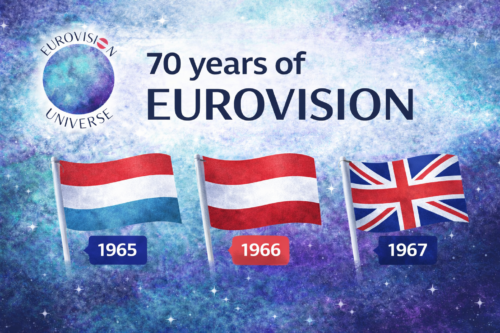
The Eurovision Song Contest is celebrating its 70th anniversary. That is a wonderful milestone. We at Eurovision Universe love diving into the history of the contest. That is why we are taking a closer look at the contests of the past 70 years. 1965 Sweden was back. Ireland made its debut. That brought the total number of countries in Naples, Italy, to no less than 18. In the RAI auditorium in this city, Renata Mauro presented the largest festival to date. Udo Jürgens participated for Austria for the second time. Conchita Bautista returned for Spain. Vice Vukov was there for the second time representing Yugoslavia. But those were not the entries that caused a stir. Bobby Solo (Italy) and Guy Mardel (France) managed to score an international hit. But the most notable one was Ingvar Wixell from Sweden. This opera singer had been assigned the song “Annorstädes Vals” in the national final. But in Naples, he suddenly sang “Absent Friend,” the English version. Nowhere in the Eurovision regulations did it state that this was not allowed. You can imagine that it was included a year later. The French singer France Gall won for Luxembourg. Her “Poupée de cire, poupée de son” was written by none other than Serge Gainsbourg. He stated that he had never watched Eurovision. He therefore had no clue what he was writing for. And perhaps that was exactly the key to the success. During the reprise, France Gall seemed to realize she had won only halfway through. Only then a smile appeared on her face. 1966 Once again, the Eurovision circus moved to the tiny studio in the Villa Lauvigny in Luxembourg. The presentation was now in the hands of Josiane Shen. The same countries as in 1965 participated. Udo Jürgens participated for Austria for the third consecutive time. Domenico Modugno returned for Italy. And then we do not want to leave two candidates unmentioned: Åse Kleveland (Norway) and Lill Lindfors (Sweden) would later host the contest themselves. Kleveland, who later also became Minister of Culture in Norway, won the hearts of the jury members with her guitar. She came third. Lindfors sang a fairy tale to jazzy music in a duet. She came second with it. However, we do not want to leave the Dutch Milly Scott out either. Not only because she was the first black singer at Eurovision. She had also quite misjudged the size of the stage. She wanted to enter with a steeplechase. That was impossible. She had to back down and put on a much simpler act. As mentioned, Udo Jürgens participated for Austria for the third time. Third time was the charm for him: he won! A promising career lay ahead of him. When he won and got to sing his “Merci Chérie” again, he turned it into “Merci Jury”. 1967 For the first time, the Eurovision Song Contest went to Vienna. Erika Vaal hosted the contest at the Vienna Hofburg. She opened the show with a speech in no less than four languages. In addition, she apologized for not being proficient in all the participants’ other languages. Denmark was not present this year and would be absent for a long time. This country was angry about the bloc formation during the voting. Raphaël from Spain and Kirsti Sparboe from Norway both participated for a second time. So did Claudio Villa from Italy. Serge Gainsbourg wrote a song, just like two years earlier. This time it was for Monaco. Singer Minouche Barelli let loose completely during Gainsbourg’s “Boum Badaboum”. The Greek Vicky (Leandros, though she did not use that surname yet) did the same. Her “L’amour est bleu” became a big hit, but not exactly for her. Orchestra conductor Paul Mauriat made a single with the instrumental version and walked away with the hit. The voting was incredibly exciting. Not because of the winner, as that was the United Kingdom with a landslide. Rather because of the many errors and misses during the scoring. The scoreboard kept malfunctioning, forcing poor Erika Vaal to constantly make adjustments. In her panic, she forgot about the last one, the Irish jury. “I thought we were going to be left out,” a crestfallen Irish jury chairman remarked. But then again, it was pop star Sandie Shaw who won for the United Kingdom with “Puppet on a String.” She caused a sensation by winning barefoot! Her song became a worldwide hit and a classic. However, Sandie Shaw has never made a secret of the fact that she herself hated that song. There have indeed been times when she refused to sing it. For example, on a Dutch television show, she simply walked away when the interviewer mentioned the word Eurovision.

Read More »
History
Martijn

70 years of Eurovision: what saved the contest?

The Eurovision Song Contest is celebrating its 70th anniversary. That is a wonderful milestone. We at Eurovision Universe love diving into the history of the contest. That is why we are taking a closer look at the contests of the past 70 years. 1968 The Royal Albert Hall in London was the venue, and Cathy Boyle hosted for the third time. The same 17 countries as the previous year participated. And something else was special too: for the first time, the Eurovision Song Contest was broadcast in color. Oddly enough, the broadcast in the host country, the United Kingdom, was still  in black and white. The British did not see the color version until the other day. The United Kingdom pulled out all the stops in more ways than one: the British participant was none other than Cliff Richard. In fact, no one really expected Cliff, who sang the song “Congratulations,” to win anymore. By then, he was high on the charts in many countries. In that light, what happened in Norway was quite remarkable. The song that won there sounded so terribly similar to Cliff’s “Summer Holiday” that the composer did not want to wait for an investigation into it. He simply withdrew the song. In Norway, people didn’t panic. The runner-up from the national selection was now allowed to go to London. That that song was called “Stress” is probably just a coincidence. Furthermore, former winner Isabelle Aubret participated for France one more time. Massiel In a hall full of screaming teenage girls, the unthinkable happened: Cliff Richard did not win. With a lead of just one point, the Spanish singer Massiel overtook him. Massiel was not the first choice in his own country. The Catalan Joan Manuel Serrat was originally supposed to sing the song “La, la, la.” However, he only wanted to sing the song in Catalan. General Franco’s dictatorial regime did not approve it. Thus, Massiel was pushed forward. Every so often, the story surfaces that General Franco allegedly bought this victory. He wanted to put Spain on the map in a positive light with it. It is an urban legend. No evidence has ever been found for these accusations. 1969 Austria refused to travel to dictatorial Spain. The number of participating countries therefore rose to sixteen. For the same reason, the Netherlands had to look for another conductor. Regular conductor Dolf van der Linden did not want to travel to Spain. Madrid was the setting. Spain had pulled out all the stops to put itself on the map in a positive way. For instance, the contest logo was designed by none other than the famous artist Salvador Dalí. The host was Laurita Valenzuela. The hall in the Teatro Real in Madrid was characterized by a huge organ. It opened the broadcast with the Te Deum. The Belgian Louis Neefs represented his country for the second time. And for the second time, he finished seventh, to disappointment of the Belgians themselves. Simone de Oliveira made a second appearance for Portugal. Siw Malmkvist also participated once again. Kirsti Sparboe even participated for the third time for Norway. Also noteworthy was Jean-Jacques, the French boy who competed for Monaco. This 13-year-old singer was by far the youngest candidate ever and would remain so until 1989. The scoring remained exciting until the very last moment. It was as battle between four countries… and all four won! The defining moment of the broadcast was when a surprised Laurita Valenzuela asked the scruteneer, Clifford Brown, if this meant there were four winners. Brown confirmed it. Four winners Spain won again. Salomé was the singer, “Vivo Cantando” the song. Salomé had a tough time. She wore a leaden blue dress. It was, in fact, made entirely of porcelain! The second winner was Lulu with “Boom Bang A Bang”. Lulu had already had a worldwide hit with the song “Shout”. A British newspaper wrote about Lulu’s entry: ‘It is a rotten song. It will undoubtedly win and be translated into Hungarian and all the dialects of Mongolia, but it is still a rotten song’. Lulu ended her performance in Spain with a loud “Olé”. The Dutch winner, Lenny Kuhr, was devoid of any frills. She had composed her song “De Troubadour” herself and performed it, accompanying herself on the guitar. Kuhr especially impressed Southern Europe. Her career would span more than fifty years. She will perform at Eurovision In Concert this year. Shortly thereafter, she will retire. The French winner, Frida Boccara, also managed to significantly expand her career. Although her song “Un jour, un enfant” didn’t do much in the charts, Boccara, who was born in Cassablanca, would remain a major star until her death in 1996. Her song “Cent mille chansons” became an evergreen. 1970 France and the Netherlands were willing to host the contest. By a draw, the Netherlands was chosen, and Eurovision moved to Amsterdam. A condition set by the Dutch broadcaster was that it would not become a funeral for the Eurovision Song Contest. Yet it almost became that funeral. Mad about the result of the previous year, all Scandinavian countries stayed away, along with Austria and Portugal. Only twelve countries participated. Nonetheless, the Dutch broadcaster NOS pulled out all the stops to make it a success. Director Theo Ordeman had devised a plan to introduce each song via a so-called ‘postcard’. It is a tradition that would never disappear. Stage designer Roland de Groot had designed a beautiful moving stage. The United Kingdom sent another big star: Mary Hopkin. Spain sent a former soccerplayer who had to retire due to an injury, and then started a singing career: Julio Iglesias. It would bring him a great deal of success, but not during the Eurovision Song Contest. David Alexandre Winter did not have much success either. He came from Amsterdam but entered for Luxembourg. He did so in an incomprehensible kind of French. No one was willing to give him any points. The Netherlands itself caused

Read More »
Follow Us: