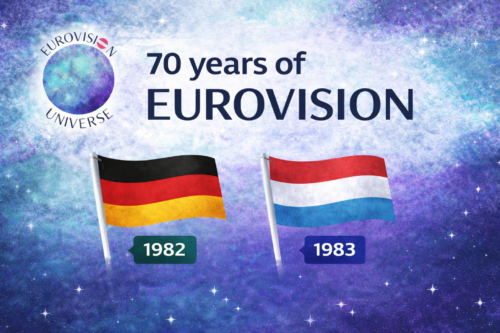
70 years of Eurovision: a couple of big hits

The Eurovision Song Contest is celebrating its 70th anniversary. That is a wonderful milestone. We at Eurovision Universe love diving into the history of the contest. That is why we are taking a closer look at the contests of the past 70 years.

1982

‘Harrogate, where?’ was the question raised at the beginning of the broadcast. For the small British seaside town was the venue for the 1982 Eurovision Song Contest. Jan Leeming hosted the event. France did not participate because the Minister of Culture considered the standard too low. Greece did have an entry, but ultimately withdrew it. Here, too, there was interference from a Minister of Culture. The song was deemed not good enough.

Jahn Teigen and Anita Skorgan participated for Norway for the second and third time, respectively. By now married, they sang a quiet ballad. Sally Ann Tripplet, a member of the group Prima Donna in 1980, was also back for the United Kingdom; now as half of the duo Bardo. Anna Vissi, who competed for Greece in 1980, now represented Cyprus. Her “Mono I agapi” finished fifth, for a long time the best score for Cyprus. And then there was Stella: with Hearts of Soul she competed for the Netherlands in 1970, with Dream Express for Belgium in 1977, and now solo, also for Belgium. She also did well with a fourth place.

We must not fail to mention the Finnish candidate: Kojo. He didn’t score a single point with a song against the neutron bomb. Unsurprisingly: the song was not very suitable for the general public. Israel sent Avi Toledano with a cheerful song called “Hora”. He came second with it.

Nicole

And that was actually what the competition was about. Because Germany won with a landslide. Nicole, 17 years old, wearing a black polka-dot dress, sitting on a stool with a guitar in her hand. This is how she sang her peace song “Ein bißchen Frieden”. There was a great deal of consensus regarding this entry. Nicole achieved the highest score up to that point. She managed to generate applause by singing her song not only in German but also in English, French, and Dutch. Later, she also released a Danish version of the song.

1983

The Olympic Stadium in Munich was the venue. More precisely, the Rudi Sedlmayer Halle, a basketball hall. The host was Marlène Charell. That poor presenter faced the impossible task of pronouncing just about every comma in three languages. Greece, France, and Italy were back, but Ireland skipped a year. This brought the total number of participants to twenty.

Guy Bonnet had the honor of opening the festival for France. He had participated before, in 1970. Jahn Teigen was also returning for Norway, with his wife Anita Skorgan in the choir. The Norwegian conductor was Sigurd Jansen. Marlène Charell didn’t have that on her cue card. She only found out when she had to announce the man. So she just made up a name on the spot, “Johannes Skorgan”.

16-year-old Carola Häggkvist competed for Sweden. Her song “Främling” came third and Carola managed to score a big hit. She released the song not only in English, but also in German and Dutch. Another international hit was that of Yugoslavia. Back home, the big stars were quite angry that they had lost the national final to Daniel, but he achieved the best score for the country up to that point with his song “Džuli”. Ofra Haza participated for Israel. She came second with the song “Chai”. Later, she had a hit throughout Europe with “Im nin’alu”. In 2000, Haza died of AIDS. A notable act participated for Belgium: the group Pas De Deux with the song “Rendez-vous”, with the full lyrics “Rendez-vous, but enough is enough and I’m done”. When that song won the Belgian national final, half the audience left the hall. The rest stayed to boo and otherwise yell through the song and make their anger known.

Corinne Hermes

The winner was once again a French singer participating for Luxembourg: Corinne Hermes. The ballad “Si la vie est cadeau” may have made the biggest impression on the jury members, but certainly not on the record-buying public. Carola from Sweden and Daniel from Yugoslavia had the big international hits. Corinne Hermes had more trouble selling her song. But, all in all, several major hits emerged from the 1983 Eurovision Song Contest.

 

Related news

Eurovision 2026

Road to Vienna: Italy

Road to Vienna: Italy As we eagerly anticipate the Eurovision Song Contest in Basel, we continue our daily spotlight on this year’s contestants. Today, we focus on Italy. Sal Da Vinci: From Child Performer to Italian Icon Sal Da Vinci, born Salvatore Michael Sorrentino, is a seasoned performer set to represent Italy at the Eurovision Song Contest 2026 with “Per sempre sì”. Born in New York City in 1969 and raised in Naples, he began his career at just seven years old, quickly gaining experience in theatre and film. Rise to Fame in Music and Theatre During the 1990s, Sal Da Vinci established himself as a recording artist, winning Festival Italiano 1994 with “Vera” and releasing several successful albums. At the same time, he built a strong reputation in musical theatre, starring in productions like C’era una volta… Scugnizzi, which won a major Italian theatre award. Sanremo Success and Continued Career Sal Da Vinci reached a wider audience at the Festival di Sanremo 2009, finishing third. Over the years, he released multiple albums and collaborated with major Italian artists, while continuing to headline theatre productions. A New Peak in the 2020s In recent years, he connected with a new generation. His 2024 hit “Rossetto e caffè” became a major streaming success and earned double platinum status. This marked a fresh high point in his long-running career. Eurovision 2026 Journey In 2026, Sal Da Vinci returned to Festival di Sanremo 2026 with “Per sempre sì” and won. Now, he heads to Eurovision in Vienna, bringing decades of experience and artistry to one of the world’s biggest music stages. Per Sempre Sì: A Romantic Italian Pop Ballad Per Sempre Sì is a heartfelt Italian pop ballad about love, devotion, and lifelong commitment. Performed by Sal Da Vinci, the song captures the emotional journey of two people building a future together. From First Meeting to a Shared Future The lyrics tell the story of a relationship that begins with a chance encounter and grows into a deep emotional bond. The couple dreams of a life together, including building a home and facing life’s challenges side by side. A Promise of Forever At the core of the song is a powerful vow of eternal love. The chorus expresses a lifelong promise, symbolizing trust, loyalty, and emotional unity. This commitment is reinforced through intimate imagery and a heartfelt declaration of devotion. Love Through Life’s Challenges The song also reflects on uncertainty and the realities of life. It shows that true love is not only romantic but also resilient, built on support, growth, and shared strength through difficult moments. The Meaning of “Yes” A central theme of the song is the word “yes,” representing a symbolic promise of forever. It stands for unity, trust, and the decision to build a life together. Themes and Style Per Sempre Sì combines emotional storytelling with classic Italian pop ballad style. Its themes of love, marriage, and devotion make it a powerful and timeless anthem, perfect for romantic moments and celebrations of commitment. Italy in the Eurovision Song Contest Italy has participated in the Eurovision Song Contest since its inception in 1956, achieving three victories: in 1964 with Gigliola Cinquetti‘s “Non ho l’età,” in 1990 with Toto Cutugno‘s “Insieme: 1992,” and in 2021 with Måneskin‘s “Zitti e buoni.” As a member of the “Big Five,” Italy automatically qualifies for the Grand Final, allowing its entries to consistently showcase the nation’s rich musical heritage. The Bookmakers Italy is currently sitting in 10th place with the bookmakers, but the real question is: how high can Sal climb within the Top 10… or will he slip just outside it?

Read More »
History
Martijn

70 years of Eurovision: a couple of big hits

The Eurovision Song Contest is celebrating its 70th anniversary. That is a wonderful milestone. We at Eurovision Universe love diving into the history of the contest. That is why we are taking a closer look at the contests of the past 70 years. 1982 ‘Harrogate, where?’ was the question raised at the beginning of the broadcast. For the small British seaside town was the venue for the 1982 Eurovision Song Contest. Jan Leeming hosted the event. France did not participate because the Minister of Culture considered the standard too low. Greece did have an entry, but ultimately withdrew it. Here, too, there was interference from a Minister of Culture. The song was deemed not good enough. Jahn Teigen and Anita Skorgan participated for Norway for the second and third time, respectively. By now married, they sang a quiet ballad. Sally Ann Tripplet, a member of the group Prima Donna in 1980, was also back for the United Kingdom; now as half of the duo Bardo. Anna Vissi, who competed for Greece in 1980, now represented Cyprus. Her “Mono I agapi” finished fifth, for a long time the best score for Cyprus. And then there was Stella: with Hearts of Soul she competed for the Netherlands in 1970, with Dream Express for Belgium in 1977, and now solo, also for Belgium. She also did well with a fourth place. We must not fail to mention the Finnish candidate: Kojo. He didn’t score a single point with a song against the neutron bomb. Unsurprisingly: the song was not very suitable for the general public. Israel sent Avi Toledano with a cheerful song called “Hora”. He came second with it. Nicole And that was actually what the competition was about. Because Germany won with a landslide. Nicole, 17 years old, wearing a black polka-dot dress, sitting on a stool with a guitar in her hand. This is how she sang her peace song “Ein bißchen Frieden”. There was a great deal of consensus regarding this entry. Nicole achieved the highest score up to that point. She managed to generate applause by singing her song not only in German but also in English, French, and Dutch. Later, she also released a Danish version of the song. 1983 The Olympic Stadium in Munich was the venue. More precisely, the Rudi Sedlmayer Halle, a basketball hall. The host was Marlène Charell. That poor presenter faced the impossible task of pronouncing just about every comma in three languages. Greece, France, and Italy were back, but Ireland skipped a year. This brought the total number of participants to twenty. Guy Bonnet had the honor of opening the festival for France. He had participated before, in 1970. Jahn Teigen was also returning for Norway, with his wife Anita Skorgan in the choir. The Norwegian conductor was Sigurd Jansen. Marlène Charell didn’t have that on her cue card. She only found out when she had to announce the man. So she just made up a name on the spot, “Johannes Skorgan”. 16-year-old Carola Häggkvist competed for Sweden. Her song “Främling” came third and Carola managed to score a big hit. She released the song not only in English, but also in German and Dutch. Another international hit was that of Yugoslavia. Back home, the big stars were quite angry that they had lost the national final to Daniel, but he achieved the best score for the country up to that point with his song “Džuli”. Ofra Haza participated for Israel. She came second with the song “Chai”. Later, she had a hit throughout Europe with “Im nin’alu”. In 2000, Haza died of AIDS. A notable act participated for Belgium: the group Pas De Deux with the song “Rendez-vous”, with the full lyrics “Rendez-vous, but enough is enough and I’m done”. When that song won the Belgian national final, half the audience left the hall. The rest stayed to boo and otherwise yell through the song and make their anger known. Corinne Hermes The winner was once again a French singer participating for Luxembourg: Corinne Hermes. The ballad “Si la vie est cadeau” may have made the biggest impression on the jury members, but certainly not on the record-buying public. Carola from Sweden and Daniel from Yugoslavia had the big international hits. Corinne Hermes had more trouble selling her song. But, all in all, several major hits emerged from the 1983 Eurovision Song Contest.  

Read More »
Follow Us: