About
Biography
Sixteen is a Polish pop-rock band formed in 1997, best known for representing Poland at the Eurovision Song Contest 1998. The group enjoyed major success in the late 1990s with hit songs and a platinum-selling album in Poland.
Formation and Early Success (1997–1998)
Sixteen debuted on the Polish music scene in June 1997 with their single, “Spadające myśli” (“Falling Thoughts”). The band was founded by lead singer Renata Dąbkowska alongside guitarist Jarosław Pruszkowski, bassist Janusz Witaszek, drummer Tomasz Stryczniewicz, and keyboardist Mirosław Hoduń. Their breakthrough came with the single “Twoja Lawa” (“Your Lava”), which became a huge radio hit. In October 1997, Sixteen released their debut studio album Lawa, which sold over 100,000 copies and achieved platinum status in Poland. The album’s success was accompanied by multiple awards: Sixteen won the 1997 PlayBox Award for Best Radio Debut and a Machina magazine award for Debut of the Year. They earned a nomination for a prestigious Fryderyk Award (Poland’s phonographic debut of the year). Another single, “Obudź we mnie Wenus” (“Awaken Venus in Me”), also became very popular, solidifying Sixteen’s status as one of Poland’s top new pop-rock acts.
Thanks to their rapid rise in popularity, Sixteen were selected to represent Poland on the international stage in 1998.
Eurovision Song Contest 1998
In 1998, Sixteen was internally selected by the Polish broadcaster TVP to represent Poland at the Eurovision Song Contest. The selection was announced on 30 March 1998, after TVP had reviewed 45 song submissions from 38 artists. Sixteen’s entry was “To takie proste” (Polish for “It’s So Simple”), a pop song composed by Jarosław Pruszkowski with lyrics by his wife Olga Pruszkowska. However, the internal choice of Sixteen stirred some controversy in Poland. A group of music producers criticized the lack of a public selection process and alleged that Sixteen’s selection was influenced by a committee member’s connection to the band’s record label. This charge was denied by the committee. Despite the criticism, Renata Dąbkowska and Sixteen moved forward enthusiastically with their Eurovision plans. They even recorded an English-language version of “To takie proste” titled “When Love Turns to Hate” for international promotion.
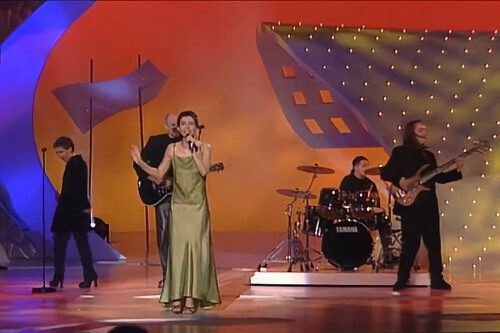
On May 9, 1998, Sixteen performed “To takie proste” live at the Eurovision grand final in Birmingham. They appeared 7th in the running order. Renata Dąbkowska’s strong vocals were accompanied by the band’s pop-rock instrumentation on the big stage. Ultimately, the song did not appeal to many international juries. Poland finished 17th out of 25 countries. This result was a disappointment for the group after the high expectations at home. However, the song found a warmer reception domestically. Renata Dąbkowska won the Public’s Choice award at the 36th National Festival of Polish Song in Opole 1999, reflecting the Polish audience’s appreciation for her music. Sixteen’s Eurovision performance gave the band significant exposure across Europe, including television appearances during Eurovision week and coverage in international media, even if the contest result was below expectations.
Tragedy
Shortly after their Eurovision adventure, Sixteen faced major upheavals. On June 13, 1998, the band’s founder and lead composer Jarosław Pruszkowski tragically died of a heart attack. His sudden death was a devastating blow to the group and marked the beginning of a turbulent period. Around the same time, internal tensions grew within the band. Renata Dąbkowska decided to leave Sixteen not long after the contest to pursue a solo career, citing personal and artistic differences. With their lead singer gone and their creative leader lost, the remaining members opted to continue the band under a new identity. They recruited guitarist Grzegorz Kloc (who also took on lead vocals) and violinist/backing vocalist Olga Pruszkowska into the lineup, and rebranded themselves as Seventeen (sometimes stylized as Sixteen-Seventeen). Despite the new name and lineup, Sixteen’s popularity waned after these changes. Many fans were unhappy about the departure of Renata and the change of style, and the band struggled to regain their previous momentum.
Seventeen Era and Hiatus (1998–2004)
Under the Seventeen moniker, the group released two studio albums. The first was Szalona (“Crazy”) in 1999, followed by Chłopak i dziewczyna (“Boy and Girl”) in 2001. Unfortunately, neither record could replicate the success of Lawa. Szalona sold around 25,000 copies, while Chłopak i dziewczyna sold only about 4,000 copies, which was a steep decline compared to their platinum debut. Although the band did score a few radio hits during this period (such as “Daj słowo” and “Piękna i wulkan” in 1999), overall public interest had diminished. The new Seventeen lineup made appearances on Polish television and performed at various concerts, but they remained in the shadow of Sixteen’s initial glory. In an effort to revive their fortunes, the group briefly reverted to the combined name Sixteen-Seventeen in 2001, but this also failed to catch on with a wider audience.
By 2003, the band’s activities had slowed significantly. In 2004, the members attempted one last comeback as Sixteen/Seventeen with a new single “Ulica (Ja i Ty)” (“Street (You and I)”), which was intended to herald a new album. This uptempo pop track received some airplay and even reached #2 on a radio chart. However, the promised new album never materialized. After this, the group effectively went on hiatus and eventually split up in 2004. For several years, Sixteen was inactive as a band, marking the end of an era that had begun with such promise. Meanwhile, Renata Dąbkowska found moderate success as a solo artist. She released two solo albums (Jedna na cały świat and Bo taka jest) and stayed in the public eye to some extent.
Later Years, Comeback Attempts and Legacy (2010–2026)
After a lengthy break, members of Sixteen resurfaced in the 2010s with new music. In 2010, the band (minus Renata) quietly returned to the studio and released a single called “Małe zło” (“Little Evil”), signaling that Sixteen/Seventeen was active again. This was followed by another single, “2 światy” (“Two Worlds”) in 2012, which reached #3 on a Polish radio chart. In 2013, they released two more songs (“Nie wyprzedzaj (to ja)” and “Moja i twoja piosenka”), though these did not chart significantly. Despite these sporadic releases, the group did not produce a full new album, and their comeback remained low-profile. The later singles, while keeping the Sixteen name alive, did not return the band to mainstream popularity. By the mid-2010s, Sixteen had once again faded from the spotlight.
Individual band members continued to be involved in music in various ways. Grzegorz Kloc, who had led the Seventeen incarnation, embarked on his own solo career in the Christian pop/rock genre. Notably, in 2008 Kloc even attempted to represent Poland at Eurovision again as a solo singer. His song “Don’t Let the Fire Die” competed in the national selection, finishing 11th in the Polish finals. Renata Dąbkowska also returned to performing; in 2015, she formed a new project and began touring again, reconnecting with the pop and disco sounds of her early career. These endeavors by former members underscore the lasting influence of Sixteen’s music journey. Today, as of 2026, Sixteen is no longer active as a full-time band.