About
Quick Facts
Name
George Alan O’Dowd
Born
14 June 1961
Nationality
🇬🇧 British
National Selection
2026 San Marino Song Contest
In Eurovision
2026 Vienna
Song
Superstar (Senhit ft. Boy George, 2026)
Biography
Boy George was born as George Alan O’Dowd on June 14, 1961, in London. He grew up in a large Irish working-class family in southeast London and developed a love for music at a young age. As a teen, he was inspired by glam-rock icons like David Bowie. Seeing Bowie’s Ziggy Stardust performance at age 11 sparked his dream of becoming a singer. George became known for his eccentric fashion and androgynous style early on, pushing boundaries with flamboyant clothing and makeup. This bold image eventually got him expelled from school. However, it also immersed him in London’s late-1970s punk and New Romantic club scene, where he honed his unique persona and musical ambitions.
Culture Club: 1980s Pop Stardom
In 1981, Boy George formed the band Culture Club with bassist Mikey Craig, drummer Jon Moss, and guitarist Roy Hay. The group’s name reflected its diverse members and their “culture” mix, including Boy George as a cross-dressing Irish frontman, which was ahead of its time. Culture Club shot to stardom in 1982 when their single “Do You Really Want to Hurt Me” became a global hit, It reached No.1 in the UK and charted top 10 in many countries. They followed with other hits like “Time (Clock of the Heart)” and 1983’s “Karma Chameleon,” the latter hitting No.1 in 16 countries (including the US).
By 1984, Culture Club was one of the biggest pop acts in the world. They won the Grammy Award for Best New Artist and earned Brit Awards for Best British Group and Best British Single (“Karma Chameleon”) that year. The band’s first two albums yielded multiple top-10 hits in both the UK and US. This made Culture Club the first group since the Beatles to have three top 10 US hits from a debut album. Boy George’s soulful voice and outrageous fashion made him a trailblazing 1980s icon, celebrated for breaking gender norms in pop culture.
Challenges and Solo Career in the Late 1980s
By the mid-1980s, the pressures of fame took a toll. Boy George developed a serious heroin addiction around 1984. The band’s third and fourth albums did not match their earlier success. Internal tensions grew. In 1986, Culture Club disbanded amidst Boy George’s drug troubles and the revelation of his secret romance with drummer Jon Moss. That year George was arrested for heroin possession, making headlines. Determined to rebuild, he went solo.
In 1987, Boy George scored a comeback with a cover of “Everything I Own,” which reached No.1 on the UK Singles Chart. This reggae-tinged hit, his first and only UK solo number-one, was released just as he was overcoming his addiction and gave his career a much-needed boost. He also found success in the U.S. with “The Crying Game” in 1992, the theme song to a hit film. Meanwhile, Boy George embraced a new path as a DJ and dance music producer, fronting the acid-house project Jesus Loves You from 1989 to 1992. During this period he also publicly acknowledged his sexuality. His openness as a gay man further cemented his status as an LGBTQ trailblazer in entertainment. In 1995, he candidly recounted his tumultuous early fame and recovery in his first autobiography Take It Like a Man.
Reunions, Musicals and 2000s Ventures
In 1998, Boy George reunited with Culture Club. The comeback yielded a new hit, “I Just Wanna Be Loved,” which reached No.4 on the UK charts. The band released a compilation with new material and later a fifth album, though that 1999 album (Don’t Mind If I Do) saw limited success. Beyond band reunions, Boy George expanded his creative pursuits. He wrote and composed the musical Taboo, which debuted in London’s West End in 2002 and went to Broadway in 2003. The show was semi-autobiographical, reflecting the 1980s club scene that Boy George once led.
In 2005, he released a second memoir, Straight, offering more reflections on fame and personal growth. However, the mid-2000s also brought new challenges. In 2006, Boy George was sentenced to community service in New York after falsely reporting a burglary. The incident famously had him cleaning city streets as punishment. In late 2007, he was involved in a legal scandal in London. He was convicted in 2008 of falsely imprisoning a male escort during a drug-fueled lapse. The singer served four months in jail in 2009. Despite these setbacks, he emerged resilient. In 2008 he even released a single called “Yes We Can,” inspired by Barack Obama’s message of hope. By the end of the 2000s, Boy George had achieved sobriety and embraced Buddhism, crediting it with helping him stay clean and sane after March 2008.
Continued Career and Legacy in the 2010s
Boy George kept reinventing himself in the 2010s. He became a popular television personality, serving as a coach on The Voice UK in 2016 and later on The Voice Australia from 2017. He also continued to record and tour with Culture Club. The band released Life in 2018, their first studio album in 19 years, and toured internationally with great success.
In 2017, Boy George teamed up with YMCA Australia to record a special version of “Y.M.C.A.” to raise awareness for mental health, youth unemployment, and marriage equality, reflecting his advocacy for LGBTQ+ rights and social causes. His distinctive look and persona remained influential. He was invited to guest-star in fashion and music events, and even took on acting roles. In 2023, Boy George joined the cast of the Broadway musical Moulin Rouge! in New York, playing the showman character Harold Zidler to the delight of theater fans. That same year he published his third autobiography, Karma, offering new insights into his life and confirming his place as a pop culture survivor.
With decades in the spotlight, Boy George’s legacy as an unapologetic innovator in music and fashion is firmly established. He has sold over 50 million records worldwide with Culture Club and as a solo artist, and is celebrated as a true icon who helped pave the way for greater diversity in pop music.
Eurovision 2026: Representing San Marino
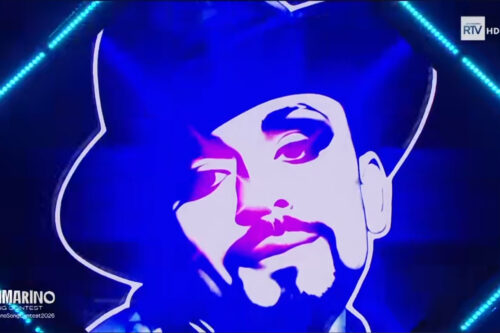
In a surprising late-career twist, Boy George is now set to make his Eurovision Song Contest debut. In March 2026, he partnered with Sammarinese singer Senhit to compete in San Marino’s national selection for Eurovision. Their duet “Superstar” won the Dreaming San Marino Song Contest 2026, earning Senhit and Boy George the right to represent San Marino at Eurovision in Vienna. The duo will perform “Superstar” in the first semi-final in May 2026, hoping to take the micro-nation to a grand-final appearance.
Entries
Superstar (Senhit featuring Boy George)
Country
🇸🇲 San Marino
Year
2026
Language
English
Lyrics
Anderz Wrethov
Boy George
Julie Aagaard
John-Emil Johansson
Thomas Stengaard
Senhit Zadek Zadek
Music
Anderz Wrethov
Boy George
Julie Aagaard
John-Emil Johansson
Thomas Stengaard
Senhit Zadek Zadek
Backings
–
Results Semi 1
Points:
Position:
Running order:
Results Finals
Points:
Position:
Running order: