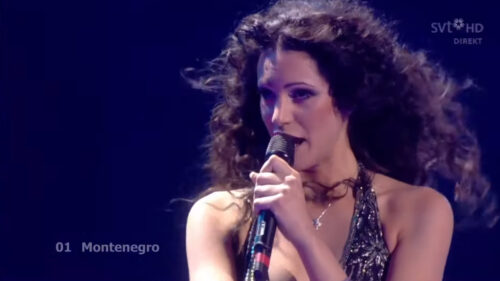
🇲🇪 Blast from the Past: Montenegro 2009

We know a lot about Eurovision and we want to share this knowledge with you! Therefore we’d like to bring you a blast from the past. Today: Andrea Demirović, singing “Just Get Out Of My Life”.

Montenegro in the Eurovision Song Contest

Montenegro made its debut as an independent nation in the competition in 2007, following the dissolution of Serbia and Montenegro, which had previously competed together. Montenegro’s participation has been marked by a series of ups and downs.

Initially, Montenegro struggled to make an impact in the contest. Their debut entry, “Ajde Kroči” by Stevan Faddy, failed to qualify for the final. This set a precedent for the country’s early years in the competition, with several non-qualifications following. Montenegro’s most successful entry to date came in 2015, when Knez represented the country with the song “Adio”. This song qualified for the grand final and finished in 13th place. However, maintaining this level of success has been challenging. Following “Adio”, Montenegro has had a mixed record at the contest, with more non-qualifications. The country has occasionally decided to withdraw from the competition, as was the case in 2010 and 2011 due to financial reasons, and again after the 2019 contest. In 2023 the country did not take part either. Participation in 2024 is not yet confirmed.
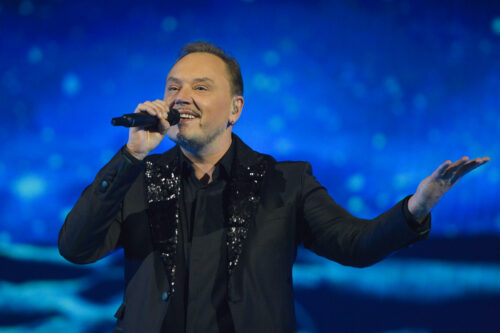
National Selection 2009

Montenegro decided to select their entry internally. The submission period opened on December 27 and closed on January 20. A total of 22 songs were submitted. Although the selection was not public, several titles were leaked:

  • Free Jack, “Ljubav se san”
  • Ivan Čanović and Merima Njegomir, “Kad bi dao Bog”
  • Nina Petković, “Srce Balkansko”
  • Sergej Ćetković, “Sjenke ljubavi”

Unfortunately, none of these songs can be found on YouTube.

But on 23 January, it was announced that Andrea Demirović was going to represent Montenegro with the song “Just Get Out Of My Life”.
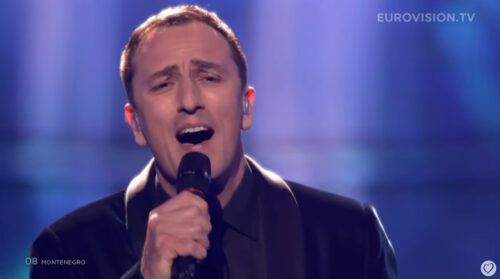
  Sergej Ćetković

Andrea Demirović

Andrea Demirović is a Montenegrin singer. Born on June 17, 1985, in Podgorica, Montenegro (which was then part of the Socialist Federal Republic of Yugoslavia), Andrea embarked on a journey in music that has seen her become a household name in her home country and beyond.

She is also known simply as Andrea. From a young age, Andrea demonstrated a passion for music, which led her to pursue formal education in the field. She became a student at the prestigious Cetinje Music Academy, where she focused on Music Pedagogy.

Breakthrough

Andrea’s big break came in 2002 at the Sunčane Skale festival, an annual music event that has been instrumental in launching the careers of many artists from the region. Her performance at the festival captured the attention of both the public and music professionals, setting the stage for a series of successful appearances at regional music festivals.
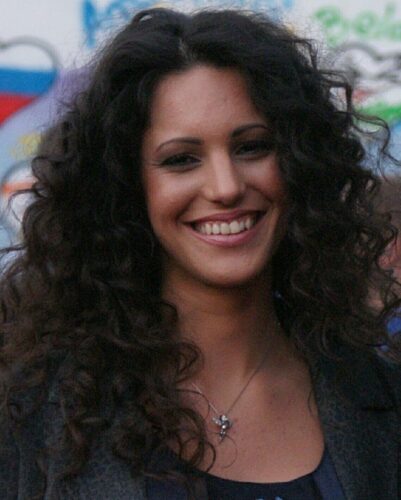
Mirela

In 2006, Andrea released her first album, aptly titled “Andrea,” under the renowned City Records label. In anticipation of her follow-up album, which was due for release in 2009, she introduced her fans to the single “The Queen of the Night.” This track was a cover of Mirela’s song from Misión Eurovisión 2007.

Eurovision

Andrea’s foray into the Eurovision Song Contest started with participations in the Serbo-Montenegrin and Montenegrin national finals. With the song “Just Get Out of My Life,” Andrea performed as the opening act in the first semi-final of the Eurovision Song Contest on May 12, 2009

In 2015, Andrea participated in Odbrojavanje za Beč (Countdown to Vienna), the Serbian national final for the Eurovision Song Contest. She did not win the ticket to Eurovision that year. Despite this, she played a prominent role in the contest by announcing the Montenegrin votes.

Recent music

In 2021, Andrea released a duet with Bojan Jovović, “Proljeće”. One month ago, she released a brand new single: “Poquito”!

Just Get Out Of My Life

The song

The song “Just Get Out Of My Life” is an uptempo pop number with elements of disco and funk. Its catchy rhythm and melody are designed to be instantly engaging. The English lyrics speak of a strong-willed individual who is taking a stand against a toxic relationship, conveying a message of empowerment and self-respect. 

The performance

In the performance, Andrea Demirović’s vocal delivery showcased her range and ability to convey emotion. The staging aimed to complement the song’s dynamic energy. Despite a vibrant performance that opened the first semi-final, “Just Get Out of My Life” did not secure enough votes to progress to the grand final.

Ralph Siegel

The song was composed by Ralph Siegel, a German producer and songwriter who is a Eurovision veteran. He wrote numerous entries for the contest over the years, including several for Germany. One of them was 1982 winner “Ein bißchen Frieden” by Nicole. The lyrics were penned by Bernd Meinunger and José Juan Santana Rodriguez. The collaboration of such experienced songwriters on Montenegro’s entry highlighted the country’s serious commitment to making an impact at the contest.

Related news

Eurovision 2026

Vienna 12 points: From MUSEXPO to Musical

Several countries start their second rehearsals in Vienna. As we still don’t have access to the rehearsals, we will do something else. Per entry, we highlight one subject and give you some more information. That can be something about the artist, the song, the lyrics or even something completely different.  Switzerland — Veronica Fusaro, “Alice” Running order: 7 | Rehearsal: 8 May, 15:00–15:25 CEST MUSEXPO is one of the music industry’s key meeting places, where artists, labels, publishers, managers and media professionals come together to discover new talent and discuss the future of music. Founded by A&R Worldwide, the event combines panels, networking sessions, awards and live showcases. It has been held in Los Angeles and has also had European editions, including London, making it a truly international platform. For Eurovision fans, MUSEXPO is interesting because it often gives rising artists a stage before a wider breakthrough. Singer Veronica Fusaro performed at MUSEXPO in London and Los Angeles, showing how the event can connect young talent with influential people from the global music business. Unlike a traditional festival, MUSEXPO is mainly aimed at professionals. Its goal is not only entertainment, but also discovery, cooperation and new opportunities across the music, media and technology world, especially for artists ready to grow internationally today.  Cyprus — Antigoni, “Jalla” Running order: 8 | Rehearsal: 8 May, 15:35–16:00 CEST Tsifteteli is a lively dance style from Greece, Cyprus, Turkey and the wider eastern Mediterranean. The name comes from the Turkish çiftetelli, often linked to a “double string” musical style. In Greek culture, tsifteteli is known for fluid hip movements, expressive arms and a sensual, celebratory feeling. It is often compared with belly dancing, but it also belongs to everyday social life: people dance it at parties, weddings and festivals, not only on stage. That background gives extra colour to Antigoni’s Eurovision lyric “Shake my hips to tsifteteli”. As a British artist with Greek-Cypriot roots, she uses the word as a cultural reference, not just as a dance instruction. In “Jalla”, tsifteteli helps create a Mediterranean party atmosphere, mixing modern pop energy with sounds and movements that many Greek and Cypriot listeners will instantly recognise. For international fans, it is a small word with big cultural meaning at Eurovision 2026 in Vienna.  Latvia — Atvara, “Ēnā” Running order: 9 | Rehearsal: 8 May, 16:10–16:35 CEST Ēnā meaning is central to Latvia’s Eurovision 2026 entry by Atvara. In Latvian, ēna means “shadow” or “shade”, while ēnā means “in the shadow” or “in the shade”. That small grammatical change gives the title extra weight, because the song places its main character inside darkness, not just near it. The lyrics show someone losing confidence, hiding feelings and drifting away from the light. Atvara links this image to the pain of growing up around another person’s addiction, which gives “Ēnā” a personal and emotional meaning. For Eurovision viewers, the title explains the dark atmosphere of Latvia’s entry. This song does not tell a simple story about sadness. It explores fear, family pressure and the courage someone needs to step out of darkness in Vienna at Eurovision 2026. That makes it a strong title for a dramatic performance. “Ēnā” proves how one Latvian word can carry emotion, memory and resilience.  Denmark — Søren Torpegaard Lund, “Før vi går hjem” Running order: 10 | Rehearsal: 8 May, 16:45–17:10 CEST Matador musical brings one of Denmark’s best-loved classics to the stage. The story comes from DR’s “Matador”, with scripts by Lise Nørgaard and direction by Erik Balling, and takes audiences back to the fictional town of Korsbæk. There, banker Hans Christian Varnæs and newcomer Mads Skjern represent two families, two social worlds and a changing Denmark before and during the Second World War. In 2024, One & Only Musicals presented a new original version with songs by Lise Cabble and Burhan G. The production mixed nostalgia, humour, ambition and family drama with a fresh musical sound. Søren Torpegaard Lund played Daniel Skjern, the son of Mads and Ingeborg Skjern. His role gave him a touching solo moment with “En dreng som mig”, a song about expectations and identity. For Eurovision fans, Matador shows the theatre background behind Denmark’s 2026 artist and adds context to his performance skills on the Eurovision stage in Vienna.  

Read More »
Eurovision 2026
Martijn

Vienna 12 points: From MUSEXPO to Musical

Several countries start their second rehearsals in Vienna. As we still don’t have access to the rehearsals, we will do something else. Per entry, we highlight one subject and give you some more information. That can be something about the artist, the song, the lyrics or even something completely different.  Switzerland — Veronica Fusaro, “Alice” Running order: 7 | Rehearsal: 8 May, 15:00–15:25 CEST MUSEXPO is one of the music industry’s key meeting places, where artists, labels, publishers, managers and media professionals come together to discover new talent and discuss the future of music. Founded by A&R Worldwide, the event combines panels, networking sessions, awards and live showcases. It has been held in Los Angeles and has also had European editions, including London, making it a truly international platform. For Eurovision fans, MUSEXPO is interesting because it often gives rising artists a stage before a wider breakthrough. Singer Veronica Fusaro performed at MUSEXPO in London and Los Angeles, showing how the event can connect young talent with influential people from the global music business. Unlike a traditional festival, MUSEXPO is mainly aimed at professionals. Its goal is not only entertainment, but also discovery, cooperation and new opportunities across the music, media and technology world, especially for artists ready to grow internationally today.  Cyprus — Antigoni, “Jalla” Running order: 8 | Rehearsal: 8 May, 15:35–16:00 CEST Tsifteteli is a lively dance style from Greece, Cyprus, Turkey and the wider eastern Mediterranean. The name comes from the Turkish çiftetelli, often linked to a “double string” musical style. In Greek culture, tsifteteli is known for fluid hip movements, expressive arms and a sensual, celebratory feeling. It is often compared with belly dancing, but it also belongs to everyday social life: people dance it at parties, weddings and festivals, not only on stage. That background gives extra colour to Antigoni’s Eurovision lyric “Shake my hips to tsifteteli”. As a British artist with Greek-Cypriot roots, she uses the word as a cultural reference, not just as a dance instruction. In “Jalla”, tsifteteli helps create a Mediterranean party atmosphere, mixing modern pop energy with sounds and movements that many Greek and Cypriot listeners will instantly recognise. For international fans, it is a small word with big cultural meaning at Eurovision 2026 in Vienna.  Latvia — Atvara, “Ēnā” Running order: 9 | Rehearsal: 8 May, 16:10–16:35 CEST Ēnā meaning is central to Latvia’s Eurovision 2026 entry by Atvara. In Latvian, ēna means “shadow” or “shade”, while ēnā means “in the shadow” or “in the shade”. That small grammatical change gives the title extra weight, because the song places its main character inside darkness, not just near it. The lyrics show someone losing confidence, hiding feelings and drifting away from the light. Atvara links this image to the pain of growing up around another person’s addiction, which gives “Ēnā” a personal and emotional meaning. For Eurovision viewers, the title explains the dark atmosphere of Latvia’s entry. This song does not tell a simple story about sadness. It explores fear, family pressure and the courage someone needs to step out of darkness in Vienna at Eurovision 2026. That makes it a strong title for a dramatic performance. “Ēnā” proves how one Latvian word can carry emotion, memory and resilience.  Denmark — Søren Torpegaard Lund, “Før vi går hjem” Running order: 10 | Rehearsal: 8 May, 16:45–17:10 CEST Matador musical brings one of Denmark’s best-loved classics to the stage. The story comes from DR’s “Matador”, with scripts by Lise Nørgaard and direction by Erik Balling, and takes audiences back to the fictional town of Korsbæk. There, banker Hans Christian Varnæs and newcomer Mads Skjern represent two families, two social worlds and a changing Denmark before and during the Second World War. In 2024, One & Only Musicals presented a new original version with songs by Lise Cabble and Burhan G. The production mixed nostalgia, humour, ambition and family drama with a fresh musical sound. Søren Torpegaard Lund played Daniel Skjern, the son of Mads and Ingeborg Skjern. His role gave him a touching solo moment with “En dreng som mig”, a song about expectations and identity. For Eurovision fans, Matador shows the theatre background behind Denmark’s 2026 artist and adds context to his performance skills on the Eurovision stage in Vienna.  

Read More »
Follow Us: