🇮🇪 Blast from the past: Ireland 1977

We know a lot about Eurovision and we want to share this knowledge with you! Therefore we’d like to bring you a blast from the past. Today: The Swarbriggs plus Two, participating in 1977.

Ireland in the Eurovision Song Contest

Ireland has been a dominant force in the Eurovision Song Contest, boasting a record seven victories, the most by any participating country.

Their winning streak began in 1970 when Dana serenaded audiences with “All Kinds of Everything.” A decade later, Johnny Logan emerged as a Eurovision legend for Ireland. He first won in 1980 with “What’s Another Year” and then again in 1987 with “Hold Me Now.” Furthermore, Logan wrote the winning song “Why Me?” which was performed by Linda Martin in 1992.

The ’90s continued to be a golden era for Ireland. Following Linda Martin, Niamh Kavanagh captured the title in 1993 with “In Your Eyes.” The subsequent year, Paul Harrington and Charlie McGettigan triumphed with “Rock ‘N’ Roll Kids.” In 1995, Eimear Quinn’s ethereal voice won with “The Voice,” marking an unprecedented fourth consecutive victory for Ireland.
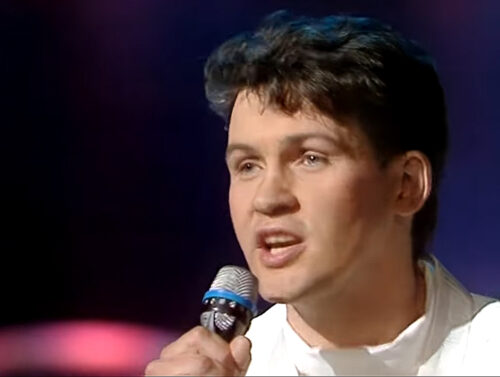
Johnny Logan

National Final

Ireland chose their entry through the Irish National Song Contest on 20 February 1977. The show was hosted by Mike Murphy and was not held in a big hall but at the RTÉ TV Studios in Dublin. Eight songs and eight different artists competed:

  1. Jamie Stone, “If I Give My Love”, 19 pts, 2nd
  2. Dickie Rock, “I Can’t Go On Without You”, 8 pts, 6th
  3. Sunshine, “Look Before You Leap”, 0 pts, 8th
  4. D.J. Curtin, “You Cannot Stop The Music”, 5 pts, 7th
  5. The Swarbriggs Plus Two, “It’s Nice To Be In Love Again“, 25 pts, 1st
  6. Denis Allen, “Da-dum Da-dum I Love You So”, 12 pts, 5th
  7. Colm C.T. Wilkinson, “There Was A Dream“, 18 pts, 3rd
  8. Chips, “Goodbye Goodbye“, 13 pts, 4th

Chips

Note that former participants Dickie Rock (1966) and The Swarbriggs (1975) participated. Colm C.T. Wilkinson had to wait another year, as he represented Ireland in 1978. The singer of the group Chips is quite a famous one: Eurovision winner Linda Martin, who first took part in 1984, before she won in 1992.

The Swarbriggs Plus Two

The Swarbriggs

Thomas “Tommy” and John James “Jimmy” Swarbrigg are renowned figures in Irish music, both as former pop artists and promoters. 

In the early ’60s, Tommy showcased his trumpet skills with Joe Dolan’s showband, The Drifters, distinct from the famed American band. By 1969, after a split, The Times Showband emerged with Jimmy as the lead singer. Their distinctive approach of composing original tracks made them stand out in the showband scene. Their rise was meteoric, leading to their own TV show by 1973. By mid-’70s, they embarked on solo careers, eventually retiring in 1980.

Known as The Swarbriggs, the duo graced the 1975 Eurovision stage with “That’s What Friends Are For”. By 1977, alongside Nicola Kerr and Alma Carroll as The Swarbriggs Plus Two, they presented “It’s Nice To Be In Love Again”, a song they authored. The brothers penned both their Eurovision entries and numerous top 20 hits throughout the ’70s, such as the chart-topping “Joanne” in 1976 and other memorable tunes like “Looking Through The Eyes Of A Beautiful Girl” and “If Ma Could See Me Now”.

In subsequent years, the Swarbriggs transitioned into concert promotion, bringing to Ireland acts like Smokie, Leo Sayer, Meatloaf, and others. They’re even humorously credited as the muse for the “My Lovely Horse” video in the show “Father Ted”.

Their song “If Ma Could See Me Now” found renewed popularity, featuring in the 2002-2008 “Mrs Brown’s Boys” film series.

Nicola Kerr

Nicola Kerr was, in those days, a wellknown and asked backing vocal and member of several groups. She had been a member of Chips before she joined The Swarbriggs in their song. As a solo singer, she did two attempts to go to Eurovision: in 1981 with “The One In My Life” and in 1989 with “This Isn’t War (It’s Revolution)“. But the biggest success for Nicola was being a backing vocal for Murray Head in the worldwide hit “One Night In Bangkok”.

Alma Caroll 

Alma began her musical journey at 15, performing solo in Dublin during 1965. By 1967, she joined Bing Crosby on his Dublin-filmed TV special with the “Young Dublin Singers” and even got her radio series on RTE. The next year, her song in the Irish National Song Contest, “Give Me All Your Love,” placed fourth but didn’t fare well on the charts. Alma’s TV presence grew, with appearances on shows like RTE’s “Steady As She Go-Goes” and BBC in Britain.

Despite never having a solo chart-topping hit, Alma’s prominence in the entertainment world didn’t wane. She remained active in the early ’70s, releasing singles and making TV appearances. In 1973, she placed second in the National Song Contest with “Isn’t It Grand”. A highlight of her career was being part of Swarbriggs Plus Two in 1977, where their song “It’s Nice To Be In Love Again” ranked first in Irish charts and third in Eurovision. 

By the early ’80s, her performances began to wane, with her last known record in 1982. Today, Alma is married to Penney’s founder, Arthur Ryan, and is a Director for UNICEF in Ireland.

It’s Nice To Be In Love Again

The song is emblematic of the upbeat, catchy melodies often associated with Eurovision entries. With its lively tempo and harmonious vocals, “It’s Nice To Be In Love Again” captured the euphoria and bliss of being in love. The performance was well-received, earning the group a respectable third place in the contest. The song, written and composed by Jimmy and Tommy Swarbrigg, received twelve points from Norway, the United Kingdom, Israel and Sweden. Finland was the only country not to give any points to the song at all.


Related news

History

Austria in the Eurovision Song Contest, part 4

This year’s Eurovision Song Contest has been won by Austria. It was the 57th Austrian entry. Reason for us to go back to all the Austrian entries in history! For the fourth episode, we will look back at the early eighties. Austria returned to having a national final. Marty Brem and Gary Lux both took part twice. Austria 1980 – Blue Danube – “Du bist Musik” By 1980 Austria was back with “Du bist Musik”, performed by the group Blue Danube. Composer-lyricist Klaus-Peter Sattler wrote this German-language entry. The song is a love ballad comparing a beloved to music, name-dropping famous composers and dances. Blue Danube was a five-member ensemble formed just for Eurovision. Notably the group included singer Marty Brem. He would represent Austria again the following year. Conducted by Richard Ă–sterreicher, “Du bist Musik” opened the night’s show and scored 64 points for 8th place out of 19. Austria 1981 – Marty Brem – “Wenn du da bist” Marty Brem was part of Blue Danube in 1980. The singer returned solo for Austria in 1981. “Wenn du da bist” (“When You’re Here”) was composed and written by Werner Böhmler, and again Richard Ă–sterreicher conducted the orchestra. For the first time since 1963, the song was chosen through a national final. Brem was the only contestant. He sang three songs. “Wenn du da bist” is a romantic ballad with a slightly jazzy, complex composition. Unfortunately, it finished in 17th place (20 points) at the contest. Marty Brem’s performance featured an energetic stage show with flamboyant costumed dancers. The Austrian singer was frontman of a band called “Marty and the Bomfriz” at the time. After Eurovision, Brem pivoted to working in music journalism and the record industry. 1982 – Mess “Sonntag” Twelve songs competed in Austria’s 1982 national final. The duo Mess won with “Sonntag” (“Sunday”), an upbeat pop track full of early-’80s Europop charm. Both members, Michael Scheickl (also known as “Fritz”) and Elisabeth “Lizzi” Engstler, had also entered the competition as solo artists. Michael Scheickl (credited as “Michael Mell”) composed the song, while Rudolf Leve wrote the lyrics. Mess brought joyful energy to the stage with their lively, danceable performance. “Sonntag” celebrated the carefree feeling of a Sunday, wrapped in a catchy, cheerful style. The song earned 57 points and placed 9th out of 18 countries. Formed specifically for Eurovision, Mess disbanded soon after. Engstler, just 21 at the time, later built a successful career as a television presenter for Austria’s ORF network. 1983 – Westend “Hurricane” In 1983, Austria chose the pop group Westend to perform “Hurricane”, selecting them from 12 finalists that included Waterloo (ESC 1976). Band member Peter Vieweger composed the song, while Heli Deinboek and Heinz Nessizius wrote the lyrics. Sung in German, “Hurricane” delivers an upbeat synth-pop sound with Schlager influences, using a whirlwind metaphor to capture the chaos of lost love. The entry scored 53 points and finished in a tie for 9th place. Westend featured five members, including Gary Lux—whose role stood out. Lux went on to represent Austria at Eurovision six times during the 1980s, both as a solo performer and backing vocalist. “Hurricane” earned Austria a solid mid-table result and later became a beloved ’80s Eurovision memory. 1984 – Anita “Einfach weg” Twelve songs battled for the ticket to Luxembourg, with Gary Lux finishing as runner-up. Austria chose Anita Spanner, known simply as Anita, for the 1984 Eurovision Song Contest with “Einfach weg” (“Simply Gone”). Brigitte Seuberth composed the track, and Walter MĂĽller wrote the lyrics. This energetic pop song featured a catchy melody and a synth-driven arrangement typical of the mid-80s. Despite strong expectations, Austria landed in 19th (last) place with just 5 points. Ironically, the song found huge success at home. It climbed to #1 on the Austrian singles chart and stayed in the Top 20 for ten weeks. Anita, a newcomer and surprise national final winner, took the stage in Luxembourg backed by vocalists including Gary Lux. Although “Einfach weg” didn’t resonate internationally, its popularity in Austria turned it into an iconic Austropop hit of the decade. 1985 – Gary Lux “Kinder dieser Welt” By 1985, Gary Lux had become a familiar face for Austria at Eurovision. Having been in Westend (1983) and a backing singer in 1984, Lux took center stage with “Kinder dieser Welt” (“Children of this World”) in Gothenburg. He was internally selected for the contest. His uplifting song was a pop anthem calling for hope and joy for children around the globe. It was written by prominent lyricist Michael Kunze and composed by the British duo Mick Jackson and Geoff Bastow. “Kinder dieser Welt” earned 60 points and secured 8th place for Austria out of 19 entries. The entry affirmed Gary Lux’s status as one of Austria’s most frequent Eurovision participants.

Read More »
History
Martijn

Austria in the Eurovision Song Contest, part 4

This year’s Eurovision Song Contest has been won by Austria. It was the 57th Austrian entry. Reason for us to go back to all the Austrian entries in history! For the fourth episode, we will look back at the early eighties. Austria returned to having a national final. Marty Brem and Gary Lux both took part twice. Austria 1980 – Blue Danube – “Du bist Musik” By 1980 Austria was back with “Du bist Musik”, performed by the group Blue Danube. Composer-lyricist Klaus-Peter Sattler wrote this German-language entry. The song is a love ballad comparing a beloved to music, name-dropping famous composers and dances. Blue Danube was a five-member ensemble formed just for Eurovision. Notably the group included singer Marty Brem. He would represent Austria again the following year. Conducted by Richard Ă–sterreicher, “Du bist Musik” opened the night’s show and scored 64 points for 8th place out of 19. Austria 1981 – Marty Brem – “Wenn du da bist” Marty Brem was part of Blue Danube in 1980. The singer returned solo for Austria in 1981. “Wenn du da bist” (“When You’re Here”) was composed and written by Werner Böhmler, and again Richard Ă–sterreicher conducted the orchestra. For the first time since 1963, the song was chosen through a national final. Brem was the only contestant. He sang three songs. “Wenn du da bist” is a romantic ballad with a slightly jazzy, complex composition. Unfortunately, it finished in 17th place (20 points) at the contest. Marty Brem’s performance featured an energetic stage show with flamboyant costumed dancers. The Austrian singer was frontman of a band called “Marty and the Bomfriz” at the time. After Eurovision, Brem pivoted to working in music journalism and the record industry. 1982 – Mess “Sonntag” Twelve songs competed in Austria’s 1982 national final. The duo Mess won with “Sonntag” (“Sunday”), an upbeat pop track full of early-’80s Europop charm. Both members, Michael Scheickl (also known as “Fritz”) and Elisabeth “Lizzi” Engstler, had also entered the competition as solo artists. Michael Scheickl (credited as “Michael Mell”) composed the song, while Rudolf Leve wrote the lyrics. Mess brought joyful energy to the stage with their lively, danceable performance. “Sonntag” celebrated the carefree feeling of a Sunday, wrapped in a catchy, cheerful style. The song earned 57 points and placed 9th out of 18 countries. Formed specifically for Eurovision, Mess disbanded soon after. Engstler, just 21 at the time, later built a successful career as a television presenter for Austria’s ORF network. 1983 – Westend “Hurricane” In 1983, Austria chose the pop group Westend to perform “Hurricane”, selecting them from 12 finalists that included Waterloo (ESC 1976). Band member Peter Vieweger composed the song, while Heli Deinboek and Heinz Nessizius wrote the lyrics. Sung in German, “Hurricane” delivers an upbeat synth-pop sound with Schlager influences, using a whirlwind metaphor to capture the chaos of lost love. The entry scored 53 points and finished in a tie for 9th place. Westend featured five members, including Gary Lux—whose role stood out. Lux went on to represent Austria at Eurovision six times during the 1980s, both as a solo performer and backing vocalist. “Hurricane” earned Austria a solid mid-table result and later became a beloved ’80s Eurovision memory. 1984 – Anita “Einfach weg” Twelve songs battled for the ticket to Luxembourg, with Gary Lux finishing as runner-up. Austria chose Anita Spanner, known simply as Anita, for the 1984 Eurovision Song Contest with “Einfach weg” (“Simply Gone”). Brigitte Seuberth composed the track, and Walter MĂĽller wrote the lyrics. This energetic pop song featured a catchy melody and a synth-driven arrangement typical of the mid-80s. Despite strong expectations, Austria landed in 19th (last) place with just 5 points. Ironically, the song found huge success at home. It climbed to #1 on the Austrian singles chart and stayed in the Top 20 for ten weeks. Anita, a newcomer and surprise national final winner, took the stage in Luxembourg backed by vocalists including Gary Lux. Although “Einfach weg” didn’t resonate internationally, its popularity in Austria turned it into an iconic Austropop hit of the decade. 1985 – Gary Lux “Kinder dieser Welt” By 1985, Gary Lux had become a familiar face for Austria at Eurovision. Having been in Westend (1983) and a backing singer in 1984, Lux took center stage with “Kinder dieser Welt” (“Children of this World”) in Gothenburg. He was internally selected for the contest. His uplifting song was a pop anthem calling for hope and joy for children around the globe. It was written by prominent lyricist Michael Kunze and composed by the British duo Mick Jackson and Geoff Bastow. “Kinder dieser Welt” earned 60 points and secured 8th place for Austria out of 19 entries. The entry affirmed Gary Lux’s status as one of Austria’s most frequent Eurovision participants.

Read More »
Follow Us: