Weekly Update

Executive summary

It’s Tuesday, 31 March 2026. It is time for another weekly Eurovision update. Céline Dion announced a 10-show return in the Paris area this autumn. Greek legend Marinella has died at 87. France’s Eurovision act Monroe performed “Regarde !” live for the first time. Preparty season adds fresh confirmations in Amsterdam and London. Malta and Romania also have new preparty nights. Eurovision Song Contest Asia is now official. The Grand Final is set for 14 November 2026 in Bangkok. 

🇨🇦 Céline Dion returns to the stage in Paris

Céline Dion has announced a five-week limited engagement in the Paris area. That is especially notable, as she has suffers from Stiff Person Syndrom (SPS) and therefore could hardly perform at all. She will perform 10 nights at Paris La Défense Arena in Nanterre. Eurovision fans also know her as Switzerland’s 1988 winner. The team filmed the announcement video under the lights of the Eiffel Tower. The run starts on Saturday 12 September 2026 and ends on Wednesday 14 October 2026. The ten dates are 12, 16, 19, 23, 26, 30 September and 3, 7, 10, 14 October 2026.

Ticket sales follow a presale-by-registration system. Fans can register through Fair AXS until 2 April at 19:00 CEST. The artist presale starts on 7 April at 10:00 CEST. Visa runs a presale from 8 April at 10:00 CEST until 9 April at 23:59 CEST. General sale opens on 10 April at 10:00 CEST. The official presale page lists AXS, Ticketmaster and Fnac Spectacles.

🇬🇷 In memoriam: Marinella

Greek singer Marinella has passed away. She died on Saturday 28 March 2026, aged 87. Kathimerini reported that her family said she died at home at 18:00. She had faced health problems after a stroke in September 2024. The stroke happened during a concert at Odeon of Herodes Atticus. The venue is in Athens. 

Eurovision fans will remember Marinella as Greece’s first Eurovision participant. She represented Greece at the Eurovision Song Contest 1974 in Brighton. Her song was “Krassi, Thalassa Ke T’agori Mou”. Greece finished 11th in its debut year. 

🇫🇷 France performs live for the first time

France Télévisions announced its Eurovision act on March 6th. It chose Monroe for France. The song is titled “Regarde !”. TF1 Info reported that Monroe is 17 and was revealed as the winner of Prodiges in 2025. Eurovision’s official site lists Monroe and “Regarde !” among the Vienna participants. 

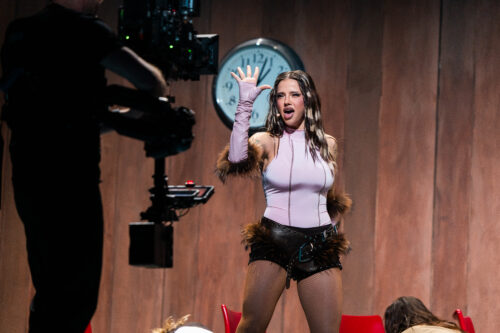
On 27 March, Monroe performed “Regarde !” live for the first time. The performance took place on C à vous. It was broadcast on France 5. Eurovoix described it as the first live performance of France’s entry. 

Eurovision live shows are scheduled for 12, 14 and 16 May. The contest takes place in Vienna, Austria. France does not compete in the semi-finals. Still, France will perform and vote in the Second Semi-Final. France is already qualified for the Grand Final as part of the “Big 4”. 

Preparty season updates

🇳🇱 Eurovision in Concert takes place on Saturday 11 April 2026. The show is held at AFAS Live in Amsterdam. The organisers recently confirmed LAVINA for the lineup. They also confirmed Akylas. LAVINA will represent Serbia at Eurovision with “Kraj Mene”. Akylas will represent Greece with “Ferto”. Source: Eurovision in Concert
🇬🇧 Vanilla Ninja joins the line-up of the London Eurovision Party. LEP returns on 19 April 2026 at HERE at Outernet. The organisers sell tickets via DICE. Source: London Eurovision Party
🇲🇹 Malta has also announced The Pre-Party – Eurovision Edition for Saturday 25 April 2026. It takes place at Tigullio in St. Julian’s, Malta. Organisers say entry is free, but free tickets are required. The listing states a 17+ age limit. source: Instagram Theprepartymt

🇷🇴 Romania will host Eurovision Pre-Party Bucharest on Saturday 18 April 2026. It is set for Arenele Romane in Bucharest. Emagic says tickets are on sale, and more artist announcements will follow. Emagic also lists TVR as a partner. An Instagram announcement names Paula Seling as a guest. Source: instagram emagic Romania

Eurovision Song Contest Asia announced

Eurovision Song Contest Asia has been officially launched. The European Broadcasting Union is working with Voxovation. It is also partnering with S2O Productions. Thailand’s Channel 3 is the broadcast partner and host broadcaster. The Grand Final is set for Saturday 14 November 2026 in Bangkok. 

Eurovision.com currently lists 10 participating countries and broadcasters for the first edition. More participants are expected to be added later. The current list is shown below. Source: eurovision.com

  Country Broadcaster / partner (as listed)
🇧🇩 Bangladesh NTV
🇧🇹 Bhutan Bhutan Broadcasting Service (BBS)
🇰🇭 Cambodia TV5 Cambodia
🇱🇦 Laos Vientiane Capital Television (VTE9)
🇲🇾 Malaysia Media Prima (TV3)
🇳🇵 Nepal Himalaya TV
🇵🇭 Philippines ABS-CBN
🇰🇷 South Korea PK Inc (produced by)
🇹🇭 Thailand Channel 3 (Host)
🇻🇳 Vietnam Vietnam Television (VTV3)


Related news

History

70 years of Eurovision: the semifinal came

The Eurovision Song Contest is celebrating its 70th anniversary. That is a wonderful milestone. We at Eurovision Universe love diving into the history of the contest. That is why we are taking a closer look at the contests of the past 70 years. 2004 It was a nice idea to have Enrique Iglesias host the Eurovision Song Contest. It didn’t happen. Whether it was an excessive fee or protests within the broadcaster because the man wasn’t Turkish, we don’t know exactly. But in the now-demolished Abdi İpekçi Arena in Istanbul, Korhan Abay and Meltem Cumbul hosted the contest. And for the first time, there was a semi-final. Countries that had not finished in the top 10 the previous year and countries that were on the reserve bench at the time had to participate. Debuting countries Albania, Belarus, Serbia & Montenegro, and Andorra were also in it. The songs The Belarusians sent the duo Aleksandra and Konstantin with the song “My Galileo”. It was sung in English, but you had to mention that. For a few years, there was an Aleksandra and Konstantin Award for the very worst English. Jonathan Cerrada was the participant for France. By then, the Belgian was a big star in the French-speaking countries. Amidst the stilt-walking backing singers, he failed to live up to expectations. Neither did the Belgian top favorite Xandee with the disco track “1 Life.” How different it was for the Albanian Anjeza Shahini. Festivali i Këngës, a major Albanian national song contest held at the end of December, became the national selection from then on. Only the song “Dua të jem imazhi yt” had to be shortened by a minute and a half, and was therefore immediately translated into English. The Bosnian Dane also stood out with his disco beat, his bleached hair, and his pink suit. Macedonia sent its biggest star, Toše Proeski. He would die in a car accident four years later. His fame has since grown to legendary proportions. Lena Philipsson was already a big star in Sweden. Yet she never managed to win Melodifestivalen. Until 2004, that is. Greece had had an extensive national final. But while it was still underway, their biggest star, Sakis Rouvas, announced his intention to go to the Eurovision Song Contest. The entire national final was set aside, and Sakis went to Istanbul. Serbia and Montenegro were represented by Željko Joksimović, who performed a piece of his own Serbian culture with “Lane moje.” Sakis and Željko would go on to compete in the final. Ruslana But they did not fight that final battle alone. The Ukrainian Ruslana also participated. She, too, had brought her own culture with her. In the song “Wild Dances,” a Ukrainian instrument, the trembita, played the leading role. Ruslana had been internally selected to go to the Eurovision Song Contest. When she won, she was honored by President Kuchma with the highest possible distinction, People’s Artist of Ukraine. With the presidential elections of late 2004 and the subsequent Orange Revolution, she sided with presidential candidate Yushchenko. He did not win; fraud was suspected. During the revolution that followed, Ruslana went on a hunger strike for a short time. Besides being a singer, she would remain a political activist and politician. 2005 Ruslana was set to present the Eurovision Song Contest, which was held at the Palace of Sports in Kyiv. She was to do so together with Pavlo Shylko. However, Ruslana withdrew, officially because she had other commitments. But it is quite possible that her poor English also played a role. Since there was a semifinal,  Bulgaria and Moldova wanted to participate as well, Hungary returned, and even Monaco came back after 26 years. The songs The Icelandic Selma participated one more time. This time, however, she did not reach the final. Chiara from Malta also took part again. She even improved on her previous success by finishing second with her “Angel”. Constantinos from Cyprus even participated for the third time. And Helena Paparizou, who represented Greece in 2001 with the duo Antique, was also present again. Debuting Moldova sent the group Zdob și Zdub. They performed their ode to a grandmother with a real grandmother on stage, who occasionally beat a huge drum. Moldova finished an impressive sixth with it. Host country Ukraine really went all out. From no fewer than 75 songs, 15 finalists emerged. But actually, no one doubted the victory for top favorite Ani Lorak. Until the broadcaster suddenly awarded wildcards to four songs: protest songs stemming from the recently concluded revolution. With that, Ani Lorak lost her chance. Karma catches up with them: the winning group Greenjolly first had to change the lyrics of their song of praise to the president. Ultimately, the group finished 19th. The German entry was controversial. Gracia already had a major hit in her own country at the time she won the German national final. What turned out to be the case? Producer David Brandes had personally bought up many CDs to boost the sales figures. David Brandes was also the producer of the Swiss entry: the Estonian group Vanilla Ninja. But these four rock chicks, popular in German-speaking countries, experienced no hindrance from their producer. And then there was a song from Latvia, sung by the duo Walters and Kazha. They sang part of their song in sign language. Helena Paparizou Greece won for the first time. As mentioned, Helena Paparizou had participated before. The singer, who lives in Sweden, previously sang in the popular duo Antique. Now she sang solo. She was to sing four songs from which one Eurovision entry would be chosen. However, the favorite, “The Light of Our Soul”, was disqualified because it had been released too early. The song chosen from the remaining three was “My Number One”. And that did indeed become number 1.

Read More »
History
Martijn

70 years of Eurovision: the semifinal came

The Eurovision Song Contest is celebrating its 70th anniversary. That is a wonderful milestone. We at Eurovision Universe love diving into the history of the contest. That is why we are taking a closer look at the contests of the past 70 years. 2004 It was a nice idea to have Enrique Iglesias host the Eurovision Song Contest. It didn’t happen. Whether it was an excessive fee or protests within the broadcaster because the man wasn’t Turkish, we don’t know exactly. But in the now-demolished Abdi İpekçi Arena in Istanbul, Korhan Abay and Meltem Cumbul hosted the contest. And for the first time, there was a semi-final. Countries that had not finished in the top 10 the previous year and countries that were on the reserve bench at the time had to participate. Debuting countries Albania, Belarus, Serbia & Montenegro, and Andorra were also in it. The songs The Belarusians sent the duo Aleksandra and Konstantin with the song “My Galileo”. It was sung in English, but you had to mention that. For a few years, there was an Aleksandra and Konstantin Award for the very worst English. Jonathan Cerrada was the participant for France. By then, the Belgian was a big star in the French-speaking countries. Amidst the stilt-walking backing singers, he failed to live up to expectations. Neither did the Belgian top favorite Xandee with the disco track “1 Life.” How different it was for the Albanian Anjeza Shahini. Festivali i Këngës, a major Albanian national song contest held at the end of December, became the national selection from then on. Only the song “Dua të jem imazhi yt” had to be shortened by a minute and a half, and was therefore immediately translated into English. The Bosnian Dane also stood out with his disco beat, his bleached hair, and his pink suit. Macedonia sent its biggest star, Toše Proeski. He would die in a car accident four years later. His fame has since grown to legendary proportions. Lena Philipsson was already a big star in Sweden. Yet she never managed to win Melodifestivalen. Until 2004, that is. Greece had had an extensive national final. But while it was still underway, their biggest star, Sakis Rouvas, announced his intention to go to the Eurovision Song Contest. The entire national final was set aside, and Sakis went to Istanbul. Serbia and Montenegro were represented by Željko Joksimović, who performed a piece of his own Serbian culture with “Lane moje.” Sakis and Željko would go on to compete in the final. Ruslana But they did not fight that final battle alone. The Ukrainian Ruslana also participated. She, too, had brought her own culture with her. In the song “Wild Dances,” a Ukrainian instrument, the trembita, played the leading role. Ruslana had been internally selected to go to the Eurovision Song Contest. When she won, she was honored by President Kuchma with the highest possible distinction, People’s Artist of Ukraine. With the presidential elections of late 2004 and the subsequent Orange Revolution, she sided with presidential candidate Yushchenko. He did not win; fraud was suspected. During the revolution that followed, Ruslana went on a hunger strike for a short time. Besides being a singer, she would remain a political activist and politician. 2005 Ruslana was set to present the Eurovision Song Contest, which was held at the Palace of Sports in Kyiv. She was to do so together with Pavlo Shylko. However, Ruslana withdrew, officially because she had other commitments. But it is quite possible that her poor English also played a role. Since there was a semifinal,  Bulgaria and Moldova wanted to participate as well, Hungary returned, and even Monaco came back after 26 years. The songs The Icelandic Selma participated one more time. This time, however, she did not reach the final. Chiara from Malta also took part again. She even improved on her previous success by finishing second with her “Angel”. Constantinos from Cyprus even participated for the third time. And Helena Paparizou, who represented Greece in 2001 with the duo Antique, was also present again. Debuting Moldova sent the group Zdob și Zdub. They performed their ode to a grandmother with a real grandmother on stage, who occasionally beat a huge drum. Moldova finished an impressive sixth with it. Host country Ukraine really went all out. From no fewer than 75 songs, 15 finalists emerged. But actually, no one doubted the victory for top favorite Ani Lorak. Until the broadcaster suddenly awarded wildcards to four songs: protest songs stemming from the recently concluded revolution. With that, Ani Lorak lost her chance. Karma catches up with them: the winning group Greenjolly first had to change the lyrics of their song of praise to the president. Ultimately, the group finished 19th. The German entry was controversial. Gracia already had a major hit in her own country at the time she won the German national final. What turned out to be the case? Producer David Brandes had personally bought up many CDs to boost the sales figures. David Brandes was also the producer of the Swiss entry: the Estonian group Vanilla Ninja. But these four rock chicks, popular in German-speaking countries, experienced no hindrance from their producer. And then there was a song from Latvia, sung by the duo Walters and Kazha. They sang part of their song in sign language. Helena Paparizou Greece won for the first time. As mentioned, Helena Paparizou had participated before. The singer, who lives in Sweden, previously sang in the popular duo Antique. Now she sang solo. She was to sing four songs from which one Eurovision entry would be chosen. However, the favorite, “The Light of Our Soul”, was disqualified because it had been released too early. The song chosen from the remaining three was “My Number One”. And that did indeed become number 1.

Read More »
Follow Us: