
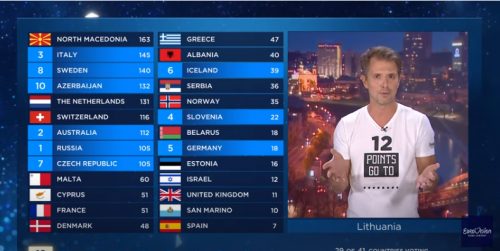
We want YOU to be a spokesperson during the final of Eurostream 2020!

Has it always been your dream to be a spokesperson during the voting sequence of the Eurovision Song Contest and deliver the votes of your country? The partner websites and outlets behind Eurostream 2020 want to help you make that dream come true!

For the live final of Eurostream 2020, to be aired on Saturday 9 May, we are looking for devoted fans to announce the jury results of the 41 countries participating in Eurovision and Eurostream 2020. Are you interested? Fill out this form and send us a video in which you say good evening from your city, thank us for the show and announce 8, 10 and 12 points to three countries of your choice! You can choose between English and French.

If you want to apply for the 41 vacancies, there are a few things you should know:
– All videos of the spokespersons will be prerecorded and broadcast during the live final.
– You can only apply once, for the country that you currently live in. If you live in a country that does not participate in Eurovision 2020, you can apply for another country, but priority will be given to applicants living in said country.
– We will only consider complete submissions that reach us through the Google Forms you can find here.
– The application deadline is Thursday 23 April 2020, 23:59 CET. Chosen spokespersons will be contacted via e-mail or social media in the immediate days afterwards.
– When chosen, you are expected to send us a video on Friday 8 May in which you announce the jury results from your country. Availability on this specific date to record the video is a must.

Please find detailed instructions on how to record the video you can find here.

Good luck, and thank you for your interest in Eurostream 2020! Follow us on Facebook, Twitter, Instagram and YouTube and check out our website eurostream2020.com for the latest information.

Eurostream 2020 is a joint project between the following partners, listed here alphabetically: 12 Points From America, aussievision.net, Ding-a-Dong Podcast, escdaily.com, escgo.com, escinsight.com, esckaz.com, escnation.com, escplus.es, esc-plus.com, eurovisionary.com, eurovisionunion.com, eurovisionuniverse.com, EuroWhat? Podcast, evrovizija.rs, scorewiz.eu, songfestival.be, songfestivalforum.nl, songfestivalweblog.nl.


Related news

History

70 years of Eurovision: Abba and Sweden

The Eurovision Song Contest is celebrating its 70th anniversary. That is a wonderful milestone. We at Eurovision Universe love diving into the history of the contest. That is why we are taking a closer look at the contests of the past 70 years. 1974 Luxembourg could not host the Eurovision Song Contest again. That is why Brighton, England, became the venue. Cathy Boyle hosted the event for the fourth and final time. Eighteen countries were supposed to participate, as Greece was making its debut with the recently deceased Marinella. However, it turned out to be 17. Shortly before Eurovision, French President Pompidou passed away. Participation in the song contest during a national period of mourning was deemed inappropriate. Singer Dany, who was to participate for France, was not allowed to travel to Brighton. The 1974 song contest is characterized by the participation of big stars, or people who would later become so. The Bendik Singers from Norway returned for a second time, but Romuald (Monaco) also participated for the third time. Former winner Gigliola Cinquetti represented Italy. Her song “Si” was forbidden in her own country. “Si” means “Yes.” What is wrong with that, you might think. At that time, a referendum on legalizing divorce was being prepared in Italy. And so that little word “Yes” suddenly became very politically sensitive. Furthermore, we saw the internationally renowned duo Mouth & MacNeal appear for the Netherlands with an act that made a deep impression. The Spanish Peret had also already scored international hits. And we don’t need to explain at all who Olivia Newton-John, the British candidate, was. However, just like Sandie Shaw seven years earlier, she absolutely hated her song. The Portuguese entry “E depois do adeus” by Paulo de Carvalho did not seem destined to be anything special. A few weeks after the festival, however, the song became the signal to launch a revolution in Portugal. And so De Carvalho’s song became immortal after all. ABBA But everything we mention here pales in comparison to ABBA, of course. Agnetha, Björn, Benny, and Annifrid (Frida) had already participated in the preliminary round the previous year, but this time they struck gold: “Waterloo”, including conductor Sven-Olof Waldorff dressed as Napoleon. After a rather tense voting, the group won. “Waterloo” became a hit, and it was certainly not the group’s last. Many titles made the group one of the most popular bands ever. Who doesn’t know “Fernando,” “SOS,” “Dancing Queen,” or “Mamma Mia”? A musical was made featuring Abba songs (“Mamma Mia”), and recently a new concert series by the quartet took place in London. They were not present in person, but their holograms were. ABBA is widely regarded as the most successful Eurovision winner ever. 1975 Thanks to ABBA’s victory, the Eurovision circus moved to Sweden for the first time. Karin Falck hosted the event at the Sankt Erik Mässanhallen in Stockholm. That she wasn’t very good with languages ​​became clear during the voting: lines like ‘Seven, how much is that in France?’ and ‘Can I have three points for the Turkey?’ illustrated that. The voting was special anyway: for the first time, the ‘twelve points, douze points’ system was used. Although Greece dropped out, Malta returned and Turkey made its debut. The latter country received little applause for the song “Seninle bir dakika”. When the first and only three points came in, the scoreboard malfunctioned so badly that the presenter suggested writing it down on a piece of paper instead. Ellen Nikolaysen of the Bendik Singers participated for Norway. Other notable candidates were The Shadows from the United Kingdom. They used to be the backing band for none other than Cliff Richard. “If we win, we can bully Cliff,” the men joked. The Irish Geraldine also stood out. She participated for Luxembourg in virtually unintelligible French. For Italy, a duo participated with a modern song: Wess and Dori Ghezzi sang “Era” for the country and took an impressive third place. For a long time, it looked as if Finland would also achieve its first top-5 position. The band Pihasoittajat sang the cheerful “Old Man Fiddle” but ultimately finished seventh with it. Teach In It was a band from the Netherlands that walked away with the trophy: Teach In. The band hails from Enschede in the east of the country. Although singer Getty Kaspers was born in Austria, she had lived in the Netherlands for a long time. The band gave a dazzling performance. A triangle sounded at the end. As a joke, one of the band members smashed a Christmas bell. Although Teach In had a hit with the winning “Ding-a-dong,” they failed to capitalize on the success. Getty Kaspers soon left the group. The band split up in 1980. They only performed for special occasions (such as the Eurovision Song Contest in Moscow in 2009 and in Rotterdam in 2021).

Read More »
History
Martijn

70 years of Eurovision: Abba and Sweden

The Eurovision Song Contest is celebrating its 70th anniversary. That is a wonderful milestone. We at Eurovision Universe love diving into the history of the contest. That is why we are taking a closer look at the contests of the past 70 years. 1974 Luxembourg could not host the Eurovision Song Contest again. That is why Brighton, England, became the venue. Cathy Boyle hosted the event for the fourth and final time. Eighteen countries were supposed to participate, as Greece was making its debut with the recently deceased Marinella. However, it turned out to be 17. Shortly before Eurovision, French President Pompidou passed away. Participation in the song contest during a national period of mourning was deemed inappropriate. Singer Dany, who was to participate for France, was not allowed to travel to Brighton. The 1974 song contest is characterized by the participation of big stars, or people who would later become so. The Bendik Singers from Norway returned for a second time, but Romuald (Monaco) also participated for the third time. Former winner Gigliola Cinquetti represented Italy. Her song “Si” was forbidden in her own country. “Si” means “Yes.” What is wrong with that, you might think. At that time, a referendum on legalizing divorce was being prepared in Italy. And so that little word “Yes” suddenly became very politically sensitive. Furthermore, we saw the internationally renowned duo Mouth & MacNeal appear for the Netherlands with an act that made a deep impression. The Spanish Peret had also already scored international hits. And we don’t need to explain at all who Olivia Newton-John, the British candidate, was. However, just like Sandie Shaw seven years earlier, she absolutely hated her song. The Portuguese entry “E depois do adeus” by Paulo de Carvalho did not seem destined to be anything special. A few weeks after the festival, however, the song became the signal to launch a revolution in Portugal. And so De Carvalho’s song became immortal after all. ABBA But everything we mention here pales in comparison to ABBA, of course. Agnetha, Björn, Benny, and Annifrid (Frida) had already participated in the preliminary round the previous year, but this time they struck gold: “Waterloo”, including conductor Sven-Olof Waldorff dressed as Napoleon. After a rather tense voting, the group won. “Waterloo” became a hit, and it was certainly not the group’s last. Many titles made the group one of the most popular bands ever. Who doesn’t know “Fernando,” “SOS,” “Dancing Queen,” or “Mamma Mia”? A musical was made featuring Abba songs (“Mamma Mia”), and recently a new concert series by the quartet took place in London. They were not present in person, but their holograms were. ABBA is widely regarded as the most successful Eurovision winner ever. 1975 Thanks to ABBA’s victory, the Eurovision circus moved to Sweden for the first time. Karin Falck hosted the event at the Sankt Erik Mässanhallen in Stockholm. That she wasn’t very good with languages ​​became clear during the voting: lines like ‘Seven, how much is that in France?’ and ‘Can I have three points for the Turkey?’ illustrated that. The voting was special anyway: for the first time, the ‘twelve points, douze points’ system was used. Although Greece dropped out, Malta returned and Turkey made its debut. The latter country received little applause for the song “Seninle bir dakika”. When the first and only three points came in, the scoreboard malfunctioned so badly that the presenter suggested writing it down on a piece of paper instead. Ellen Nikolaysen of the Bendik Singers participated for Norway. Other notable candidates were The Shadows from the United Kingdom. They used to be the backing band for none other than Cliff Richard. “If we win, we can bully Cliff,” the men joked. The Irish Geraldine also stood out. She participated for Luxembourg in virtually unintelligible French. For Italy, a duo participated with a modern song: Wess and Dori Ghezzi sang “Era” for the country and took an impressive third place. For a long time, it looked as if Finland would also achieve its first top-5 position. The band Pihasoittajat sang the cheerful “Old Man Fiddle” but ultimately finished seventh with it. Teach In It was a band from the Netherlands that walked away with the trophy: Teach In. The band hails from Enschede in the east of the country. Although singer Getty Kaspers was born in Austria, she had lived in the Netherlands for a long time. The band gave a dazzling performance. A triangle sounded at the end. As a joke, one of the band members smashed a Christmas bell. Although Teach In had a hit with the winning “Ding-a-dong,” they failed to capitalize on the success. Getty Kaspers soon left the group. The band split up in 1980. They only performed for special occasions (such as the Eurovision Song Contest in Moscow in 2009 and in Rotterdam in 2021).

Read More »
Follow Us: