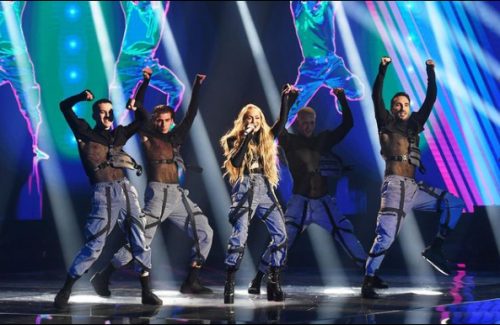
Portugal selects their entry through Festival da Canção. Tonight is the night of the final. However, this year most of the participants stated they will not represent Portugal, due to the participation of Israel. Only André Amaro and Bandidos do Cante will travel to Vienna. Sandrino’s opinion is not known yet. The show starts at 22.15 CET and you can watch it at RTP. final date: 7 MarchPlace: Valentim de Carvalho Studios, LisbonHosts: Vasco Palmeirim, Alexandre Guimarães & Catarina Maia 1 Bandidos Do Cante Rosa l: Duarte Farias, Miguel Costa, Luís Aleixo, Francisco Pestana, Francisco Raposo, Kasha, Gui Alface, Gonçalo Narciso & Bluay m: Duarte Farias, Miguel Costa, Luís Aleixo, Francisco Pestana & Francisco Raposo 2 João Ribeiro Canção do Querer l: Cristina Branco m: Luís Figueiredo & André Henriques 3 André Amaro Dá-Me a Tua Mão l & m: André Amaro 4 Gonçalo Gomes Doce ilusão l: Gonçalo Gomes & Pedro Fernandes m: Gonçalo Gomes, João Umbelino, Pedro Fernandes & Bernardo Almeida 5 Marquise Chuva l: Mafalda Matos m: Mafalda Matos, Matias Ferreira, Miguel Azevedo & Miguel Pereira 6 Evaya Sprint l: Beatriz Bronze & Guilherme Firmino m: Beatriz Bronze, Guilherme Firmino & João Valente 7 Sandrino Desposto a tudo l & m: Sandrino & Francesco Meoli 8 Nunca Mates o Mandarim Fumo l: João Amorim m: João Amorim, João Campello & Manuel Dinis 9 Silvana Peres Não Tem fim l & m: Rita Dias 10 Dinis Mota Jurei l & m: Dinis Mota 1st semifinal date: 21 FebruaryPlace: Valentim de Carvalho Studios, LisbonHosts: Vasco Palmeirim, Alexandre Guimarães & Catarina Maia 1 Dinis Mota Jurei final l & m: Dinis Mota 2 Nunca Mates o Mandarim Fumo final l: João Amorim m: João Amorim, João Campello & Manuel Dinis 3 Evaya Sprint final l: Beatriz Bronze & Guilherme Firmino m: Beatriz Bronze, Guilherme Firmino & João Valente 4 André Amaro Dá-Me a Tua Mão final* l & m: André Amaro 5 Bateu Matou Nos Teus Olhos eliminated l & m: Joaquim Albergaria, Ruit Pité & Ivo Costa 6 Marquise Chuva final l: Mafalda Matos m: Mafalda Matos, Matias Ferreira, Miguel Azevedo & Miguel Pereira 7 Agridoce Onde Quero Estar eliminated l & m: Margarida Castanheira, Joana Banza, Sofia Jorge, Tiago Alves & Pedro Agostinho 8 Mário Marta Pertencer eliminated l & m: Djodje & Alberto Koenig 2nd semifinal date: 28 FebruaryPlace: Valentim de Carvalho Studios, LisbonHosts: Vasco Palmeirim, Alexandre Guimarães & Catarina Maia 1 Gonçalo Gomes Doce ilusão final* l: Gonçalo Gomes & Pedro Fernandes m: Gonçalo Gomes, João Umbelino, Pedro Fernandes & Bernardo Almeida 2 Silvana Peres Não Tem fim final l & m: Rita Dias 3 Sandrino Desposto a tudo final l & m: Sandrino & Francesco Meoli 4 Francisco Fontes Copiloto eliminated l & m: Francisco Fontes 5 Bandidos Do Cante Rosa final l: Duarte Farias, Miguel Costa, Luís Aleixo, Francisco Pestana, Francisco Raposo, Kasha, Gui Alface, Gonçalo Narciso & Bluay m: Duarte Farias, Miguel Costa, Luís Aleixo, Francisco Pestana & Francisco Raposo 6 Jacaréu & Ana Margarida O-pi-ni-ão eliminated l & m: Jacaréu 7 João Ribeiro Canção do Querer final l: Cristina Branco m: Luís Figueiredo & André Henriques 8 Inês Sousa Um Filme ao Contrário eliminated l & m: Inês Sousa