Weekly Update

It is Tuesday, April 21, 2026, which means it is time for another weekly Eurovision update! Pre-party season wrapped up in style this week, with events in Bucharest and London. In Vienna, the stage at the Wiener Stadthalle is nearly ready. The bookmakers still have Finland firmly in the lead. And American fans finally have a free way to watch Eurovision. Here are this week’s top stories.


Pre-Party Season

🇷🇴 Eurovision Pre-Party Bucharest 2026

Pre-party season continued in Romania this past weekend. The Eurovision Pre-Party Bucharest 2026 took place on Saturday at the Arenele Romane in Bucharest. Four acts performed their entries for the 70th Eurovision Song Contest: Bulgaria’s DARA, Greece’s Akylas, Malta’s Aidan, and Romania’s Alexandra Căpitănescu. The event was organised by eMagic in collaboration with TVR, AIMR and OGAE Romania

🇬🇧 London Eurovision Party 2026

One of the biggest pre-parties of the season took place on Sunday night. The London Eurovision Party 2026 was held at the Outernet in London. Over twenty acts performed their Eurovision entries. Here’s a recap:


Eurovision 2026

🇦🇹 Stage Construction Almost Complete in Vienna

Things are coming together fast at the Wiener Stadthalle. ORF has released new images showing that stage construction for the 70th Eurovision Song Contest is nearly finished. The main screen and LED panels are in place, with finishing touches being completed ahead of stand-in rehearsals before delegations arrive in Vienna next week.

The scale of the production is impressive. Forty commentator booths, 2,135 lighting fixtures with 8,500 individually controllable LEDs, and a full green room have been installed. The production will use 28 cameras in total. That’s including two camera cranes, three aerial camera systems, and four steady cams. For the first time at Eurovision, a system will be used to give the entire broadcast a cinematic look. 
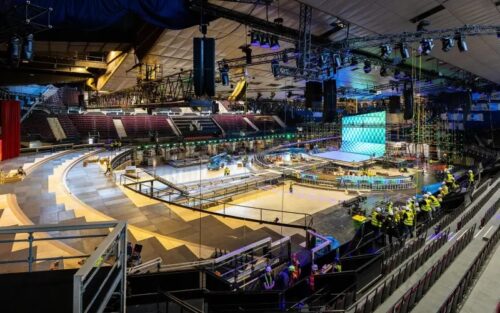
📷 ORF/Christian Öser

source: ORF

🇦🇹 Emily Busvine to Host the Green Room

ORF has confirmed the face of the Eurovision green room. Emily Busvine will serve as the green room host for the 70th Eurovision Song Contest in Vienna. She is the presenter of the FM4 Morning Show. Busvine was born in Vienna in 1996 and studied at the University of Cambridge before joining Radio FM4 in 2020. While Victoria Swarovski and Michael Ostrowski host from the main stage, Busvine will interview the competing acts live in the green room, in front of an estimated 180 million viewers. 

This year, the green room will reflect Viennese coffee house culture, giving international audiences a taste of one of Austria’s most beloved traditions. source: orf

🇫🇮 Current Odds: Finland Still on Top

The bookmakers have not changed their minds. Finland’s Linda Lampenius and Pete Parkkonen with “Liekinheitin” remain the clear favourite to win Eurovision 2026, with a winning probability of around 31%. France’s Monroe with “Regarde !” sits in second place at approximately 11%, followed by Denmark’s Søren Torpegaard Lund at around 10%. Australia’s Delta Goodrem and Greece’s Akylas round out the top five. 
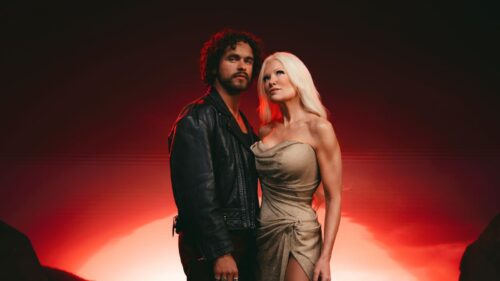
Further down, Romania, Ukraine, and Italy are all placed between 3% and 4% winning probability. The contest takes place on May 12, 14, and 16 in Vienna. source: eurovisionworld

Interviews: Satoshi (Moldova) and Alis (Albania)

Two of this week’s most talked-about interviews come from our own Kal, who sat down with Satoshi from Moldova and Alis from Albania at the pre-party circuit.

🇲🇩 Satoshi is one of the most magnetic performers in this year’s lineup. His entry “Viva, Moldova!” bursts with energy, and in his interview he explains that the song is rooted in a personal process of understanding his own identity. He also describes the pre-party experience as a genuinely positive one, saying that the enthusiasm from audiences makes it easy to perform. Moldova has not competed since 2024, making this a comeback year. Satoshi is exactly the kind of artist who makes a splash. Wanna know the favourite band of Satoshi? And did Aliona Moon have any advice for him? If you have not watched this interview yet, do yourself a favour and press play.

🇦🇱 Albania’s Alis is equally compelling. His Eurovision entry “Nân” is a deeply personal ode to the maternal figure, rooted in Albanian culture and tradition. In his interview, Alis spoke about his hometown of Shkodër and the writing process behind “Nân”, describing the mother figure as someone who deserves recognition across the Balkans. What was his original plan for Eurovision? And why was he scared of stage before Eurovision? nd Kal even has an advice for him. Alis takes Eurovision serious, and this interview is not to be missed.


Short News

🎬 Eurovision 2026: A Little Bit More

The official Eurovision YouTube channel is steadily filling up with content ahead of the contest. The 2026 edition of “A Little Bit More” is well underway, with participants delivering alternative versions of their own entries and covers of Eurovision classics. Albania’s Alis has shared a piano version of “Nân”, Moldova’s Satoshi has given “Viva, Moldova!” an even harder-hitting reworking, San Marino’s Senhit delivered a stripped-back version of “Superstar”, and Australia’s Delta Goodrem offered a high-energy mix of “Eclipse”. The full playlist is available on the official Eurovision Song Contest YouTube channel.

🇺🇸 USA Can Now Watch Eurovision for Free

American Eurovision fans have a new option this May. The EBU has confirmed that all three live shows of the Eurovision Song Contest 2026 will be available to watch for free in the United States via YouTube, alongside the existing Peacock stream. In some countries such as the United Kingdom, Australia, and Greece, local broadcasters retain exclusive rights and the YouTube stream will not be available. This is a major step in expanding Eurovision’s reach beyond Europe, and it means millions of new viewers could be tuning in for the first time this May. source: Hollywoodreporter.com

Related news

Eurovision 2026

Road to Vienna: Austria

Just before rehearsals kick off in Vienna, we’ve got one more stop on our daily Road to Vienna: the host country itself, Austria. Cosmó: Austria’s Young Pop Star and student to Eurovision 2026 Cosmó, born Benjamin Gedeon on 18 June 2006 in Budapest, is a 19-year-old Austrian singer-songwriter from Burgenland. He started music early, attending music school at just four years old and learning piano by six. By his early teens, he was already writing songs, inspired by musical theatre, karaoke experiences, and a growing love for pop music. Early Career and TV Breakthrough Cosmó first appeared on The Voice Kids Germany in 2020, gaining early stage experience. His breakthrough came in 2022 when he reached the final under the mentorship of Álvaro Soler. Around the same time, he won a regional songwriting competition with his original track “Fall into Your Arms,” strengthening his reputation as a rising young talent. Building His Sound and Identity After his TV success, Cosmó began performing live across Austria and collaborating with established artists. He formed his own band and developed a distinct pop style influenced by electronic music and club culture. In 2025, he released his debut EP From My Room, showcasing his modern, youthful sound and growing artistic identity.      Now based in Vienna and studying dentistry, Cosmó balances academic life with a fast-growing music career. His name, short for “Cosmopolitan,” reflects his open-minded and global outlook. Tanzschein: A Club Anthem with a Deeper Message At first listen, “Tanzschein” by Cosmó sounds like a high-energy club track built for the dance floor. Neon lights, nightlife excitement, and party energy set the tone—but underneath the upbeat surface lies a layered social commentary. The Club as a Mirror of Society In “Tanzschein,” the nightclub becomes a metaphor for society itself. The lyrics portray partygoers as instinct-driven and performative, highlighting themes of dominance, ego, and social hierarchy. By exaggerating nightlife behavior, the song subtly reflects real-world social dynamics in a humorous yet critical way. The Meaning of the “Dance License” A central concept in the song is the fictional “dance license.” While it sounds playful, it represents emotional intelligence, respect, and self-awareness. Those who “have it” are welcomed into the club, while those who don’t remain outside—symbolizing exclusion caused by ego-driven or impulsive behavior. Satire, Vulnerability, and Growth What makes “Tanzschein” stand out is its balance between satire and sincerity. The song critiques toxic behavior often found in nightlife culture, but it also introduces vulnerability through a character afraid to join the dance floor. This shift transforms the club from a place of competition into one of acceptance and self-expression. A Dance Floor as a Social Lesson Ultimately, “Tanzschein” turns nightlife into a reflection of society. It suggests that true connection goes beyond rhythm and appearance—it requires empathy, awareness, and openness. The song delivers a playful yet thought-provoking message, making it one of the more conceptually rich entries on the Eurovision 2026 stage.   Austria in the Eurovision Song Contest Austria has participated in the Eurovision Song Contest 56 times since its debut in 1957. The country has won three times: in 1966 with Udo Jürgens‘ “Merci, Chérie”, in 2014 with Conchita Wurst‘s “Rise Like a Phoenix.” And ofcourse last year with JJ‘s “Wasted love” Austria has experienced varying success over the years, with several last-place finishes and instances of receiving zero points. The Bookmakers With a guaranteed spot in the Grand Final as last year’s winner, Austria somehow finds itself ranked 32nd with the bookmakers—while only 25 acts will actually compete.  

Read More »
Eurovision 2026
Anja Kroeze

Road to Vienna: Austria

Just before rehearsals kick off in Vienna, we’ve got one more stop on our daily Road to Vienna: the host country itself, Austria. Cosmó: Austria’s Young Pop Star and student to Eurovision 2026 Cosmó, born Benjamin Gedeon on 18 June 2006 in Budapest, is a 19-year-old Austrian singer-songwriter from Burgenland. He started music early, attending music school at just four years old and learning piano by six. By his early teens, he was already writing songs, inspired by musical theatre, karaoke experiences, and a growing love for pop music. Early Career and TV Breakthrough Cosmó first appeared on The Voice Kids Germany in 2020, gaining early stage experience. His breakthrough came in 2022 when he reached the final under the mentorship of Álvaro Soler. Around the same time, he won a regional songwriting competition with his original track “Fall into Your Arms,” strengthening his reputation as a rising young talent. Building His Sound and Identity After his TV success, Cosmó began performing live across Austria and collaborating with established artists. He formed his own band and developed a distinct pop style influenced by electronic music and club culture. In 2025, he released his debut EP From My Room, showcasing his modern, youthful sound and growing artistic identity.      Now based in Vienna and studying dentistry, Cosmó balances academic life with a fast-growing music career. His name, short for “Cosmopolitan,” reflects his open-minded and global outlook. Tanzschein: A Club Anthem with a Deeper Message At first listen, “Tanzschein” by Cosmó sounds like a high-energy club track built for the dance floor. Neon lights, nightlife excitement, and party energy set the tone—but underneath the upbeat surface lies a layered social commentary. The Club as a Mirror of Society In “Tanzschein,” the nightclub becomes a metaphor for society itself. The lyrics portray partygoers as instinct-driven and performative, highlighting themes of dominance, ego, and social hierarchy. By exaggerating nightlife behavior, the song subtly reflects real-world social dynamics in a humorous yet critical way. The Meaning of the “Dance License” A central concept in the song is the fictional “dance license.” While it sounds playful, it represents emotional intelligence, respect, and self-awareness. Those who “have it” are welcomed into the club, while those who don’t remain outside—symbolizing exclusion caused by ego-driven or impulsive behavior. Satire, Vulnerability, and Growth What makes “Tanzschein” stand out is its balance between satire and sincerity. The song critiques toxic behavior often found in nightlife culture, but it also introduces vulnerability through a character afraid to join the dance floor. This shift transforms the club from a place of competition into one of acceptance and self-expression. A Dance Floor as a Social Lesson Ultimately, “Tanzschein” turns nightlife into a reflection of society. It suggests that true connection goes beyond rhythm and appearance—it requires empathy, awareness, and openness. The song delivers a playful yet thought-provoking message, making it one of the more conceptually rich entries on the Eurovision 2026 stage.   Austria in the Eurovision Song Contest Austria has participated in the Eurovision Song Contest 56 times since its debut in 1957. The country has won three times: in 1966 with Udo Jürgens‘ “Merci, Chérie”, in 2014 with Conchita Wurst‘s “Rise Like a Phoenix.” And ofcourse last year with JJ‘s “Wasted love” Austria has experienced varying success over the years, with several last-place finishes and instances of receiving zero points. The Bookmakers With a guaranteed spot in the Grand Final as last year’s winner, Austria somehow finds itself ranked 32nd with the bookmakers—while only 25 acts will actually compete.  

Read More »
Follow Us: