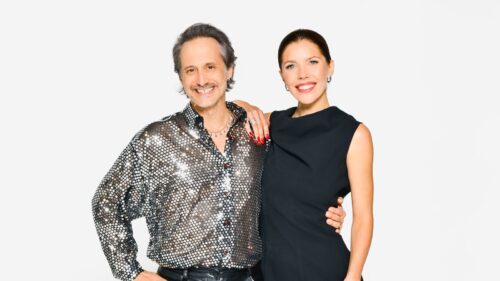
Vienna 2026: Hosts revealed

đź“· Thomas Ramstorfer/ORF

Vienna 2026 hosts Victoria Swarovski and Michael Ostrowski have been officially announced by Austrian broadcaster ORF as the presenters of the Eurovision Song Contest 2026 in Vienna. Both hosts are prominent Austrian personalities. They bring a blend of glamour and experience to the contest’s stage. Below, we explore their backgrounds, careers, and connections to Austria, as well as their past hosting experience, to understand what they will bring to Eurovision 2026.

Victoria Swarovski: Austrian TV Star and Entrepreneur

Victoria Swarovski, 30, hails from Innsbruck in Tyrol, Austria. She has built a multifaceted career as a television presenter, entrepreneur, model, and designer. Swarovski first gained wide attention after winning the German dance competition Let’s Dance in 2016. That was a victory that marked a turning point in her public career. In 2018, she returned to Let’s Dance as one of its hosts. With this, she proved her prowess in front of the camera as a presenter.

Beyond television, Victoria Swarovski has expanded into business and fashion. In 2020 she launched her own beauty brand, ORIMEI. Her work also includes modeling and design, underscoring her versatility in the entertainment industry. As one of the Vienna 2026 hosts, Swarovski’s combination of on-stage confidence and business savvy represents the modern, dynamic face of Austria on the Eurovision stage.

Michael Ostrowski: Acclaimed Actor and Presenter

Michael Ostrowski, Fifty, is an acclaimed actor, writer, and presenter from Leoben in Styria, Austria. He achieved his professional breakthrough in 2004 with a hit comedy film and has since become a recognisable figure in Austrian film and television. Known for his comic timing and charm, Ostrowski has enjoyed a long-running screen career spanning both acting and filmmaking.

Importantly for his Eurovision role, Michael Ostrowski also has extensive hosting experience. He has fronted major Austrian TV events, including the gala 100 Years of Radio, for which he earned a prestigious Romy award (Austria’s top television honor) as Best Presenter. His background in live entertainment and event hosting equips him well to engage the massive international audience of Eurovision. As one of the Vienna 2026 hosts, Ostrowski brings seasoned stage presence and a touch of humor to the proceedings.

The Vienna 2026 Hosts on Eurovision’s Stage

Together, the Vienna 2026 hosts Victoria Swarovski and Michael Ostrowski exemplify Austrian talent and showmanship on the Eurovision stage. This duo has been praised by ORF as “an exciting and unique pair” with great passion for the contest. Their combined skills—Swarovski’s live TV polish and Ostrowski’s comedic flair—promise a balanced hosting team capable of guiding viewers through the semi-finals and grand final with professionalism and Austrian warmth. Eurovision fans can look forward to a memorable show in May 2026 as this hosting pair leads the 70th Eurovision Song Contest in Vienna.

source: eurovision.com

Related news

Eurovision 2026

Song: Switzerland, Armenia, Czechia and Georgia complete the latest reveal wave

The latest Eurovision 2026 entries have sharpened the picture for Vienna. Switzerland has confirmed Veronica Fusaro with Alice. Armenia has completed the artist lineup with SIMĂ“N and Paloma Rumba. Czechia moves forward with Daniel Zizka and CROSSROADS. Georgia closes the release cycle with Bzikebi’s On Replay. Together, these four songs add alternative pop, rebellious energy, emotional sincerity and a strong dose of comeback value to a contest field that is now taking clear shape ahead of May. Switzerland brings a darker message with Alice Switzerland’s new entry may be one of the most serious songs in this latest batch of Eurovision 2026 entries. Eurovision describes Veronica Fusaro’s Alice as an alternative pop track with rock influences. The song tells the story of a woman whose boundaries are crossed under the disguise of affection. In the official article you can read the lyrics explore several forms of violence, including manipulation, control and abuse of power. It is also a new version of a song from Fusaro’s 2025 album Looking for Connection, reworked with British producer Charlie McClean. Armenia completes the lineup with Paloma Rumba Armenia, meanwhile, arrives with one of the day’s most immediate concepts. Paloma Rumba, performed by SIMĂ“N, is framed by Eurovision as a rebellious anthem about breaking out of a suffocating routine and choosing ambition over comfort. The official story explains that the title refers to a joyful dance of freedom, while the lyrics follow a character who walks away from an unrewarding nine-to-five life. The song was composed by LI’LITH, and the lyric team includes Rosa Linn, who represented Armenia at Eurovision 2022. With this announcement on 11 March, Armenia also became the final country to confirm its singer for Vienna 2026. Czechia puts its faith in Daniel Zizka Czechia takes a different route. Rather than leaning into spectacle, broadcaster ÄŚT appears to be backing authenticity with 23-year-old Daniel Zizka. Eurovision describes him as one of the most compelling voices of a new generation in Czech music, while the official participant list confirms CROSSROADS as his song for Vienna. The Eurovision feature also notes that magazine Headliner has named him among the future talents of the Czech scene. In addition, Czech delegation head Kryštof Šámal praised Zizka’s focus and control in early studio sessions, while Zizka himself said he wants to bring music and emotion rather than hide behind flashy tricks. Georgia turns nostalgia into a new Eurovision chapter Finally, Georgia offers one of the most intriguing stories of the season. Bzikebi are no ordinary newcomers: the trio won Junior Eurovision for Georgia in 2008, and Eurovision.com notes that the country has since gone on to collect a record-setting four Junior Eurovision victories. Now reunited as adults, Giorgi Shiolashvili, Mariam Tatulashvili and Mariam Kikuashvili return with On Replay, which Eurovision calls the final song to be released for the 70th contest. Composed by Giga Kukhianidze with lyrics by Lizi Japaridze, the entry sends Georgia into the First Half of the First Semi-Final on 12 May with a familiar name and a fresh mission. What these Eurovision 2026 entries say about this year Taken together, these Eurovision 2026 entries reveal a striking balance. Switzerland brings social weight and a darker lyrical edge. Armenia goes for motion, release and personal freedom. Czechia bets on sincerity and clean emotional delivery. Georgia, by contrast, turns proven Eurovision history into a contemporary comeback story. That variety matters. In a contest where memorability is often just as important as melody, none of these four countries has chosen the same lane, and that should help each entry carve out its own identity as rehearsals draw closer. source: eurovision.com        

Read More »
Eurovision 2026
Martijn

Song: Switzerland, Armenia, Czechia and Georgia complete the latest reveal wave

The latest Eurovision 2026 entries have sharpened the picture for Vienna. Switzerland has confirmed Veronica Fusaro with Alice. Armenia has completed the artist lineup with SIMĂ“N and Paloma Rumba. Czechia moves forward with Daniel Zizka and CROSSROADS. Georgia closes the release cycle with Bzikebi’s On Replay. Together, these four songs add alternative pop, rebellious energy, emotional sincerity and a strong dose of comeback value to a contest field that is now taking clear shape ahead of May. Switzerland brings a darker message with Alice Switzerland’s new entry may be one of the most serious songs in this latest batch of Eurovision 2026 entries. Eurovision describes Veronica Fusaro’s Alice as an alternative pop track with rock influences. The song tells the story of a woman whose boundaries are crossed under the disguise of affection. In the official article you can read the lyrics explore several forms of violence, including manipulation, control and abuse of power. It is also a new version of a song from Fusaro’s 2025 album Looking for Connection, reworked with British producer Charlie McClean. Armenia completes the lineup with Paloma Rumba Armenia, meanwhile, arrives with one of the day’s most immediate concepts. Paloma Rumba, performed by SIMĂ“N, is framed by Eurovision as a rebellious anthem about breaking out of a suffocating routine and choosing ambition over comfort. The official story explains that the title refers to a joyful dance of freedom, while the lyrics follow a character who walks away from an unrewarding nine-to-five life. The song was composed by LI’LITH, and the lyric team includes Rosa Linn, who represented Armenia at Eurovision 2022. With this announcement on 11 March, Armenia also became the final country to confirm its singer for Vienna 2026. Czechia puts its faith in Daniel Zizka Czechia takes a different route. Rather than leaning into spectacle, broadcaster ÄŚT appears to be backing authenticity with 23-year-old Daniel Zizka. Eurovision describes him as one of the most compelling voices of a new generation in Czech music, while the official participant list confirms CROSSROADS as his song for Vienna. The Eurovision feature also notes that magazine Headliner has named him among the future talents of the Czech scene. In addition, Czech delegation head Kryštof Šámal praised Zizka’s focus and control in early studio sessions, while Zizka himself said he wants to bring music and emotion rather than hide behind flashy tricks. Georgia turns nostalgia into a new Eurovision chapter Finally, Georgia offers one of the most intriguing stories of the season. Bzikebi are no ordinary newcomers: the trio won Junior Eurovision for Georgia in 2008, and Eurovision.com notes that the country has since gone on to collect a record-setting four Junior Eurovision victories. Now reunited as adults, Giorgi Shiolashvili, Mariam Tatulashvili and Mariam Kikuashvili return with On Replay, which Eurovision calls the final song to be released for the 70th contest. Composed by Giga Kukhianidze with lyrics by Lizi Japaridze, the entry sends Georgia into the First Half of the First Semi-Final on 12 May with a familiar name and a fresh mission. What these Eurovision 2026 entries say about this year Taken together, these Eurovision 2026 entries reveal a striking balance. Switzerland brings social weight and a darker lyrical edge. Armenia goes for motion, release and personal freedom. Czechia bets on sincerity and clean emotional delivery. Georgia, by contrast, turns proven Eurovision history into a contemporary comeback story. That variety matters. In a contest where memorability is often just as important as melody, none of these four countries has chosen the same lane, and that should help each entry carve out its own identity as rehearsals draw closer. source: eurovision.com        

Read More »
Follow Us: