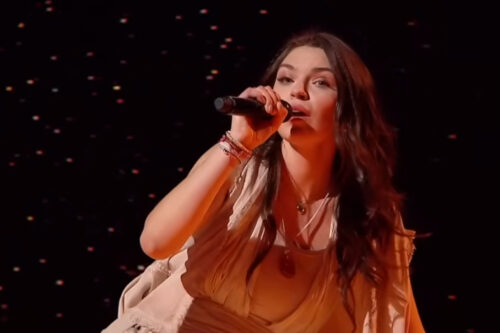
🇸🇲 National: Senhit featuring Boy George represent San Marino

Senhit represents San Marino at the 2026 Eurovision Song Contest in Vienna. She will be featured by eighties pop star Boy George. Senhit and Boy George will perform the song “Superstar” in the 2nd semifinal.

It is the third time Senhit represents San Marino. In 2011 and 2021 she also did the job, the last time featured by Flo Rida. So this time, it’s gonna be Boy George who features.

final

date: 6 March
Place: Teatro Nuovo, Dogana
Hosts: Simona Ventura

1 Pellegrina Pibigas Il Giorno Che        
         
2 Magdalena Tul I’ll Be Around        
 l & m: Magdalena Tul        
3 Klem Ok Respira        
 l & m: Alfredo Bruno & Clemente Mezzacapo        
4 Molella ft. Maxè Fever        
 l: Chris Westermann, Lena Westermann & Maurizio Accetta  m: Chris Westermann, Maurizio Accetta & Maurizio Molella        
5 Iuna Freedom Calling        
         
6 Paolo Belli Bellissima final     3
 l & m: Leo Pari, Marco Cantagalli  & Riccardo Scirè        
7 Orphy Rise Again        
l & m: Daniyl Muntianu Volodymyrovych & Kiril Rohovets        
8 Andreas Habibi ft. Aura All We Need Is Love        
l & m: Novel ‘Beatgeek’ Janussi & Elisa Kolk        
9 Dolcenera My Love        
         
10 Myky Outta Tune        
l & m: Michele Petillo        
11 Kelly Joyce Oh Là Là       1
         
12 Luka Basi Chicolo        
 l: Aleš Vovk & Charlie Mason  m: Aleš Vovk & Marjetka Vovk        
13 Anna Smith Bruised        
         
14 Matias Ferreira Paura        
l & m: José Pablo Polo, Matias Ferreira, Pablo Dazán & Samuel Sheinberg        
15 Rosa Chemical Mammami        
         
16 L’Orchestraccia Cara Madre Mia        
         
17 Senhit ft. Boy George Superstar       2
 l & m: Boy George, Jonathan Bellini, Senhit & Thomas Stengaard        
18 Inis Neziri In My Head       4
l & m: Inis Neziri & Kejdi Musta        
19 Edward Maya ft. William Imola Ball        
 l: William Imola  m: Eduard Ilie Marian (Edward Maya)        
20 Maya Azucena My Sin       4
         
21 Marco Shine        


1st semifinal

date: 4 march
Place: Teatro Nuovo, Dogana
Hosts: Simona Ventura

1 Alien Cut ft. Tayma In gara con brano in via di comunicazione eliminated      
         
2 Capabrò Lavorare fa schifo eliminated      
         
3 Daudia Talk About It eliminated      
         
4 Erisu Ghost Of Ninive eliminated      
         
5 Giacomo Voli Figaro eliminated      
         
6 Lorenzo Bonfire Ode To Guilt eliminated      
         
7 Metiria Attention Seeker eliminated      
         
8 Mrtina My Insanity eliminated      
         
9 4calamano Twilight eliminated      
         
10 Anna Smith Bruised final      
         
11 Myky Outta Tune final      
l & m: Michele Petillo        
12 N’Ice Cream Not The Winner eliminated      
         
13 Pellegrina Pibigas Il Giorno Che final      
         
14 Orphy Rise Again final      
l & m: Daniyl Muntianu Volodymyrovych & Kiril Rohovets        
15 Sheila Zemra e Tokes eliminated      
         
16 Star Guy Star Shadez eliminated      
         
17 Stefano Pesce rosso eliminated      
         
18 Yume Paura di amare eliminated      
         
19 Ryan Song Break The Cage eliminated      
         
20 Matias Ferreira Paura final      
l & m: José Pablo Polo, Matias Ferreira, Pablo Dazán & Samuel Sheinberg        


2nd semifinal

date: 5 march
Place: Teatro Nuovo, Dogana
Hosts: Simona Ventura

1 Atwood Midnight Alibi eliminated      
         
2 Ciro Maddaluno Distratto eliminated      
         
3 Deva Mi fa male l’America eliminated      
         
4 Elysa The Alchemist eliminated      
         
5 Ilred Playlist In Loop eliminated      
         
6 Iuna Freedom Calling final      
         
7 Klem Ok Respira final      
 l & m: Alfredo Bruno & Clemente Mezzacapo        
8 Luka Where It Ends eliminated      
         
9 Luka Basi Chicolo final      
 l: Aleš Vovk & Charlie Mason  m: Aleš Vovk & Marjetka Vovk        
10 Lupi Mannaggia Ignorantità eliminated      
         
11 Magdalena Tul I’ll Be Around final      
 l & m: Magdalena Tul        
12 Maraaya Alu Alu eliminated      
         
13 Marco Sbarbati Pretty Little Secret eliminated      
         
14 Maya Azucena My Sin final      
         
15 Nicolò Deori Mi ucciderai per sempre eliminated      
         
16 NovaBlue Muoio di fame eliminated      
         
17 Paolo Martini Fase Rem eliminated      
         
18 Sezina Kelsey You Raise Me High eliminated      
         
19 Utopia Twins e Valerie Fake Smile eliminated      
         
20 Xannova Xan Unbreakable eliminated      


Related news

Uncategorized

70 years of Eurovision: chaos

The Eurovision Song Contest is celebrating its 70th anniversary. That is a wonderful milestone. We at Eurovision Universe love diving into the history of the contest. That is why we are taking a closer look at the contests of the past 70 years. 1990 Eurovision was held in Zagreb. The hosting proved to be quite a challenge. When hosts Oliver Mlakar and Helga Vlahović discovered that a much younger duo was ready to replace them, they called it quits. It took the Yugoslav broadcaster considerable effort to get the two back. The Norwegian Ketil Stokkan participated for the second time. After 1986, he now sang about the “Brandenburger Tor”. After the fall of the Berlin Wall, a striking number of songs were built around the theme of peace. The German entry was titled “Frei zu Leben” (Free to Live). Italy sang about the unification of Europe in “Insieme: 1992” (In Together: 1992). The Finnish group Beat sang “Fri?” (Free?), and the Austrian Simone sang “Keine Mauern mehr” (No More Walls). The latter did not even win the national final. The winning duo, Duett, was disqualified because it turned out that the song had already participated in a German national final.  The show started in a peculiar way. Spain was allowed to open, but after the intro, the ladies of the duo Azucar Moreno walked off angrily. The backing track had been started incorrectly. The ladies had to start over. The uptempo number by the Icelandic duo Stjórnin also stood out. It achieved a fourth place. Honking cars drove down the streets in Iceland as if the country had won. Joëlle Ursull represented France with a song by Serge Gainsbourg: “The White and Black Blues”. There was cheerful drumming on oil drums. Ursull came second, but had to share that place with the Irishman Liam Reilly. Seated at the piano, he sang “Somewhere in Europe”. And we do not want to leave Tajči unmentioned. She was a sort of Yugoslavian Marilyn Monroe, who managed to score quite nicely with the cheerful “Hajde da ludujemo”.  Toto Cutugno But Italy’s European song, “Insieme: 1992”, won. The singer, Toto Cutugno, was certainly no stranger. His biggest hit across Europe was “L’Italiano”. He finished high at the San Remo festival several times. In 1990 he did not win, but the numbers one and two were not interested in participating in Eurovision. When he won, all sorts of things happened. Champagne was poured over his head, causing the black dye to start dripping from his hair. That was very visible because he was wearing a white jacket. Someone in a black jacket quickly rushed over to solve this problem. Out of enthusiasm, Cutugno crawled into the audience during the encore, followed by a whole horde of journalists. For the public, the whole thing was not really safe. But Cutugno hadn’t noticed any of that, he said later. 1991 The entire 1991 Eurovision Song Contest can be summed up by one word: chaos. It started with the venue itself. The contest was supposed to be held in San Remo, but after the outbreak of the Gulf War, that proved not to be safe enough. It became Cinecittà, the studio in Rome where the spaghetti westerns were filmed. The set looked mostly like a collection of props that hadn’t been put away. The Italian broadcaster RAI decided to invite the two former winners, Gigliola Cinquetti and Toto Cutugno, as hosts. While Gigliola tried to keep things on track a little bit, Toto Cutugno was mainly an unguided missile. He didn’t listen, talked over jury chairmen, and started talking about something completely different at unexpected moments. At the end of the evening, scrutineer Frank Naef, usually an eloquent man, sat behind his table, turned red with annoyance. The songs Thomas Forstner returned for Austria. He had been successful in 1989, so he hoped to finish in the top 10 once again. It was quite disappointing: no one had points for him. The group Just4Fun from Norway included former Bobbysock Hanne Krogh and former Icy member Eirikur Hauksson from Iceland. Stefan Hilmarsson participated for Iceland itself; he was one half of the duo Beathoven. Malta was back! Not having participated since 1975, the duo Georgina & Paul Giordimaina was back. Surprisingly, their ballad “Could It Be” finished sixth. That was Malta’s best score ever up to that point. The Israeli Duo Datz also stood out, particularly with their typical Israeli dance. Sergio Dalma from Spain lived up to his reputation as a crooner with a fourth-place finish. And then there was Atlantis 2000 from Germany. They had bypassed the televoter and let a panel of a thousand people choose the song. Not a good idea, as it turned out. Singer and face of the group, Hermann Weindorff, sang so badly that his solos were distributed among the other group members to salvage what could still be salvaged. The group Clouseau, wildly popular in Belgium, also failed to do well, despite an Italian newspaper labeling them as the big favorites. The Belgians received no support from the Netherlands, where the group was also very popular. The Netherlands had to withdraw due to a remembrance day. And then there was Greece. Sophia Vossou’s song “I Anixi” featured a saxophone solo. Unfortunately, the young saxophonist from the orchestra was replaced at the last minute by an older gentleman. He couldn’t manage to get his fingers on the saxophone at the right moment. The sax solo went completely wrong. Carola At the end of the show, there were two winners. France and Sweden had the same number of points. The countries also received 12 points equally often, but Sweden received 10 more frequently. Sweden therefore won in the end. France had scored well with a singer from Tunisia. That was clearly audible. The song contained many Arabic influences. Singer Amina knew how to capitalize on her participation. Her song “Le dernier qui à parlé” became an international hit. But it was Carola, also

Read More »
Uncategorized
Martijn

70 years of Eurovision: chaos

The Eurovision Song Contest is celebrating its 70th anniversary. That is a wonderful milestone. We at Eurovision Universe love diving into the history of the contest. That is why we are taking a closer look at the contests of the past 70 years. 1990 Eurovision was held in Zagreb. The hosting proved to be quite a challenge. When hosts Oliver Mlakar and Helga Vlahović discovered that a much younger duo was ready to replace them, they called it quits. It took the Yugoslav broadcaster considerable effort to get the two back. The Norwegian Ketil Stokkan participated for the second time. After 1986, he now sang about the “Brandenburger Tor”. After the fall of the Berlin Wall, a striking number of songs were built around the theme of peace. The German entry was titled “Frei zu Leben” (Free to Live). Italy sang about the unification of Europe in “Insieme: 1992” (In Together: 1992). The Finnish group Beat sang “Fri?” (Free?), and the Austrian Simone sang “Keine Mauern mehr” (No More Walls). The latter did not even win the national final. The winning duo, Duett, was disqualified because it turned out that the song had already participated in a German national final.  The show started in a peculiar way. Spain was allowed to open, but after the intro, the ladies of the duo Azucar Moreno walked off angrily. The backing track had been started incorrectly. The ladies had to start over. The uptempo number by the Icelandic duo Stjórnin also stood out. It achieved a fourth place. Honking cars drove down the streets in Iceland as if the country had won. Joëlle Ursull represented France with a song by Serge Gainsbourg: “The White and Black Blues”. There was cheerful drumming on oil drums. Ursull came second, but had to share that place with the Irishman Liam Reilly. Seated at the piano, he sang “Somewhere in Europe”. And we do not want to leave Tajči unmentioned. She was a sort of Yugoslavian Marilyn Monroe, who managed to score quite nicely with the cheerful “Hajde da ludujemo”.  Toto Cutugno But Italy’s European song, “Insieme: 1992”, won. The singer, Toto Cutugno, was certainly no stranger. His biggest hit across Europe was “L’Italiano”. He finished high at the San Remo festival several times. In 1990 he did not win, but the numbers one and two were not interested in participating in Eurovision. When he won, all sorts of things happened. Champagne was poured over his head, causing the black dye to start dripping from his hair. That was very visible because he was wearing a white jacket. Someone in a black jacket quickly rushed over to solve this problem. Out of enthusiasm, Cutugno crawled into the audience during the encore, followed by a whole horde of journalists. For the public, the whole thing was not really safe. But Cutugno hadn’t noticed any of that, he said later. 1991 The entire 1991 Eurovision Song Contest can be summed up by one word: chaos. It started with the venue itself. The contest was supposed to be held in San Remo, but after the outbreak of the Gulf War, that proved not to be safe enough. It became Cinecittà, the studio in Rome where the spaghetti westerns were filmed. The set looked mostly like a collection of props that hadn’t been put away. The Italian broadcaster RAI decided to invite the two former winners, Gigliola Cinquetti and Toto Cutugno, as hosts. While Gigliola tried to keep things on track a little bit, Toto Cutugno was mainly an unguided missile. He didn’t listen, talked over jury chairmen, and started talking about something completely different at unexpected moments. At the end of the evening, scrutineer Frank Naef, usually an eloquent man, sat behind his table, turned red with annoyance. The songs Thomas Forstner returned for Austria. He had been successful in 1989, so he hoped to finish in the top 10 once again. It was quite disappointing: no one had points for him. The group Just4Fun from Norway included former Bobbysock Hanne Krogh and former Icy member Eirikur Hauksson from Iceland. Stefan Hilmarsson participated for Iceland itself; he was one half of the duo Beathoven. Malta was back! Not having participated since 1975, the duo Georgina & Paul Giordimaina was back. Surprisingly, their ballad “Could It Be” finished sixth. That was Malta’s best score ever up to that point. The Israeli Duo Datz also stood out, particularly with their typical Israeli dance. Sergio Dalma from Spain lived up to his reputation as a crooner with a fourth-place finish. And then there was Atlantis 2000 from Germany. They had bypassed the televoter and let a panel of a thousand people choose the song. Not a good idea, as it turned out. Singer and face of the group, Hermann Weindorff, sang so badly that his solos were distributed among the other group members to salvage what could still be salvaged. The group Clouseau, wildly popular in Belgium, also failed to do well, despite an Italian newspaper labeling them as the big favorites. The Belgians received no support from the Netherlands, where the group was also very popular. The Netherlands had to withdraw due to a remembrance day. And then there was Greece. Sophia Vossou’s song “I Anixi” featured a saxophone solo. Unfortunately, the young saxophonist from the orchestra was replaced at the last minute by an older gentleman. He couldn’t manage to get his fingers on the saxophone at the right moment. The sax solo went completely wrong. Carola At the end of the show, there were two winners. France and Sweden had the same number of points. The countries also received 12 points equally often, but Sweden received 10 more frequently. Sweden therefore won in the end. France had scored well with a singer from Tunisia. That was clearly audible. The song contained many Arabic influences. Singer Amina knew how to capitalize on her participation. Her song “Le dernier qui à parlé” became an international hit. But it was Carola, also

Read More »
Follow Us: