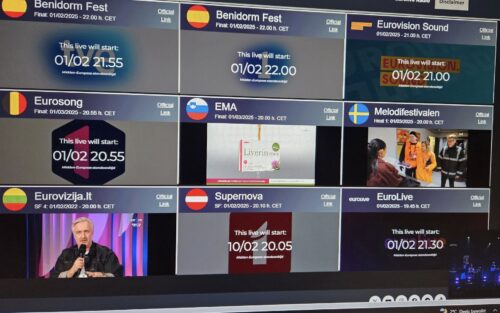
Weekly update

There is a weekly update about Eurovision! The past week in the Eurovision community has been marked by significant events and announcements:

Guest performers

The Roop and Efendi will be guest performers at the Eurovision Song Contest. They will perform in one of the semifinals, when the theme is ‘for the fans’. When Switzerland in the Eurovision Song Contest is the theme, in the other one, we know now that Paola, Peter, Sue & Marc, Luca Hänni and Gjon’s Tears will perform a medley.

Luca Häni will perform in the semifinal.

Stand-in rehearsals started

Last Friday, the stand-in rehearsals for the Eurovision Song Contest in Basel started. Those are rehearsals without the actual artist, but with someone who has the same colour of clothes. It is a camera rehearsal. To have an idea, below you will see last year’s Greek stand in rehearsal.

Flag regulations

Artists, participating in the Eurovision Song Contest, are only allowed to wear their national flags during the parade. In the past few years, several artists had a pride flag with them. That is no longer allowed.

The audience is allowed to have any flag with them. Flags with racist and discriminatory content, including symbols that incite hatred or violence, flags that may be considered offensive or defamatory and flags with symbols of banned terrorist organisations are excluded. 

via GIPHY

Blind Channel

Singer Joel Hokka has left the band Blind Channel. The band participated in the 2021 Eurovision Song Contest. “We wanna thank Joel for everything and we wish Joel nothing but the absolute best in the future. For now, Blind Channel will continue as a five member band. The band is currently on a break”, the band stated.

“12 years is a long time. The growth from high school boys to successful musicians has been a journey like no other. The past few years have pushed me to my limits, and ongoing sleep issues have made touring impossible. I’ve come to realize that the intensity of this lifestyle just doesn’t align with my health right now. I’m beyond grateful for everything these years have given me and wish my brothers all the best in their future endeavors”, Joel added.

source: instagram

New releases from Eurovision Artists

Achille LauroSucco d’Ananas
Els Amics de les Arts (including Sergio Dalma) – Louisiana
Daði FreyrI don’t wanna talk
VoyagerSeen better days
Conchita WurstMrs. Thomas
AlessandraNon Stop
Dino MerlinRudar
Selin & Sertab ErenerSon damla
MelovinTormoz chi na gaz
Getter JaaniVajan hingata
NemoCasanova

There is a weekly update about Eurovision! For sure you will see a new update next week!

Related news

History

Austria in the Eurovision Song Contest, part 7

This year’s Eurovision Song Contest has been won by Austria. It was the 57th Austrian entry. Reason for us to go back to all the Austrian entries in history! For Austria in the Eurovision Song Contest, part 7, we look back at the start of the 21st century. Alf Poier participated for Austria, but there were also some unsuccesful entries. And there was a 3-year gap. 2000 – The Rounder Girls – All To You Austria’s 2000 entry “All To You” was internally selected by broadcaster ORF. The song was written by American songwriter Dave Moskin. Moskin gave the three-piece vocal group The Rounder Girls an up-tempo, gospel-influenced pop track. Performing last in the Stockholm final, the trio, with members from Austria, the US and the UK, delivered slick harmonies and choreography. They finished 14th out of 24 countries with 34 points. The Rounder Girls were a seasoned soul/gospel ensemble, and their Eurovision appearance raised their profile, though Austria’s middling result meant the country sat out the contest in 2001. 2002 – Manuel Ortega – Say A Word “Say A Word” by Manuel Ortega won Austria’s “Song.Null.Zwei” 2002 national final out of ten songs. this entry was an upbeat pop song with a catchy, boy-band style hook. It was composed by Alexander Kahr with lyrics by Robert Pfluger. At Eurovision 2002 in Tallinn, Ortega performed third and Austria placed 18th (26 points) in the final. Manuel Ortega, a young pop singer, had scored a summer hit in 2001 and was nicknamed “the Austrian Ricky Martin” for his Latin pop flair. His Eurovision song’s fun choreography and positive message reflected that image, though the result was a lower mid-table finish. 2003 – Alf Poier – Weil der Mensch zählt ORF organized the “Song.Null.Drei” 2003 selection. Petra Frey (ESC 1994) was the runner up. Comedian-singer Alf Poier triumphed with “Weil der Mensch zählt”. Poier penned this satirical song himself. Musically it’s a quirky folk-pop tune delivered in Styrian dialect. The performance, complete with cartoonish animal props, was a parody of Eurovision’s over-the-top style. At the Riga contest, this offbeat entry surprised many by scoring 6th place with 101 points. Alf Poier, an Austrian stand-up comedian known for absurdist humor, thus earned Austria’s best Eurovision result in over a decade. His comedic approach and catchy refrain turned him into a fan favorite that year. 2004 – Tie Break – Du bist Austria’s national final “Song.Null.Vier” chose Tie Break’s “Du bist” for Eurovision 2004. Waterloo & Robinson (ESC 1976!) were the runners up. Note that a song, written by popstar Falco, participated too. So posthumously, Falco did a Eurovision attempt!Written by composer Peter Zimmermann, “Du bist” is a tender schlager-style pop ballad performed in German. Tie Break, a trio of fresh-faced male singers (a boy band formed via a talent search), delivered tight harmonies in Istanbul’s final. Thanks to Austria’s top-10 result the year before, they pre-qualified directly for the final. Tie Break finished 21st out of 24 with 9 points. The group had gained national fame through the selection process, but on the Eurovision stage their gentle ballad struggled to stand out in a field dominated by more dynamic acts. 2005 – Global.Kryner – Y así In 2005, “Song.Null.Fünf” was held and the crossover folk band Global.Kryner won with “Y así”. They narrowly beated Alf Poier. The controversy was that Austria changed the rules of the voting on the very last moment. Would the original voting procedure be used, Alf Poier would have won. Band members Edi Köhldorfer (composer) and Christof Spörk (lyricist) combined Latin salsa rhythms with Austrian alpine polka to create this unique “salsa-polka-pop” song. Global.Kryner was a six-member ensemble known for blending folk and jazz influences. They opened the Eurovision semi-final in Kyiv with an energetic performance featuring yodels and Latin dance breaks. However, “Y así” did not advance to the final, placing 21st of 25 in the semi-final with 30 points. The group had earned acclaim in Austria and Germany, but their daring genre fusion proved too quirky for the Eurovision televote that year. 2007 – Eric Papilaya – Get A Life – Get Alive After a brief Eurovision hiatus, Austria returned in 2007 by internally selecting Eric Papilaya. His entry “Get A Life – Get Alive” – composed by Greg Usek with lyrics by Austin Howard. It was the official anthem of Vienna’s Life Ball AIDS charity event. This song is an upbeat pop-rock anthem with an inspirational message and flashy staging. Papilaya performed with a giant red ribbon on stage. Papilaya, a rock vocalist who rose to fame on the TV talent show Starmania, gave a spirited performance in Helsinki’s semi-final. Unfortunately Austria did not qualify for the final; he placed 27th (four points) in the semi. The entry drew media attention for its charity theme, but it wasn’t enough to overcome tough competition in 2007. 2011 – Nadine Beiler – The Secret Is Love Austria returned to Eurovision in 2011 through the national selection “Düsseldorf – wir kommen!”. The competition featured ten songs. However, well-known artists Alf Poier and Petra Frey failed to pass the online preselection. As a result, Nadine Beiler won the final with her soulful ballad “The Secret Is Love”. She co-wrote the song with veteran producer Thomas Rabitsch. Musically, the entry combines elements of gospel and pop, while it clearly highlights Beiler’s strong vocal range. Previously, Nadine Beiler had gained national fame by winning the television talent show Starmania in 2007 at the age of 16. Therefore, expectations were already high when she took the stage in Düsseldorf. Her Eurovision performance began a cappella and gradually built towards a powerful climax. Consequently, Austria qualified from the semi-final in seventh place with 69 points. In the grand final, Beiler finished 18th, scoring 64 points. Nevertheless, this result marked Austria’s first appearance in a Eurovision final in seven years and therefore signalled a credible and positive comeback.

Read More »
Eurovision Song Contest 2026 - Banner
Eurovision 2026

This is the 2026 allocation draw

Vienna’s City Hall (Wiener Rathaus) hosted the Semi-Final Allocation Draw on Monday 12 January, officially kicking off the Eurovision Song Contest 2026 season. The ceremony determined the lineup of the 35 participating countries across the two Semi-Finals scheduled for 12 and 14 May.  The draw also determined which Semi-Final each automatic finalist will vote in – this includes host country Austria and the “Big 4” (France, Germany, Italy, United Kingdom). Germany and Italy will vote and perform in Semi-Final 1, while France, United Kingdom and Austria will vote and perform in Semi-Final 2. Meanwhile, Eurovision 2026 tickets go on sale to the public this Tuesday, 13 January, at 13:00 CET. Only fans who pre-registered in advance will have access to this first wave of tickets. 1st semifinal (Tuesday, 12 May) 1st half GeorgiaPortugalCroatiaSwedenFinlandMoldovaGreece 2nd half MontenegroEstoniaSan MarinoPolandBelgiumLithuaniaSerbiaIsrael 2nd semifinal (Thursday, 14 May) 1st half ArmeniaRomaniaSwitzerlandAzerbaijanLuxembourgBulgariaCzechia 2nd half AlbaniaDenmarkCyprusNorwayMaltaAustraliaUkraineLatvia Find all the information about the 2026 contest here. source: eurovision.com

Read More »
Eurovision Song Contest 2026 - Banner
Eurovision 2026
Martijn

This is the 2026 allocation draw

Vienna’s City Hall (Wiener Rathaus) hosted the Semi-Final Allocation Draw on Monday 12 January, officially kicking off the Eurovision Song Contest 2026 season. The ceremony determined the lineup of the 35 participating countries across the two Semi-Finals scheduled for 12 and 14 May.  The draw also determined which Semi-Final each automatic finalist will vote in – this includes host country Austria and the “Big 4” (France, Germany, Italy, United Kingdom). Germany and Italy will vote and perform in Semi-Final 1, while France, United Kingdom and Austria will vote and perform in Semi-Final 2. Meanwhile, Eurovision 2026 tickets go on sale to the public this Tuesday, 13 January, at 13:00 CET. Only fans who pre-registered in advance will have access to this first wave of tickets. 1st semifinal (Tuesday, 12 May) 1st half GeorgiaPortugalCroatiaSwedenFinlandMoldovaGreece 2nd half MontenegroEstoniaSan MarinoPolandBelgiumLithuaniaSerbiaIsrael 2nd semifinal (Thursday, 14 May) 1st half ArmeniaRomaniaSwitzerlandAzerbaijanLuxembourgBulgariaCzechia 2nd half AlbaniaDenmarkCyprusNorwayMaltaAustraliaUkraineLatvia Find all the information about the 2026 contest here. source: eurovision.com

Read More »
Follow Us: