Basel Bulletin: the start of Eurovision 2025

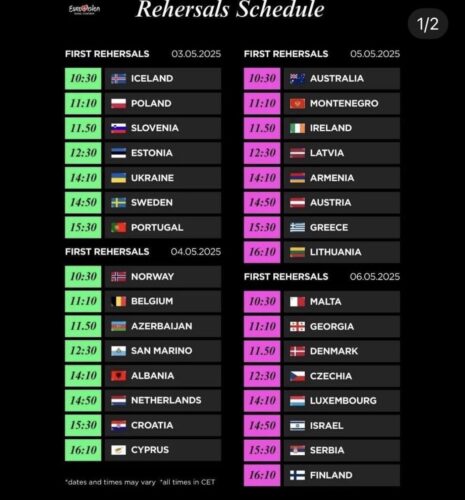
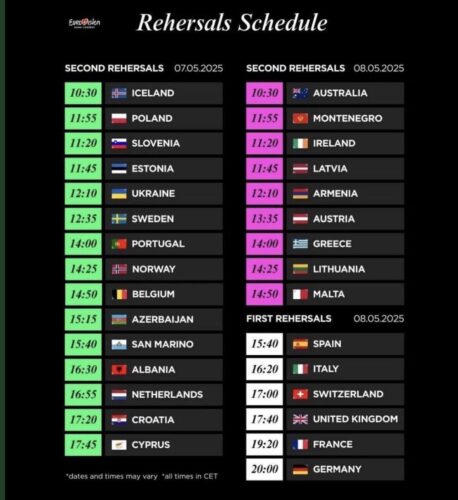
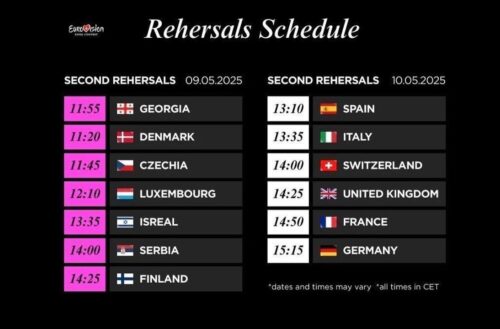
Basel Bulletin: the start of Eurovision 2025 is there! Tomorrow is the first day of the rehearsals in Basel. That means, the rehearsals with the artists. The camera- and stand-in rehearsals are already going on for a while.

Rehearsals

Below you will find the full rehearsal schedules. Eurovision Universe will cover the rehearsals on this site, but also on Facebook, Instagram and Bluesky. Keep a careful eye on us if you want to know everything!

Stage teaser

The EBU shared a small film about the building of this year’s stage. Enjoy the beautiful, typical Swiss, stage:

Non-stop Eurovision hits

You also have the ability to watch non-stop Eurovision hits. The live stream with 24/7 Eurovision music is offered to you by the official Eurovision channel:

No winners press conferences

“This year, there will be no winners’ press conferences following the semi-finals. Instead, the winning artists will go directly to the hosts, where they will take part in a draw to determine whether they will perform in the first or second half of the final. For the past 20 years, these press conferences have contributed to the atmosphere of the contest and were seen as an important part of the journey toward securing a place in the final. It is likely that this is the way EBU wants to prevent critical questions like this:


Related news

Uncategorized

70 years of Eurovision: small studios and lost footage

The Eurovision Song Contest is celebrating its 70th anniversary. That is a wonderful milestone. We at Eurovision Universe love diving into the history of the contest. That is why we are taking a closer look at the contests of the past 70 years. 1962 Eurovision traveled to Luxembourg City, the capital of Luxembourg. Everything was just a little too small in this small country. Luxembourg television received assistance from the German broadcaster ZDF. The presentation was in the hands of Mireille Delannoy. The same sixteen countries as in 1961 participated. Camillo Felgen took part for Luxembourg yet again. With a third place, he did much better this time than two years before. But the absolute top favorite was Germany. Dutch commentator Willem Duys introduced her with the words: “She looked as if she had just won the entire Grand Duchy in a lottery.” After hearing the competition, she was slightly less self-assured. Ultimately, she would finish sixth with her “Zwei Kleine Italiener.” However, she did have the contest’s big hit. The French-speaking countries were in charge this year. Luxembourg itself came third, Monaco second, and France won. A ballad by Isabelle Aubret about, of course, love. Aubret received 26 points with her “Un premier amour.” That was double the score of the runner-up. That year, there were even four countries that received no points at all! That was a first time. But that didn’t bother Isabelle Aubret; she won! 1963 Because France had had enough of organizing by then, the United Kingdom took over. The festival was held in various studios of the brand-new BBC Television Centre in London. Host Cathy Boyle was in one studio, the artists in another, and the orchestra in yet another studio. This made it look just as if the viewer was watching a pop music show from those days. Big stars tried their luck. Françoise Hardy participated for Monaco, Nana Mouskouri for Luxembourg, Carmela Corren for Austria, and Esther Ofarim for Switzerland. Hardy was deeply disappointed when she discovered that she wasn’t allowed to lip-sync. Mouskouri walked away crying and stamping her feet afterwards. She was nowhere to be found at the afterparty. Switzerland won. But then the Norwegian jury had to vote one more time. The jury spokesman spoke way too fast. Cathy Boyle had been unable to repeat the points. The second time, Norway suddenly submitted a completely different result. As a result, it was not Switzerland that won, but Denmark instead. An investigation by the EBU later revealed that the Norwegians didn’t cheat. When they were called, the points had not yet been ready. Esther Ofarim has always said that she was the winner. But it was ultimately the Danish couple Grethe and Jørgen Ingmann with the three-quarter time “Dansevise”. 1964 Copenhagen was the venue. Not much footage of this festival has been preserved. Only the opening scene and parts of the winner’s performance remain. Sweden did not participate. A musicians’ strike resulted in a withdrawal. The Swedes could not send a participant to their neighboring country. However, because Portugal made its debut, the number of participants remained 16. Host Lotte Waever hosted the show. It was held at the Tivoli Theater in Copenhagen. Big stars did not come to Copenhagen. That is to say: Udo Jürgens, who participated for Austria, only achieved international breakthrough later. A trio participated for Spain: the Uruguayan group Los TNT. That is not allowed. The two male members of the group were therefore relegated to a backing choir. The broadcast did not go smoothly. Midway through, a demonstrator managed to get onto the stage. He held up a sign reading ‘Boycott Franco and Salazar’, referring to the dictators of Spain and Portugal. Little of it was visible on television. However, photos were taken of the incident. It did not get exciting that evening. Italy won with 49 points. By comparison: the runner-up, the United Kingdom, had 17. It was sixteen-year-old Gigliola Cinquetti who captured the hearts of viewers and jury members. She sang the innocent “Non ho l’eta” (I am not old enough yet). It became not only the winner of the Eurovision Song Contest, but also a worldwide hit. The EBU recently posted a video on the Eurovision YouTube channel with a complete reconstruction of the performance.

Read More »
Uncategorized
Martijn

70 years of Eurovision: small studios and lost footage

The Eurovision Song Contest is celebrating its 70th anniversary. That is a wonderful milestone. We at Eurovision Universe love diving into the history of the contest. That is why we are taking a closer look at the contests of the past 70 years. 1962 Eurovision traveled to Luxembourg City, the capital of Luxembourg. Everything was just a little too small in this small country. Luxembourg television received assistance from the German broadcaster ZDF. The presentation was in the hands of Mireille Delannoy. The same sixteen countries as in 1961 participated. Camillo Felgen took part for Luxembourg yet again. With a third place, he did much better this time than two years before. But the absolute top favorite was Germany. Dutch commentator Willem Duys introduced her with the words: “She looked as if she had just won the entire Grand Duchy in a lottery.” After hearing the competition, she was slightly less self-assured. Ultimately, she would finish sixth with her “Zwei Kleine Italiener.” However, she did have the contest’s big hit. The French-speaking countries were in charge this year. Luxembourg itself came third, Monaco second, and France won. A ballad by Isabelle Aubret about, of course, love. Aubret received 26 points with her “Un premier amour.” That was double the score of the runner-up. That year, there were even four countries that received no points at all! That was a first time. But that didn’t bother Isabelle Aubret; she won! 1963 Because France had had enough of organizing by then, the United Kingdom took over. The festival was held in various studios of the brand-new BBC Television Centre in London. Host Cathy Boyle was in one studio, the artists in another, and the orchestra in yet another studio. This made it look just as if the viewer was watching a pop music show from those days. Big stars tried their luck. Françoise Hardy participated for Monaco, Nana Mouskouri for Luxembourg, Carmela Corren for Austria, and Esther Ofarim for Switzerland. Hardy was deeply disappointed when she discovered that she wasn’t allowed to lip-sync. Mouskouri walked away crying and stamping her feet afterwards. She was nowhere to be found at the afterparty. Switzerland won. But then the Norwegian jury had to vote one more time. The jury spokesman spoke way too fast. Cathy Boyle had been unable to repeat the points. The second time, Norway suddenly submitted a completely different result. As a result, it was not Switzerland that won, but Denmark instead. An investigation by the EBU later revealed that the Norwegians didn’t cheat. When they were called, the points had not yet been ready. Esther Ofarim has always said that she was the winner. But it was ultimately the Danish couple Grethe and Jørgen Ingmann with the three-quarter time “Dansevise”. 1964 Copenhagen was the venue. Not much footage of this festival has been preserved. Only the opening scene and parts of the winner’s performance remain. Sweden did not participate. A musicians’ strike resulted in a withdrawal. The Swedes could not send a participant to their neighboring country. However, because Portugal made its debut, the number of participants remained 16. Host Lotte Waever hosted the show. It was held at the Tivoli Theater in Copenhagen. Big stars did not come to Copenhagen. That is to say: Udo Jürgens, who participated for Austria, only achieved international breakthrough later. A trio participated for Spain: the Uruguayan group Los TNT. That is not allowed. The two male members of the group were therefore relegated to a backing choir. The broadcast did not go smoothly. Midway through, a demonstrator managed to get onto the stage. He held up a sign reading ‘Boycott Franco and Salazar’, referring to the dictators of Spain and Portugal. Little of it was visible on television. However, photos were taken of the incident. It did not get exciting that evening. Italy won with 49 points. By comparison: the runner-up, the United Kingdom, had 17. It was sixteen-year-old Gigliola Cinquetti who captured the hearts of viewers and jury members. She sang the innocent “Non ho l’eta” (I am not old enough yet). It became not only the winner of the Eurovision Song Contest, but also a worldwide hit. The EBU recently posted a video on the Eurovision YouTube channel with a complete reconstruction of the performance.

Read More »
Follow Us: