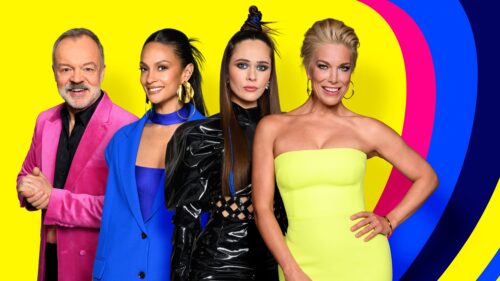
Hosts enjoy a party with heart and soul

Hosts

You have seen three of the four hosts already: Ukrainian Julia Sanina and British Hannah Waddingham and Alesha Dixon. But Graham Norton, who is also the BBC commenter, will only show up in the final.

Graham Norton: heart and soul

Today, the four attended a press conference. For Graham, that was a special occasion, as someone from Israel had a present for him: the Hebrew version of his book. Graham also stated that Eurovision is a party, but this year it’s different. “Because of Ukraine, it’s a party with heart and soul”. Graham is also asked about the speech Ukrainian president Zelensky wanted to have, but the EBU decided not to allow politics. “That is EBU’s decision, not ours. We were not involved”, the host replied. 

Hannah Waddingham: I am grateful

Hannah states that she already knew Graham. “But we have never met as ladies”, she states about her colleagues Julia and Alesha. “I am grateful and have such respect for them because it’s not an easy job. I didn’t think it’s as popular as it is. I am really thrilled.” Hanna also explained that she had her first hosting job a month ago at the Olivier Awards. “I would say the winners and the losers make the efforts of their lifes, unified by music”,  she compares both events.

Alesha Dixon: the hosting job is enough for me

Did some of you recognize Julia Sanina? Well, she participated in the 2016 Ukrainian national final with the band The Hardkiss. They became 2nd. Logical question is whether she ever wants to participate in the Eurovision Song Contest. “We tried to participate in 2016 national selection which Jamala won. We will see wat’s in the future. I wont say no. I really love the audience. It’s more likely to do it after I saw it.” Alesha also responds on that question answering that she will not participate. The hosting job is enough for her.

Julia Sanina: it’s super hard to smile

Julia also speaks about British humour: “British humour quite dry. With the girls I feel so much joy, especially backstage when nobody is listening. They made me laugh a lot. Of course I am nervous, first time hosting, it is not my language. There was a joke about the word ‘queue’, I really didn’t know what that word meant.” But apart from the humour, Julia also became emotional, when someone asked her how she felt representing Ukraine. “for me it’s a huge responsibility because in ukraine we have war now. My every morning starts with bad news. It’s super hard to smile and feel joy. I feel a lot of support from Ukraine. They are proud of what we’ve done in Eurovision. I hope that in this dark times we bring some joy in the lifes of Ukrainian people.”

 

Related news

Uncategorized

Israel Eurovision 2025 Participation Sparks Boycott

Israel Eurovision 2025 Participation Sparks Boycott Israel’s participation in the Eurovision Song Contest 2025 has ignited a major controversy. After organizers decided to allow Israel to remain in the competition, four countries, the Netherlands, Spain, Ireland, and Slovenia, announced their withdrawal from Eurovision 2026 in protest. This rare Eurovision boycott has turned the contest into a political flashpoint. Background: Israel in Eurovision 2025 Israel finished second at Eurovision 2025, a strong result driven by public votes. However, several countries complained that Israel had artificially boosted its tally through a broad advertising campaign urging Europeans to vote for its entry. The dispute unfolded amid the Gaza war, pushing the ostensibly apolitical contest into an uncomfortable spotlight. In response, the European Broadcasting Union (EBU) rolled out new measures to protect Eurovision’s neutrality. Government-led promotion campaigns were discouraged under the updated rules. In early December, EBU members reviewed these changes and decided not to hold a vote on Israel’s status. With this, they effectively confirmed Israel would remain in Eurovision 2026. Four Countries Withdraw in Protest Following the EBU decision to keep Israel in the contest, four national broadcasters promptly confirmed their withdrawal from Eurovision 2026. Ireland’s RTÉ deemed participation “unconscionable” amid Gaza’s civilian death toll. Spain’s RTVE and the Netherlands’ AVROTROS also pulled out after the Geneva vote, arguing that taking part was incompatible with their public service values. Slovenia likewise confirmed it would boycott the contest, as it had vowed if Israel stayed. Impact and Reactions The boycott is especially significant because it includes Spain. The country is one of Eurovision’s “Big Five” nations that provide major funding and automatic finalist spots. Organizers warn that losing multiple major countries could dent the show’s global audience (typically around 150 million viewers) and deter sponsors. Israeli officials, meanwhile, welcomed the EBU’s decision. President Isaac Herzog said Israel “deserves to be represented on every stage around the world”. This saga presents Eurovision with an unprecedented challenge: upholding its spirit of musical unity in the face of deep geopolitical divides.

Read More »
Uncategorized
Martijn

Israel Eurovision 2025 Participation Sparks Boycott

Israel Eurovision 2025 Participation Sparks Boycott Israel’s participation in the Eurovision Song Contest 2025 has ignited a major controversy. After organizers decided to allow Israel to remain in the competition, four countries, the Netherlands, Spain, Ireland, and Slovenia, announced their withdrawal from Eurovision 2026 in protest. This rare Eurovision boycott has turned the contest into a political flashpoint. Background: Israel in Eurovision 2025 Israel finished second at Eurovision 2025, a strong result driven by public votes. However, several countries complained that Israel had artificially boosted its tally through a broad advertising campaign urging Europeans to vote for its entry. The dispute unfolded amid the Gaza war, pushing the ostensibly apolitical contest into an uncomfortable spotlight. In response, the European Broadcasting Union (EBU) rolled out new measures to protect Eurovision’s neutrality. Government-led promotion campaigns were discouraged under the updated rules. In early December, EBU members reviewed these changes and decided not to hold a vote on Israel’s status. With this, they effectively confirmed Israel would remain in Eurovision 2026. Four Countries Withdraw in Protest Following the EBU decision to keep Israel in the contest, four national broadcasters promptly confirmed their withdrawal from Eurovision 2026. Ireland’s RTÉ deemed participation “unconscionable” amid Gaza’s civilian death toll. Spain’s RTVE and the Netherlands’ AVROTROS also pulled out after the Geneva vote, arguing that taking part was incompatible with their public service values. Slovenia likewise confirmed it would boycott the contest, as it had vowed if Israel stayed. Impact and Reactions The boycott is especially significant because it includes Spain. The country is one of Eurovision’s “Big Five” nations that provide major funding and automatic finalist spots. Organizers warn that losing multiple major countries could dent the show’s global audience (typically around 150 million viewers) and deter sponsors. Israeli officials, meanwhile, welcomed the EBU’s decision. President Isaac Herzog said Israel “deserves to be represented on every stage around the world”. This saga presents Eurovision with an unprecedented challenge: upholding its spirit of musical unity in the face of deep geopolitical divides.

Read More »
Follow Us: