About
Biography
Mălina Olinescu biography: early life and first music steps
Mălina Olinescu was born on 29 January 1974 in Bucharest. She came from an artistic family. Her mother was singer Doina Spătaru and her father was actor Boris Olinescu. Music entered her life very early. She started singing when she was only five and soon joined festivals. Her first major prize came in 1995, when she won the interpretation section of the Aurelian Andreescu light music festival. Then, in 1996, she joined the singers’ team of TVR’s popular show Școala Vedetelor. That programme gave her a national audience and many concerts.
The breakthrough years
Her breakthrough came in the second half of the 1990s. In 1996, she also took third prize in the interpretation section at the Mamaia festival. One year later, she won the Mamaia schlager section with “Mi-e dor de tine”, written by Adrian Romcescu. In the same year, she took first prize in the interpretation section at Cerbul de Aur. Those results made her one of the most promising young Romanian voices. She also released her debut album, Ready for You, in 1997. That record was built around English-language songs. Therefore, Mălina Olinescu entered 1998 with awards, a growing public profile and a clear musical direction.
Mălina Olinescu at Eurovision 1998
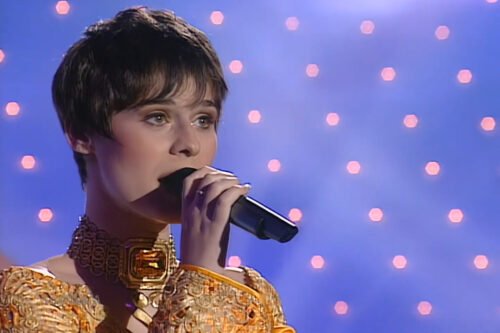
In March 1998, Mălina Olinescu won Romania’s Selecția Națională for Eurovision with “Eu cred”. Adrian Romcescu wrote the music, while Liliana Ștefan wrote the lyrics. The song later came out as a single, paired with its English version, “You Live”. On 9 May 1998, she represented Romania at the Eurovision Song Contest in Birmingham. She performed 15th in the running order and finished 22nd out of 25 entries with 6 points. It was not the result Romania wanted. However, Eurovision still became the biggest international moment of her career. It also fixed her name in Eurovision history and kept “Eu cred” alive for later fans of the contest.
Albums, festivals and television after Birmingham
Mălina Olinescu did not stop after Eurovision. In the same year, she won third prize in the creation section at Mamaia with “Pot să zbor”, a song linked to Adrian Despot. That title later became the name of her second album, released in 1999. For that record, she worked with composers such as Andrei Kerestely, Adrian Despot and Adrian Romcescu. Around 2000, she also moved into television work and co-hosted the TVR show Întâlnirea de la miezul nopții with Petre Magdin.
New directions in the 2000s
In the early 2000s, Mălina Olinescu showed another side of her voice. She sang on the first three volumes of the children’s series Cutiuța muzicală, released between 2001 and 2003. That work introduced her to younger listeners and added a softer chapter to her catalogue. She also tried Eurovision again. In 2003, she entered Selecția Națională with “Tăcerea doare”, written by Călin Geambașu and Zoia Alecu. This time, she did not reach the final. The song finished seventh in semi-final 2. Even so, the entry showed that Mălina Olinescu still believed in the Eurovision stage and still wanted to compete with new music.
Later years and her death
As the music market changed, her career became harder to sustain. In a 2008 interview, Mălina Olinescu said she had not chosen to disappear. She explained that record labels and radio stations had closed their doors because her music was seen as not commercial enough. Even so, she kept performing. Publicly available videos and reports still place her on television and in concerts in 2009 and 2011. Her life ended in Bucharest on 12 December 2011, when she was 37. She committed suicide by jumping out of the 6th-floor window in the building in which she lived. A later Mediafax report said prosecutors closed the case in 2012. Her death cut short a career that had started with real promise and had produced some of Romania’s most remembered late-1990s light pop songs.
Mălina Olinescu today
Today, Mălina Olinescu still has a place in Romanian pop memory and Eurovision history. Tributes started soon after her death. In 2013, friends organised the memorial concert Glas de înger in her honour. Later, TVR included her in anniversary tributes for Cerbul de Aur in 2018 and for Mamaia in 2023. In 2024, Eurovision România published a quote from singer Adriana Moraru, who said her own Eurovision dream started when she saw Mălina Olinescu perform “Eu cred” in 1998. Her music also remains available on digital platforms. Apple Music and Spotify still list her older songs, children’s recordings and even a 2024 “Tango to Evora” remix. So, although her life ended far too early, Mălina Olinescu’s voice still reaches new listeners today.