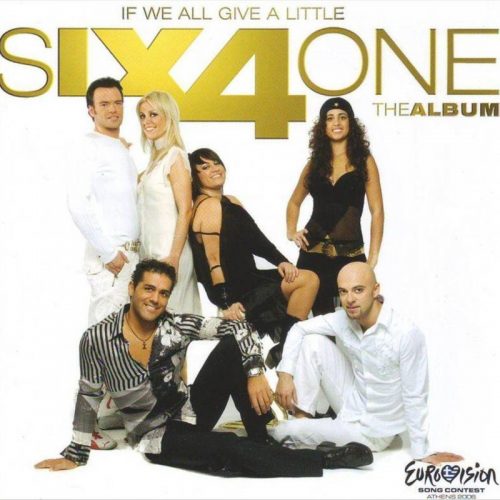
🇨🇭 Blast from the past: Switzerland 2006

We know a lot about Eurovision and we want to share this knowledge with you! Therefore we’d like to bring you a blast from the past. Today: singers from six different countries coming together.

Switzerland in the Eurovision Song Contest

Switzerland participates in the Eurovision Song Contest since the very first moment, in 1956. They even organized the first contest, in the Teatro Kursaal in Lugano. They also won this contest in their own country. Lys Assia gained the first prize with her song “Refrain”. Lys took part twice after this, but didn’t win again. Until she passed away in 2018, she has been a welcome guest in the contest.
The second, and last, Swiss victory was in 1988. Also this singer is not quite a nobody: it’s Celine Dion. Only famous in the French speaking countries in those days, the Canadian singer won for Switzerland with her song “Ne Partez Pas Sans Moi”. A year later, she was the guest of honour in the contest. She sang “Where Does My Heart Beat Now”, which became her first worldwide hit.
Although the country won only twice, Switzerland has a history with many top-5 places. The most recent one was in 2021, when Gjon’s Tears became 3rd with “Tout l’Univers”, getting the highest amount of votes from the juries.

National final

On 22 July 2005, SRG SSR idĂ©e suisse started accepting song submissions from interested composers, with the deadline set for 14th of October 2005. By 14th of December, it was revealed that the song chosen to represent Switzerland in Athens was penned by Ralph Siegel and Bernd Meinunger. The song’s selection process involved a jury made up of members from Switzerland’s three major broadcasters: SF DRS (Swiss-German/Romansh), TSR (Swiss-French), and TSI (Swiss-Italian).

Between November 25-27 2005, auditions for the song’s performers were held at Munich’s Olympia Studios. Siegel, in collaboration with a panel from SF DRS, TSR, and RSI, picked six artists from six countries to form the group named six4one for the Eurovision competition. The chosen song, “If We All Give a Little,” was introduced to audiences on 18 March 2006 during the SF1 program, Benissimo.
Six4One

Six4One was formed specifically for the Eurovision Song Contest in 2006. The group’s name, which can be read as “six for one,” symbolized the unity of the six individual artists coming together for a single purpose, which was to represent Switzerland in the Eurovision Song Contest. Their members are:

Andreas Lundstedt

Andreas Lundstedt is a Swedish singer best known as a founding member of the pop group Alcazar. Born on May 20th, 1972, in Uppsala, Sweden, he embarked on a solo career in the 1990s, releasing several singles. Andreas gained widespread recognition with Alcazar’s disco-centric hits in the 2000s. Open about his HIV diagnosis, Andreas has been an advocate for destigmatizing the condition. His charisma and vocal prowess have secured his place in Swedish pop history.

Tinka Milinović

Tinka Milinović is a versatile Slovenian artist recognized for her endeavors in singing, television hosting, and acting. Born on September 18th, 1973, in Sarajevo, Bosnia and Herzegovina, she kickstarted her career in music before branching out into television. Tinka’s presence earned her various hosting gigs, including for popular Slovenian TV shows. Beyond music and TV, Milinović also ventured into the world of opera. 

Claudia D’Addio

Claudia D’Addio is a Swiss singer who came into the limelight as a member of the band Six4One. Prior to her Eurovision stint, she was a participant in the third series of the reality show MusicStars in Switzerland, where she garnered attention for her vocal abilities. Post-Eurovision, Claudia continued her musical pursuits, but her presence in the mainstream media has been relatively limited. She remains a figure of interest in Swiss music circles.

Keith Camilleri

Keith Camilleri is a Maltese singer, most prominently recognized for his participation in the group Six4One. His versatile voice allowed him to experiment with various genres, cementing his place in the Maltese music scene. Besides Eurovision, Keith has been involved in local music events and productions in Malta. His commitment to his craft has made him a respected figure in Maltese entertainment. He took part in the Maltese preselections for the Eurovision Song Contest in 2004 and 2005.

Marco Matias

Marco Matias is a German singer of Portuguese origin. Born in Portugal, Marco showcased a penchant for music from a young age. His melodious voice and distinct style led him to explore various musical projects, both within Portugal and beyond. His involvement with Six4One was a significant milestone in his career, allowing him to connect with a wider audience. Outside of Eurovision, Marco’s contributions to the music scene are celebrated, especially in Portuguese-speaking circles. He participated in Internationalen Festival Jovem das Comunidades Portuguesas 2000 and in Die Deutsche Stimme 2003.

Liel Kolet

Liel Kolet is an Israeli singer who began her musical journey at a very young age. Born on July 11th, 1989, in Karmiel, Israel, she quickly gained recognition for her captivating voice and impactful performances. At just 14, Liel shared a stage with former U.S. President Bill Clinton, singing John Lennon’s “Imagine” in a peace rally. Her dedication to promoting peace through music led to collaborations with notable figures like Scorpions’ frontman Klaus Meine.

If We All Give A Little

“If we all Give A Little” was a typical Ralph Siegel ballad, with lyrics written by Bernd Meinunger. The song embodies a message of unity, peace, and understanding. As the title suggests, it emphasizes the power of collective effort, suggesting that even small contributions from everyone can lead to significant positive change. The lyrics speak to a global audience, urging cooperation and mutual support. In the contest, Switzerland was automatically placed for the final, due to a successful score in 2005. The song placed 16th in the final. 

Related news

Eurovision 2026

Weekly Update

It’s Tuesday, November 25, 2025, and time for another weekly update! This week the Eurovision community saw major news straight from the EBU. A comprehensive overhaul of the Eurovision Song Contest voting system was announced ahead of Vienna 2026. The news was accompanied by an open letter to fans. Meanwhile, Eurovision’s online presence got a big upgrade with the launch of a brand-new official website. Plans for Eurovision 2026 tickets were revealed. The road to the 70th Contest is truly heating up. Here are this week’s top stories: Contest Updates Martin Green Addresses Fans in Open Letter on Voting Changes Martin Green, the Eurovision Song Contest Director, has written an open letter to the fan community about upcoming voting change. He acknowledged concerns raised after Eurovision 2025 and said the EBU spent the summer reviewing issues and consulting broadcasters. Green stressed the need to “strengthen trust” in the Contest’s fairness and keep Eurovision a “neutral space” where music unites people. He assured fans that a “series of significant changes” in 2026 will  as the Contest moves forward. 📷 Martin Green, EBU Eurovision 2026 Voting Overhaul: Key Rule Changes Unveiled The EBU has unveiled a major overhaul of Eurovision voting rules for 2026. These updates aim to ensure a fairer contest after concerns last year. Stricter promotion rules will now ban any broadcaster or artist from supporting third-party voting campaigns (including government-backed drives) that could distort the results. The maximum number of votes per viewer (per payment method) is being halved from 20 to 10. This encourages viewers to spread their support across multiple entries. Professional juries will return to the Semi-Finals. A roughly 50/50 jury–public vote balance is restored. Each national jury is expanding from 5 to 7 members (with at least two aged 18–25) to add more diverse expertise. In addition, enhanced anti-fraud systems will monitor and block any suspicious or coordinated voting activity. Together, these measures are designed to strengthen trust and transparency in the lead-up to Eurovision 2026. Fan Updates Official Eurovision Website Moves to Eurovision.com Eurovision’s official website has a new home. The organisation has launched Eurovision.com as the “new home for everything” Eurovision, replacing the longtime Eurovision.tv site. The old site will shut down next week. The modernised platform is fully accessible and packed with features. One highlight is a comprehensive Contest database covering all 70 editions of the contest, dating back to 1956. Fans can also create a free “Eurofan” account on the site. This offers early ticket access, exclusive merchandise, special perks and personalised content. The Eurovision app, Junior Eurovision site, and other digital platforms will be updated over the coming months to match the new site. New features will start rolling out from February, as the road to Vienna 2026 officially begins on this upgraded online hub. Eurovision 2026 Tickets: Registration Required for January Sale Tickets for Eurovision 2026 are on the way, but fans need to act now to secure their chance. The first wave of tickets will go on sale on Tuesday 13 January 2026 at 13:00 CET. To participate in this sale, fans must pre-register during the current registration window (open now until 18 December 2025). Registration involves creating a free Eurofan account on the new official website and signing up with Eurovision’s ticketing partner, Oeticket, using the same email address. Only those who complete both steps by 18 December will receive an email in early January with a personal link and access code to buy tickets. Each code will allow the purchase of up to four tickets. Demand is expected to be very high. Receiving a code doesn’t guarantee tickets. Additional ticket sales rounds are likely to follow later, so fans who miss out should keep an eye on official updates.   source: eurovision.tv

Read More »
Eurovision 2026
Martijn

Weekly Update

It’s Tuesday, November 25, 2025, and time for another weekly update! This week the Eurovision community saw major news straight from the EBU. A comprehensive overhaul of the Eurovision Song Contest voting system was announced ahead of Vienna 2026. The news was accompanied by an open letter to fans. Meanwhile, Eurovision’s online presence got a big upgrade with the launch of a brand-new official website. Plans for Eurovision 2026 tickets were revealed. The road to the 70th Contest is truly heating up. Here are this week’s top stories: Contest Updates Martin Green Addresses Fans in Open Letter on Voting Changes Martin Green, the Eurovision Song Contest Director, has written an open letter to the fan community about upcoming voting change. He acknowledged concerns raised after Eurovision 2025 and said the EBU spent the summer reviewing issues and consulting broadcasters. Green stressed the need to “strengthen trust” in the Contest’s fairness and keep Eurovision a “neutral space” where music unites people. He assured fans that a “series of significant changes” in 2026 will  as the Contest moves forward. 📷 Martin Green, EBU Eurovision 2026 Voting Overhaul: Key Rule Changes Unveiled The EBU has unveiled a major overhaul of Eurovision voting rules for 2026. These updates aim to ensure a fairer contest after concerns last year. Stricter promotion rules will now ban any broadcaster or artist from supporting third-party voting campaigns (including government-backed drives) that could distort the results. The maximum number of votes per viewer (per payment method) is being halved from 20 to 10. This encourages viewers to spread their support across multiple entries. Professional juries will return to the Semi-Finals. A roughly 50/50 jury–public vote balance is restored. Each national jury is expanding from 5 to 7 members (with at least two aged 18–25) to add more diverse expertise. In addition, enhanced anti-fraud systems will monitor and block any suspicious or coordinated voting activity. Together, these measures are designed to strengthen trust and transparency in the lead-up to Eurovision 2026. Fan Updates Official Eurovision Website Moves to Eurovision.com Eurovision’s official website has a new home. The organisation has launched Eurovision.com as the “new home for everything” Eurovision, replacing the longtime Eurovision.tv site. The old site will shut down next week. The modernised platform is fully accessible and packed with features. One highlight is a comprehensive Contest database covering all 70 editions of the contest, dating back to 1956. Fans can also create a free “Eurofan” account on the site. This offers early ticket access, exclusive merchandise, special perks and personalised content. The Eurovision app, Junior Eurovision site, and other digital platforms will be updated over the coming months to match the new site. New features will start rolling out from February, as the road to Vienna 2026 officially begins on this upgraded online hub. Eurovision 2026 Tickets: Registration Required for January Sale Tickets for Eurovision 2026 are on the way, but fans need to act now to secure their chance. The first wave of tickets will go on sale on Tuesday 13 January 2026 at 13:00 CET. To participate in this sale, fans must pre-register during the current registration window (open now until 18 December 2025). Registration involves creating a free Eurofan account on the new official website and signing up with Eurovision’s ticketing partner, Oeticket, using the same email address. Only those who complete both steps by 18 December will receive an email in early January with a personal link and access code to buy tickets. Each code will allow the purchase of up to four tickets. Demand is expected to be very high. Receiving a code doesn’t guarantee tickets. Additional ticket sales rounds are likely to follow later, so fans who miss out should keep an eye on official updates.   source: eurovision.tv

Read More »
Follow Us: